

Bonsai Grow Lights: The Complete Buyer’s Guide (Which Trees Need Them and Which Don’t)
June 5, 2026 | by Ian
Affiliate Disclosure: BonsaiLessons.com is reader-supported. Some links on this page are affiliate links. If you purchase through them, we may earn a small commission at no extra cost to you.
Quick Answer
Most tropical indoor bonsai trees kept more than three feet from a bright window need a grow light. Aim for a full-spectrum LED in the 5000K to 6500K range delivering 10,000 to 20,000 lux at the canopy, run on a timer for 12 to 14 hours per day. Temperate species like junipers and maples should live outside, not under lights.
Do Bonsai Trees Need Grow Lights?
It depends on the tree and your home. The short answer: tropical bonsai grown indoors almost always benefit from supplemental light, while temperate bonsai should not be grown indoors at all.
Ficus, jade, Carmona, Serissa, and Schefflera are tropicals. They can survive on a bright south or west-facing windowsill, but most apartments and offices simply do not deliver the light intensity these trees evolved to handle. Indoor light levels drop fast, halving roughly every 18 to 20 inches you move away from the glass. A tree sitting on your desk six feet from the window is getting a tiny fraction of the energy it needs.
A grow light closes that gap. It pushes intensity back up to what your tree actually evolved to use, keeps growth tight and compact, and prevents the leggy, pale, weak shoots you get from a light-starved bonsai.
For temperate species, including junipers, pines, Japanese maples, and most elms outside the tropical Chinese elm, no grow light is going to save them indoors. These trees need a real winter dormancy with cold temperatures and natural day length cycles. A grow light cannot replicate that. They belong on a patio, balcony, or in the garden.
So the real question is not “do bonsai need grow lights” but “do my specific trees need them?” If you keep a ficus on a north-facing desk in a Chicago apartment in February, the answer is yes. If you keep a Japanese maple on a balcony in Portland, the answer is no.
Signs Your Indoor Bonsai Isn’t Getting Enough Light
Light starvation creeps in slowly, but the symptoms are unmistakable once you know what to look for. Catch them early and you can correct course before the tree weakens permanently.
- Long, stretched internodes. The spaces between leaves get noticeably longer as the tree reaches for light. New shoots look thin and wiry instead of stout.
- Oversized, pale leaves. Leaves enlarge to capture more light and lose their deep green color, fading to lime or yellow-green.
- Leaning growth. The whole canopy tilts toward the window, even after you rotate the pot.
- Leaf drop on inner branches. Light cannot reach the interior of the canopy, so older inner leaves yellow and fall first.
- Slow or stalled growth. A healthy tropical bonsai should push new growth nearly year-round. Months without movement is a red flag.
- Weak ramification. Branching gets sparse. The fine twiggy structure you want in a refined bonsai never develops.
If you see two or more of these signs, your tree is begging for more light. Before you blame your watering schedule or soil mix, take a hard look at where the tree lives.
How Much Light Does a Bonsai Need?
Plants measure light differently than humans do. The unit that matters here is lux, which captures the intensity of light hitting a surface. Outdoor direct sun runs around 100,000 lux. Bright shade under a tree might be 10,000 to 20,000 lux. A typical living room three feet from a window? Often under 500 lux. That gap is enormous.
For bonsai, you want the canopy receiving enough lux for active photosynthesis without scorching the leaves. The range varies by species, with tropicals needing somewhat less than full-sun outdoor trees.
Species-Specific Lux Requirements
| Species | Min Lux | Ideal Lux | Hours/Day | Needs Grow Light Indoors? |
|---|---|---|---|---|
| Ginseng ficus | 5,000 | 15,000-25,000 | 10-14 | Yes, unless near a bright south window |
| Ficus retusa | 5,000 | 15,000-25,000 | 10-14 | Yes, unless near a bright south window |
| Chinese elm bonsai | 10,000 | 20,000-40,000 | 12-14 | Often yes indoors (best kept outdoors) |
| Jade bonsai | 8,000 | 20,000-40,000 | 10-12 | Yes indoors, jade loves intense light |
| Juniper | 20,000 | 50,000+ | Full sun | Should not be kept indoors |
| Azalea (Satsuki) | 15,000 | 30,000-50,000 | Full sun | Should not be kept indoors |
| Japanese maple | 20,000 | 30,000-50,000 | Full sun, dappled afternoon | Should not be kept indoors |
| Schefflera (Hawaiian umbrella) | 3,000 | 10,000-20,000 | 10-12 | Yes, in most rooms |
| Carmona (Fukien tea) | 8,000 | 15,000-25,000 | 12-14 | Almost always yes indoors |
| Serissa (snow rose) | 5,000 | 15,000-20,000 | 10-12 | Yes, in most rooms |
The “ideal lux” column reflects healthy photosynthetic activity for refined growth, not just survival. A ficus will not die at 2,000 lux, but it will not thrive either. Push toward the ideal range and your tree responds with tight internodes, dense ramification, and saturated leaf color.
For perspective on how much natural light an indoor space actually delivers, the University of Maryland Extension’s lighting guide notes that south-facing windowsills typically peak at 500 to 1,000 footcandles, which is only around 5,000 to 10,000 lux. Move three feet inside the room and that figure drops by half or more.
Types of Grow Lights for Bonsai
The grow light category has exploded over the past five years, and not every option suits a bonsai. Here is what works, what kind of works, and what to avoid.
Full-Spectrum LED (best choice)
Modern full-spectrum LEDs are the right answer for almost every indoor bonsai. They produce balanced light across the blue and red wavelengths plants actually use, run cool enough to sit close to foliage, sip electricity, and last 30,000 to 50,000 hours. Look for fixtures rated 5000K to 6500K with a high PPFD (photosynthetic photon flux density) figure if the manufacturer lists one.
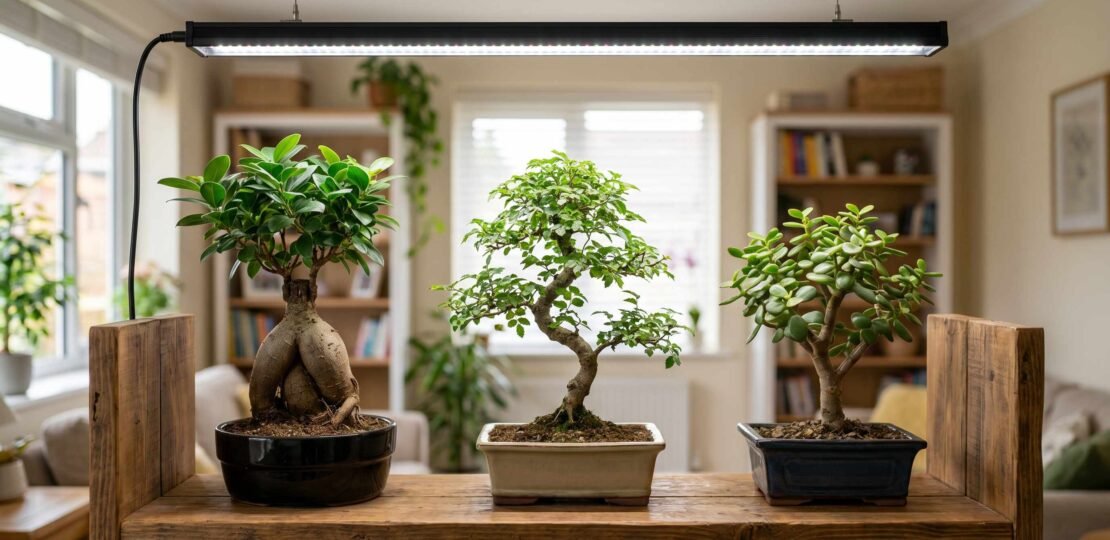
Single-panel LEDs work for one tree. LED bars or strips work for a small bonsai shelf. Bulb-style LEDs that screw into a regular lamp work for a windowsill setup where you want supplemental light without dedicated fixtures.
Fluorescent (still viable, fading from market)
T5 high-output fluorescent tubes were the gold standard for years and still produce excellent light. They cost more to run than LEDs, generate more heat, and the tubes degrade over time. If you already own a T5 setup, keep using it. If you are buying new, go LED.
Standard T8 shop lights are weaker but workable for low-light tropicals like Schefflera. Hang them 4 to 6 inches above the canopy.
What to avoid
- Incandescent “grow bulbs.” They produce mostly heat and almost no usable light spectrum. Skip these.
- Purple “blurple” panels. The old red-and-blue LED panels work, but the color makes it impossible to see your tree’s actual health. Stick with white full-spectrum LEDs.
- Cheap unbranded Amazon panels with no specs. If the listing does not state wattage, PPFD, or Kelvin temperature, the manufacturer is hiding something.
- High-pressure sodium (HPS) and metal halide. These industrial fixtures get hot, draw heavy electricity, and are massive overkill for a hobby bonsai setup.
Key Specs to Look For in a Bonsai Grow Light
Manufacturer specs can be a mess of marketing numbers. Focus on these five.
- Color temperature: 5000K to 6500K for vegetative growth. This range mimics midday sun and keeps foliage compact.
- Spectrum: “Full spectrum” or “white full spectrum” with both blue (400-500nm) and red (600-700nm) wavelengths represented.
- Wattage: True draw, not “equivalent” wattage. For a single bonsai, 20 to 40 actual watts is plenty. For a shelf of three or four trees, 60 to 100 watts.
- PPFD at distance: Photosynthetic photon flux density tells you how much usable light reaches the canopy. Aim for at least 200 to 400 umol/m2/s at the leaf surface for tropicals.
- Coverage area: A 12×12-inch footprint suits one bonsai. A 24×24-inch footprint covers two to three small trees comfortably.
Skip lights that brag about “1000W equivalent” without listing real draw. That number is meaningless marketing.
Best Bonsai Grow Lights by Budget 2026
The right light depends on how many trees you keep and how serious you are about growth. We have broken the market into three tiers, each with a real product category that delivers solid results for the price.
| Budget | Type | Wattage | Spectrum | Coverage | Best For |
|---|---|---|---|---|---|
| Under $30 | Clip-on LED desk lamp style | 10-20W actual draw | Full spectrum white, 5000-6500K | Single tree, 8×8 inches | One small bonsai, beginners, low commitment |
| $30-$80 | LED bar or strip panel | 30-50W actual draw | Full spectrum, 5000-6500K with red supplemental | One or two trees, 18×18 inches | Serious hobbyists with one or two bonsai |
| $80+ | Full-spectrum LED panel | 60-150W actual draw | Full spectrum quantum board, 3500K + 5000K mix | Multi-tree shelf, 24×24 inches or larger | Collectors, indoor bonsai shelves, serious growers |
Under $30: Clip-on LED desk lamps
These are the gateway grow lights. They clip onto a shelf, a window frame, or a desk edge, and feature a flexible gooseneck so you can position the LED right over your tree. Most include a built-in timer and three brightness levels. They work for a single ficus, jade, or Schefflera on a desk.
Limits: weak coverage and modest output. Not enough for a Carmona that demands intense light, and useless for more than one tree. But for a beginner with one bonsai who wants to upgrade from “windowsill only,” this is a sensible first purchase.
$30-$80: LED bar or strip panels
This is the sweet spot for most indoor bonsai keepers. A 30 to 50W LED bar mounted six to twelve inches above your tree delivers genuine photosynthetic intensity, runs cool, and covers enough area for two trees side by side. Many include a built-in timer and dimmer.
The Spider Farmer SF-1000 class, Mars Hydro TS-600 class, and similar mid-tier panels all live in this range. Look for fixtures listing real wattage and PPFD figures, not “equivalent” marketing numbers.
$80+: Full-spectrum quantum boards and large panels
Once you have three or more indoor trees, or you want serious growth on a Carmona or refined ficus, step up to a quantum board panel. These deliver high PPFD across a 24×24-inch or larger footprint, run on efficient Samsung or Bridgelux diodes, and last a decade of daily use.
Overkill for a single bonsai. Essential if you are building a winter shelf for a small collection.
How to Set Up a Grow Light for Your Bonsai
Hanging a light is the easy part. Dialing in distance, timing, and rotation is where most beginners get it wrong.
Distance from canopy
Start with 12 inches between the LED and the top of your tree, then adjust based on what you see. Too close and leaves bleach, curl, or scorch. Too far and you lose intensity quickly because light falls off with the square of distance. If your fixture supports it, hang it on adjustable ratchet hangers so you can fine-tune.
For fluorescent T5 or T8 fixtures, hang four to six inches above the canopy. Fluorescents are weaker per square inch, so they need to sit closer.
Photoperiod and timing
Tropical bonsai do well with 12 to 14 hours of light per day. Set a smart timer for a fixed daily cycle, for example 7am to 9pm. Consistency matters more than the exact start time. Plants reset their internal rhythms to whatever schedule you give them, but jumping between schedules stresses them.
A basic mechanical timer works fine. A smart plug paired with a phone app costs the same and lets you adjust on the fly when daylight savings or travel shifts your routine. Either way, never run lights 24 hours a day. Plants need a dark period for respiration and root development.
Rotation
Even with a light directly overhead, your tree will lean slightly toward the brightest side. Rotate the pot a quarter turn every week to keep growth symmetric. This is especially important for trees that also receive some natural window light, because the window side always wins.
Ventilation
LEDs run cool, but the air around a tree under constant light can stagnate. If you have multiple trees on a shelf, add a small clip fan on the lowest setting. Gentle air movement strengthens stems and reduces fungal pressure.
How to Measure Your Room’s Light Level
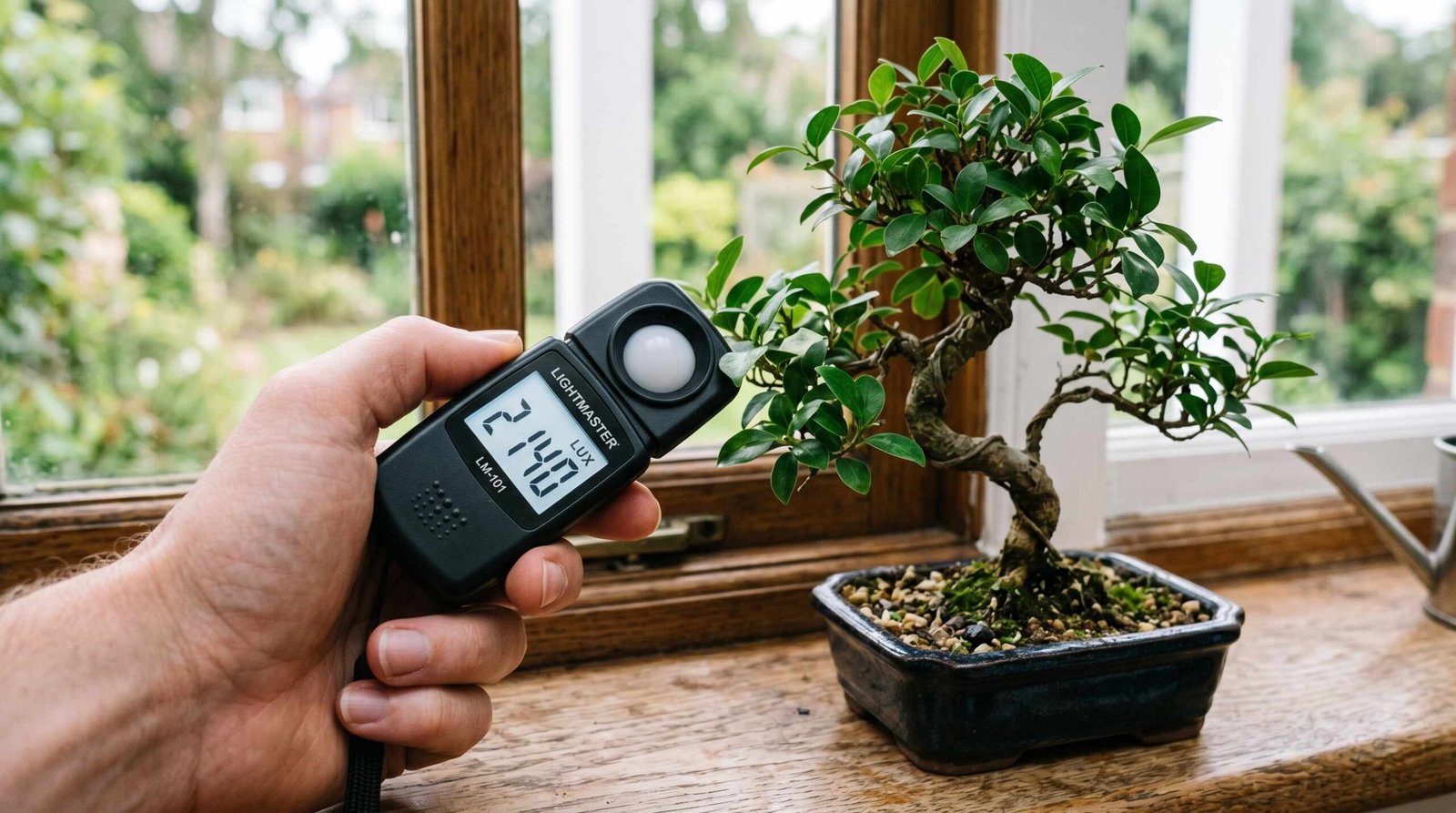
Eyeballing light intensity is unreliable. Your eyes adapt instantly. A room that feels bright to you might be delivering 300 lux at the tree. Get a measurement.
The easiest tool is a phone-based light meter app. Free apps like Lux Light Meter or Photone use your phone’s camera or ambient light sensor and give a reasonable approximation. For under $30, dedicated light meters from brands like Dr.Meter, URCERI, or BTMETER deliver accurate readings.
How to take a measurement
- Hold the meter at the same height as your tree’s canopy, with the sensor pointing up toward the light source.
- Wait two or three seconds for the reading to stabilize.
- Take readings at different times of day to understand how the light shifts. The morning peak on an east-facing window is very different from the midday flat on a north window.
- Compare the reading to the species-specific lux table above.
If your tree is at 1,500 lux in the brightest spot in your home and the species wants 15,000, you know exactly how much catching up your grow light needs to do. The information transforms guesswork into a real plan.
For deeper context on how plants use indoor light, the resource from Bonsai4Me on indoor bonsai care covers why window glass actually filters out light wavelengths plants need, even on the sunniest sill.
Common Grow Light Mistakes
Even well-meaning hobbyists tend to make the same handful of errors. Watch for these.
- Running lights 24/7. Plants need a dark period. Twelve to fourteen hours of light, then off. Continuous light disrupts root development and can stress tropicals into leaf drop.
- Buying on price alone. A $12 USB grow stick from a no-name brand delivers almost nothing usable. You will replace it with a real fixture within months. Spend $30 to $50 the first time and skip the cycle.
- Mounting too close. Bleached leaf tips and curling are signs the light is too intense at that distance. Raise the fixture before you blame the tree.
- Mounting too far. A panel hanging 30 inches above a ficus is barely contributing anything. Six inches of distance can double or triple actual canopy intensity.
- Ignoring color temperature. A warm 2700K bulb pulled from your bedside lamp looks bright but produces a spectrum your bonsai cannot fully use. Go 5000K to 6500K.
- Forgetting to rotate. Even under a perfect grow light, trees lean toward the brightest spot. Rotate weekly.
- Trying to grow temperate species indoors. No grow light will substitute for genuine cold dormancy. Junipers, pines, and maples die slowly indoors no matter how good the light is.
- Skipping the timer. Manual on/off works for about two weeks before you forget. A $10 timer pays for itself in tree health.
Frequently Asked Questions
How many hours of grow light does a bonsai need per day?
Tropical bonsai do best with 12 to 14 hours of grow light per day. If your tree gets some natural window light, you can reduce supplemental light to 8 to 10 hours, timed to extend the natural photoperiod. Never run lights 24 hours, because trees need a dark period for respiration and healthy root activity.
Can I use any LED bulb as a bonsai grow light?
No. Standard household LED bulbs produce light tuned for human vision, not for photosynthesis. They lack the blue and red wavelengths plants actually use. Buy a fixture marketed as full-spectrum grow light rated 5000K to 6500K. The price difference is small and the performance gap is huge.
Are grow lights safe to leave on while I’m away?
Yes, when controlled by a timer. Modern LED grow lights run cool and use much less power than incandescent bulbs. A timer ensures consistent on/off cycles even when you travel. We suggest plugging your fixture into a basic mechanical timer or a smart plug for hands-off scheduling.
How close should the grow light be to my bonsai?
For full-spectrum LED panels, start at 12 inches above the canopy. For fluorescent T5 or T8 tubes, four to six inches above the canopy. Watch for bleached leaf tips (too close) or stretched, leggy growth (too far) and adjust distance accordingly.
Do I still need a grow light if my bonsai sits in a south-facing window?
Often, yes. Window glass filters out significant amounts of usable light, and intensity drops fast as you move even a few inches inside the room. A south-facing windowsill in summer might hit 10,000 lux at the glass and only 2,000 lux six inches inside. A supplemental grow light bridges the gap, especially in winter when day length shortens.
Can I use a grow light to keep an outdoor bonsai indoors year-round?
For tropicals like ficus, jade, Carmona, and Schefflera, yes. For temperate species (junipers, pines, Japanese maples, most azaleas, hornbeams, beeches), no. These trees need a true cold dormancy that no grow light can replicate. They will weaken and die indoors regardless of light quality.
What’s better for bonsai: LED or fluorescent grow lights?
LED, in almost every case. Modern full-spectrum LEDs run cooler, use roughly half the electricity of equivalent fluorescent fixtures, last three to five times longer, and deliver better spectrum tuning. Fluorescents still work fine if you already own them, but new buyers should go straight to LED.
Will a grow light make my bonsai grow too fast?
Not if you choose a fixture sized for your tree and run it 12 to 14 hours. The risk of “too fast” growth comes from overfeeding, overwatering, and oversize pots more than from light. Good light produces compact, tight, healthy growth, exactly the kind you want for a refined bonsai.
RELATED POSTS
View all

Bonsai Tools for Beginners: The 4 You Actually Need First
December 22, 2023 | by bonsailessons.com
Bonsai Wire: Aluminum vs Copper, Gauge Guide, and Best Picks for 2026
December 22, 2023 | by bonsailessons.com
Bonsai Fertilizer: The Complete Guide (NPK Ratios, Schedules, and Top Picks)
December 22, 2023 | by bonsailessons.com