

Bonsai Fertilizer: The Complete Guide (NPK Ratios, Schedules, and Top Picks)
December 22, 2023 | by bonsailessons.com
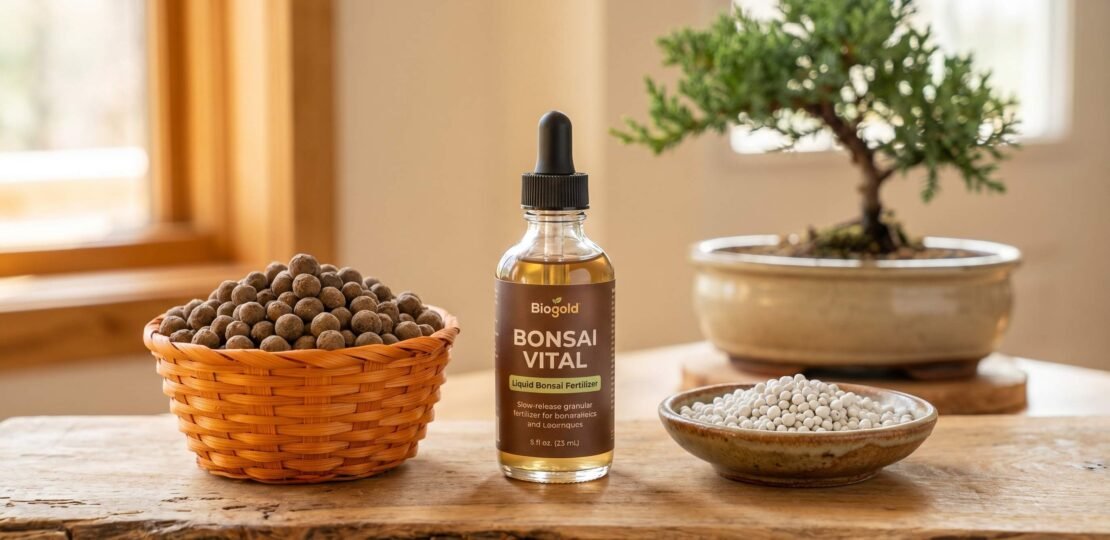
This article contains affiliate links. If you purchase through our links, we may earn a commission at no extra cost to you.
Bonsai Fertilizer: The Complete Guide (NPK Ratios, Schedules, and Top Picks)
Quick Answer
For most bonsai, use a balanced NPK fertilizer (around 6:6:6) during the growing season, shifting to higher nitrogen (10:6:6) in spring and low-nitrogen, high-potassium (3:6:9) in fall. Organic pellets like Biogold release slowly and feed soil life, while liquid fertilizers like Dyna-Gro Foliage-Pro give precise, fast control. Feed every two weeks from March through October.
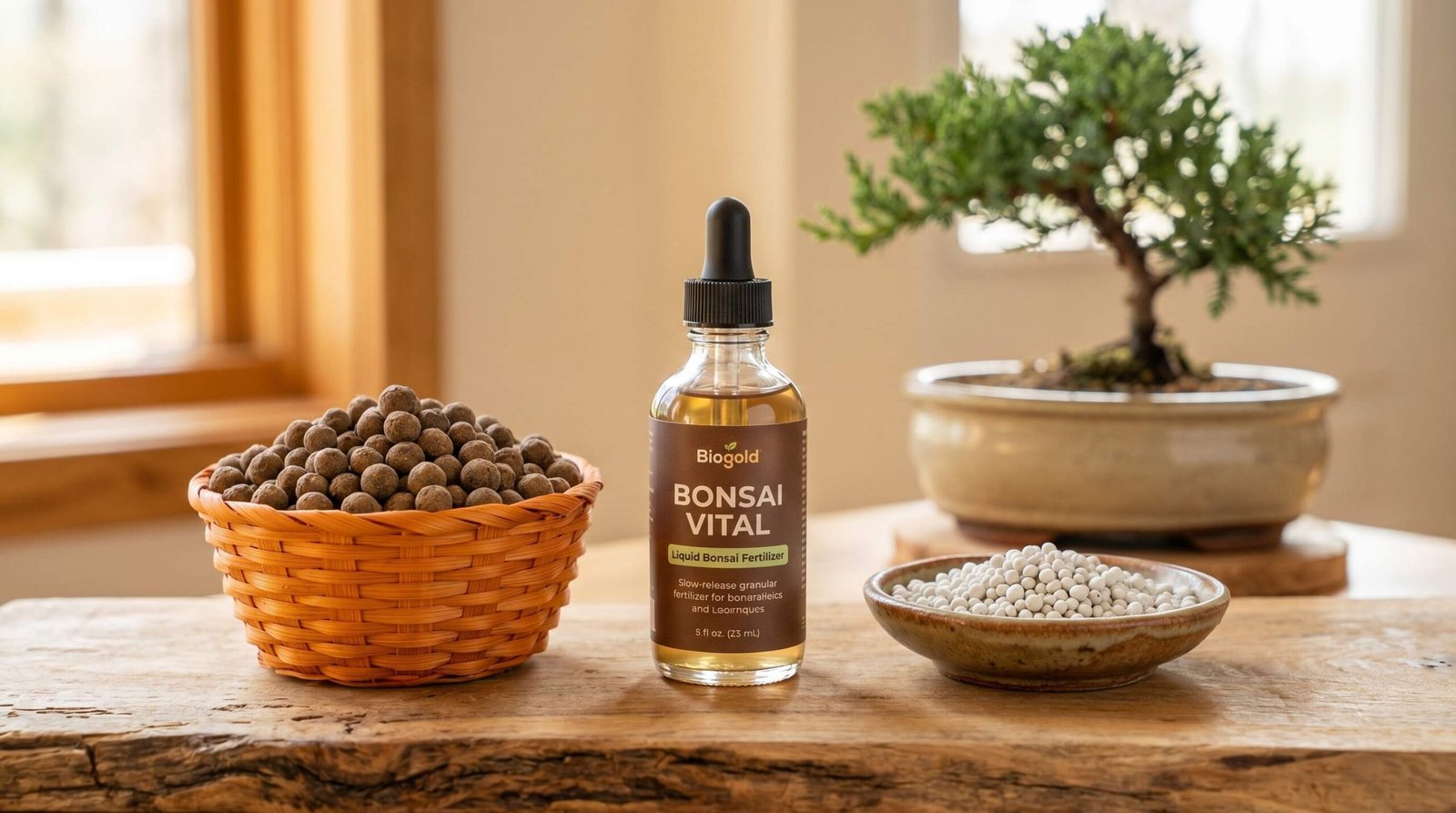
Why Fertilizer Matters for Bonsai
A bonsai is a full-sized tree living in a teacup. That single fact drives almost every decision you make about feeding it. Out in nature, an oak or pine sends roots dozens of feet through soil that gets steadily replenished by decaying leaves, microbes, rainfall, and animal activity. Your bonsai has none of that. It sits in a few cups of fast-draining substrate, and every time you water, you flush dissolved nutrients out the drainage holes.
Without regular feeding, a bonsai will not die quickly, but it will slowly decline. Leaves shrink, internodes shorten in a bad way (weak growth, not healthy compact growth), branches stop ramifying, and the tree loses its capacity to recover from styling or stress. Fertilizer is what makes refinement possible. It is also what separates a healthy show tree from a stunted survivor. Strong feeding is one half of your overall bonsai care routine, sitting right alongside correct watering and seasonal sun exposure.
NPK Ratios for Bonsai: What the Numbers Mean
Every fertilizer bag or bottle has three numbers separated by dashes or colons. That is the NPK ratio, and it tells you the percentage by weight of nitrogen, phosphorus, and potassium in the product. A 10-6-6 fertilizer is 10 percent nitrogen, 6 percent phosphorus (as phosphate), and 6 percent potassium (as potash). The rest is carrier material, micronutrients, and inert filler.
Each of the three macronutrients does something distinct:
- Nitrogen (N): Drives leaf production and vegetative growth. High nitrogen pushes lush green foliage and rapid shoot extension. Too much during the wrong season gives you leggy growth, large leaves, and weak wood.
- Phosphorus (P): Supports root development, flower formation, and fruit set. Newly repotted trees and flowering species like azaleas benefit from adequate phosphorus, though deficiency is rare in most growing media.
- Potassium (K): Builds disease resistance, regulates water use, and helps wood harden off before winter. Fall feeding leans on potassium for exactly this reason.
The right NPK changes through the year. Spring wants nitrogen for push. Fall wants potassium for hardening. Summer wants balance. Here is the seasonal pattern most bonsai growers follow:
| Season | Recommended NPK | Why |
|---|---|---|
| Spring (growth phase) | High N: 10:6:6 | Fuel rapid new growth and leaf expansion |
| Summer (maintenance) | Balanced: 6:6:6 | Sustain growth without forcing excessive extension |
| Fall (hardening off) | Low N, high K: 3:6:9 | Harden wood, build root reserves for winter |
| Winter (dormant) | None (outdoor); low N: 0:10:10 (indoor tropicals) | Outdoor dormant trees don’t use nutrients; tropicals grow slowly indoors |
You do not need three separate bottles to follow this scheme. Many growers use a single balanced fertilizer year-round and adjust frequency instead of ratio. But if you have a tree in refinement, the seasonal switch is worth the trouble.
Organic vs Synthetic Bonsai Fertilizer
Bonsai fertilizers come in two broad camps: organic (derived from plants, fish, bone, manure) and synthetic (manufactured chemical salts). Both work. The choice is really about how you want to feed and what kind of soil biology you want under the surface.
Organic fertilizers like Biogold pellets, fish emulsion, and rapeseed cakes break down through microbial action. They release nutrients slowly over weeks, feed soil microbes alongside the tree, and almost never burn roots. The tradeoff is precision: you cannot dial in exactly how much nitrogen the tree gets this Tuesday. They also smell. Fish emulsion in particular will let your neighbors know you fed your trees today.
Synthetic fertilizers like Dyna-Gro, Miracle-Gro, and most slow-release pellets dissolve into immediately plant-available ions. You get rapid response, precise control of ratios, and clean handling. The downside is that overdose burns roots, and repeated heavy use can suppress beneficial fungi and bacteria in your substrate.
| Factor | Organic | Synthetic |
|---|---|---|
| Release speed | Slow (weeks to months) | Fast (immediate to days) |
| Burn risk | Very low | Moderate to high if overdosed |
| Soil health | Builds microbial life, improves CEC over time | Neutral to slightly suppressive of microbes |
| Cost per feeding | Higher upfront, fewer applications | Lower upfront, more frequent applications |
| Ease of use | Place pellets in tea bag or basket, replace monthly | Mix with water, apply at watering |
Most experienced growers run a combined program. Organic pellets provide a slow steady baseline, and a weak liquid feed supplements during heavy growth or when a tree needs a specific push. The Portland Bonsai Society’s fertilizing notes go deeper on this hybrid approach, and it is what most professional nurseries do.
The Best Bonsai Fertilizers: Our Top Picks
You can spend a lot of money on bonsai fertilizer, or you can spend a little. These three products cover the spectrum well. Pick based on how hands-on you want to be.
1. Biogold Original Bonsai Fertilizer (Organic Pellets)
Biogold is the fertilizer you see in almost every Japanese bonsai nursery and on the benches of serious collectors in the West. It is a cold-pressed organic pellet, NPK roughly 5.5-6.5-3.5, that you place directly on the soil surface (often inside a small plastic basket so the pellets do not roll around when you water).
The release is gentle and steady over four to six weeks. Burn risk is essentially zero. It works for every species I have ever fed it to, from junipers to flowering azaleas. The downside is price: Biogold is one of the more expensive fertilizers per pound. For a single tree, that does not matter. For a collection of 30, it adds up. Biogold Original Bonsai Fertilizer is the standard, and it deserves the reputation.
2. Dyna-Gro Foliage-Pro 9-3-6 (Liquid)
If you want one liquid fertilizer for everything you grow indoors and out, Dyna-Gro Foliage-Pro is hard to beat. It is a complete formula containing all 16 nutrients plants need, including the often-missed micronutrients like calcium, magnesium, and the trace metals. The 9-3-6 ratio is well-suited to leafy growth, which makes it especially useful in spring and on tropicals year-round.
You dilute it heavily, typically a quarter to a half teaspoon per gallon, and apply with each watering or every other watering. It mixes cleanly, does not smell, and gives you precise control. Serious hobbyists who tropicalize ficus and Chinese elms indoors lean on this one. Dyna-Gro Foliage-Pro 9-3-6 is the liquid I keep on the shelf for everything in pots.
3. Slow-Release Bonsai Fertilizer Pellets (Osmocote or Purpose-Made)
If you are new and you want the fewest decisions per week, slow-release pellets are the answer. Osmocote Plus and similar coated synthetic pellets release nutrients over three to four months. Sprinkle the recommended amount on the soil surface in spring, and you are mostly done for the season.
The downside is that slow-release pellets do not adjust to weather. On a 95 degree day with heavy watering, they release more than you might want. On a cool week, they slow down. For a beginner with five trees in stages of recovery and growth, that is a fair tradeoff. Slow-release bonsai fertilizer pellets are the set-and-forget option, and they keep more trees alive than perfect liquid regimens do.
How Often to Fertilize Bonsai: A Seasonal Schedule
The general rule for outdoor bonsai in temperate climates is feed from buds opening in spring through the first cold nights in late fall. For most of North America and Europe, that means roughly March through November. Here is a month-by-month guide:
| Month | Fertilizing Action |
|---|---|
| March | First feed once buds swell. Start with low strength, half the recommended dose. Use a balanced or high-N formula. |
| April | Full strength high-N (10:6:6) every two weeks. Trees are pushing hard. |
| May | Continue high-N feeding every two weeks. Watch for first flush hardening before pinching or pruning. |
| June | Shift to balanced 6:6:6. Heat slows uptake; if temps exceed 90 F regularly, ease back to every three weeks. |
| July | Light balanced feeding every three to four weeks. Many trees enter a short summer rest. |
| August | Resume regular balanced feeding as days cool. Begin transitioning to lower N at month’s end. |
| September | Switch to low-N, high-K fall fertilizer (3:6:9). Apply every two weeks. |
| October | Continue fall feed. Final application late in the month for most species. |
| November | Stop fertilizing outdoor trees. Tropicals indoors can take very dilute feeding monthly. |
One major caveat: do not fertilize a newly repotted tree for six to eight weeks. Fresh cuts on roots are vulnerable, and salt exposure slows recovery. The same goes for sick trees, trees recovering from heavy pruning, and trees just collected from the ground. If you just finished repotting your bonsai, mark the calendar and hold off until you see vigorous new growth.
Species-Specific Fertilizing Guide
Generic schedules get you 80 percent of the way there. The last 20 percent comes from knowing your species. Here is a quick reference for six common bonsai subjects:
| Species | Start Month | Stop Month | NPK Preference | Notes |
|---|---|---|---|---|
| Juniper | March | October | High N spring (10:6:6), balanced summer, low N fall | Strong feeder in spring; foliage pads thicken quickly with steady N. See our juniper bonsai care guide for full detail. |
| Japanese Maple | April | September | Balanced 6:6:6 all season, lower N in summer | Too much nitrogen produces leggy growth and large leaves. Restraint protects refinement. |
| Ficus | Year-round (indoor) | Never (half strength in winter) | Balanced or slightly high N year-round | Tropical, no true dormancy indoors. Feed at half strength November through February. |
| Jade | April | October | Low N, balanced 3:3:3 or diluted | Very sensitive to overfeeding. Half-strength always. Skip entirely if leaves look swollen. |
| Pine | April | August (no fall N) | High P early spring (3:9:6), balanced summer | Pines harden wood naturally; fall nitrogen ruins candle structure. Stop N by late August. |
| Azalea | March | October | Acid-specific, balanced or slightly high N | Use acid-loving plant fertilizer. Avoid high-pH or lime-containing formulas; they will yellow the foliage fast. |
Two species deserve a closer look. Pines are the classic case of fall-nitrogen ruining a tree. If you push nitrogen into pines in September, you get long needles, weak interior buds, and trees that never refine. Azaleas need an acid fertilizer because their roots cannot uptake iron and other nutrients at neutral or alkaline pH. Camellias, rhododendrons, and blueberries are in the same camp.
Inorganic Bonsai Soil and Fertilizing Frequency
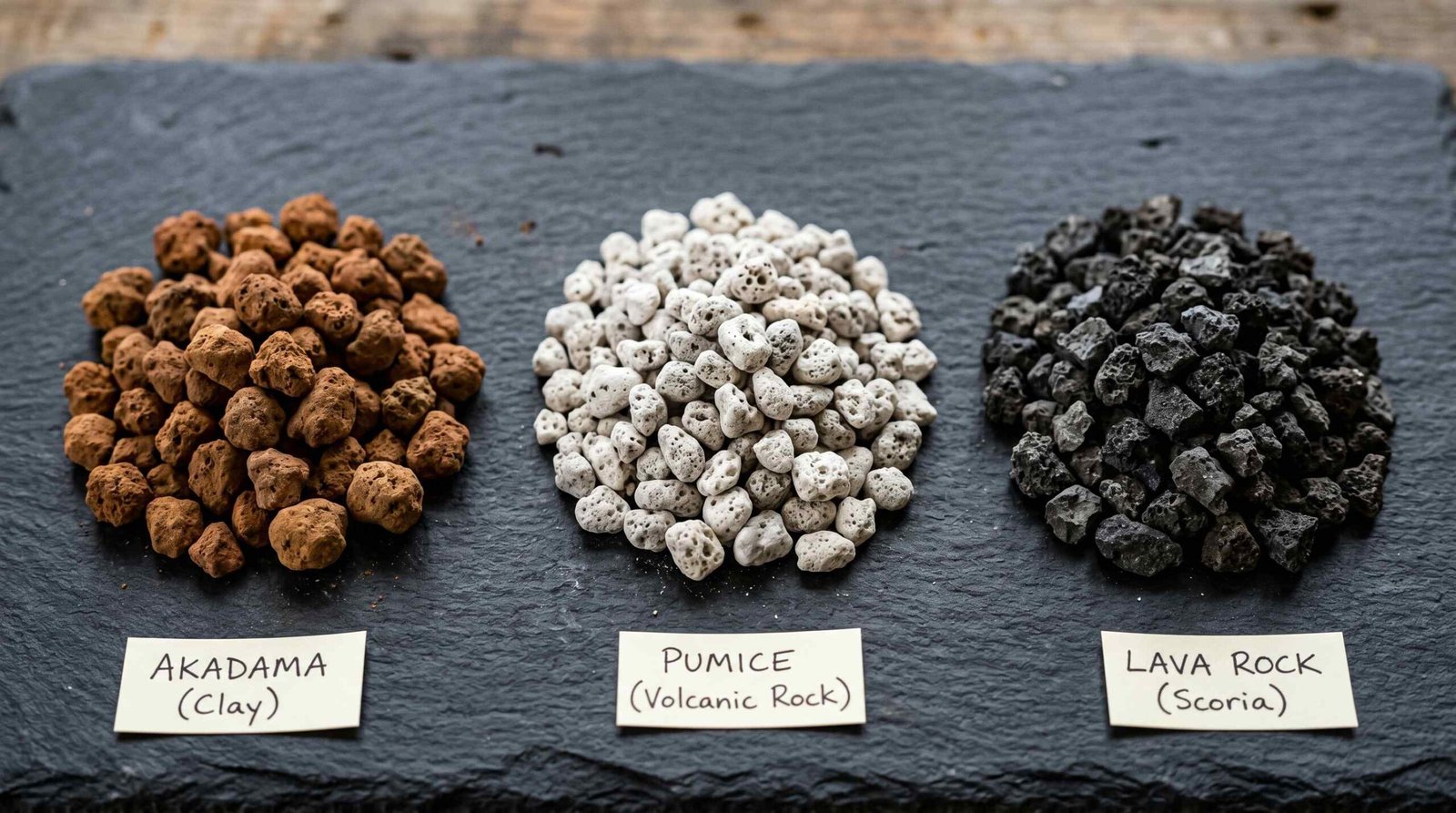
If your bonsai sits in a traditional Japanese mix (akadama, pumice, lava rock in some combination), you need to fertilize more frequently than someone using a peat-based organic mix. The reason is cation exchange capacity, or CEC.
CEC is the ability of a soil particle to hold positively charged nutrient ions (like ammonium, potassium, calcium, magnesium) on its surface and release them slowly to roots. Organic matter has high CEC. Clay has moderate CEC. Pure pumice and lava rock have almost none. Akadama has some, particularly when fresh, but it is still far below a peat-based mix.
What this means in practice: nutrients in inorganic bonsai soil do not stick around. When you water, dissolved fertilizer largely flushes through within a watering or two. There is no nutrient reserve banked in the substrate. To compensate, you feed lightly and often. Many serious growers using pure inorganic mixes feed weekly at half strength rather than biweekly at full strength. Organic pellets sitting on the soil surface help by releasing slowly as you water, but they still need replacing every four to six weeks.
This also explains why your watering technique matters so much. Inorganic substrate dries quickly and needs daily watering in summer, which means daily flushing of any dissolved nutrients. Skip a feed and your tree will show it within ten days.
Signs of Nutrient Deficiency in Bonsai
Bonsai do not tell you they are hungry. They show you. Once you know what the visual symptoms mean, you can diagnose problems before they become serious.
| Symptom | Likely Deficiency | What to Do |
|---|---|---|
| Yellowing of older, lower leaves while new growth stays green | Nitrogen deficiency | Increase N feeding immediately. Use a high-N liquid for fast response, or add fresh organic pellets. |
| Purple or reddish tint on leaf undersides, slow growth | Phosphorus deficiency | Apply a balanced or P-heavy fertilizer. Check soil pH; very acidic or alkaline soil locks out P even when present. |
| Brown, scorched leaf edges, weak stems | Potassium deficiency | Switch to a K-rich formula like 3:6:9. Common in trees over-fed with high-N products. |
| Yellow new leaves with distinct green veins | Iron chlorosis (often pH-driven, not true deficiency) | Check soil pH. For azaleas and camellias, use acid fertilizer. A chelated iron foliar spray gives fast relief. |
| Small leaves, weak buds, thin shoots overall | General starvation or undersized container | Resume regular feeding at full strength once weather is appropriate. Consider whether the pot is too small for the tree’s vigor. |
One note on iron chlorosis: it looks like a deficiency, but the iron is usually present in the soil. The problem is pH. When soil is too alkaline, iron becomes chemically unavailable. The cure is to lower pH (with acid fertilizer, vinegar dilution, or for severe cases a sulfur amendment), not necessarily to add more iron.
Fertilizing Mistakes to Avoid
If you do nothing else right, avoiding these six mistakes will keep your trees healthy:
- Fertilizing newly repotted trees too soon. Wait six to eight weeks after a repot. Cut roots are not ready to handle salts, and you slow recovery instead of speeding it.
- Fertilizing sick or stressed trees. A tree dropping leaves, fighting pests, or recovering from heavy pruning is not eating. Fertilizer becomes a chemical insult, not a meal. Diagnose and stabilize first, then resume feeding once new growth appears.
- Using too-high nitrogen in fall. A late N push prevents wood from hardening off and leaves the tree vulnerable to winter damage. On pines this is catastrophic; on most species it is merely unhelpful.
- Ignoring species needs. A jade fed like a juniper will rot. An azalea fed with lime-rich fertilizer will yellow and weaken. Match the food to the species.
- Not adjusting for container size. A tree in a deep development pot can tolerate stronger feeding than the same tree in a shallow show pot, where roots are restricted and salts accumulate faster.
- Following the bottle label literally. Most fertilizer labels are written for houseplants in large pots. For bonsai, halve the recommended dose and feed twice as often. The total quantity is similar but the peak concentrations are safer.
The American Bonsai Society and regional clubs publish a steady stream of fertilizing advice from experienced growers. If you want to go deeper than this article, find a local club and watch what people actually do at their benches. Practical observation beats theory every time.
A Note on Indoor Tropical Bonsai
Indoor bonsai (ficus, Chinese elm, jade, fukien tea, schefflera) live by different rules. They do not have a true dormancy, but they do slow down in winter when light is short and home heating dries the air. Feed at full strength during the growing season from spring through fall, and at half strength once a month through winter. Watch for spindly stretched growth in winter, which usually means too little light rather than too little fertilizer. The Royal Horticultural Society’s bonsai care guidance covers indoor species in helpful detail for growers in cooler climates.
Frequently Asked Questions About Bonsai Fertilizer
What is the best fertilizer for bonsai trees?
There is no single best fertilizer because needs change with season and species. For a general all-purpose recommendation, Biogold organic pellets are the trusted choice across professional nurseries for slow steady feeding. For precision and indoor use, Dyna-Gro Foliage-Pro 9-3-6 covers all the bases including micronutrients. Many growers run both in combination.
How often should I fertilize my bonsai?
For outdoor temperate species, feed every two weeks from March through October. Reduce to every three to four weeks during peak summer heat if temperatures regularly exceed 90 F. Indoor tropicals can be fed every two to three weeks year-round, dropping to monthly half-strength feeds in winter. Trees in pure inorganic substrate need feeding more often, often weekly at half strength.
Can I use regular plant fertilizer on bonsai?
Yes, with adjustments. A balanced houseplant fertilizer like Miracle-Gro 10-10-10 or a tomato fertilizer will work fine. The key is to dilute heavily, typically to a quarter or half of the label recommendation, and feed more frequently. Bonsai-specific fertilizers offer more appropriate ratios and gentler formulations, but they are not strictly required.
Is liquid or granular fertilizer better for bonsai?
Both work. Liquid fertilizer gives you precise control, fast response, and clean application. Granular or pelletized organic fertilizer provides a steady slow release, builds soil biology, and requires less effort week to week. Many experienced growers combine the two, using organic pellets as a baseline and liquid feeds for targeted boosts. For beginners, slow-release pellets are the most forgiving.
When should I stop fertilizing my bonsai?
Stop outdoor fertilizing in late October or early November once trees show signs of going dormant (leaf drop on deciduous species, slowed growth on evergreens). Resume in early spring when buds begin to swell. For pines, stop nitrogen feeding by late August to allow needles to harden properly. Newly repotted trees should not be fed for six to eight weeks regardless of season.
What happens if I over-fertilize my bonsai?
Symptoms include brown crispy leaf tips and edges (salt burn), yellowing combined with leaf drop, a white crust on the soil surface, and in severe cases root death and tree collapse. If you suspect overfeeding, flush the soil thoroughly with plain water for several minutes, hold off all fertilizer for at least a month, and move the tree to a shaded location to reduce stress while it recovers.
Do indoor bonsai need fertilizer in winter?
Yes, but at reduced strength. Tropical species like ficus, Chinese elm, and jade do not go fully dormant indoors, so they continue to use nutrients at a slow rate. Feed once a month at half strength from November through February. If your tree is in a bright spot with supplemental grow lights and actively growing, you can feed every two to three weeks at half to two-thirds strength.
Putting It All Together
A simple effective bonsai fertilizing program looks like this. Place organic pellets on the soil surface in March, refresh every four to six weeks. Add a weak liquid feed (quarter to half label dose) every other watering during heavy growth. Switch the liquid to a low-N, high-K formula in September. Stop everything by early November for outdoor trees. Halve the doses for jade, skip fall nitrogen for pines, use acid fertilizer for azaleas, and feed indoor tropicals lightly through winter.
That program will keep almost any bonsai healthy. The refinements come with time and observation. Watch your trees. They will tell you what they need if you learn to read them. Healthy leaf color, steady ramification, and predictable seasonal rhythm are the signs of a tree being fed well. Yellowing, weakness, or explosive leggy growth are signs to adjust. Fertilizer is not a problem to solve once, it is a conversation you have with your tree across years.
RELATED POSTS
View all

Bonsai Tools for Beginners: The 4 You Actually Need First
December 22, 2023 | by bonsailessons.com
Bonsai Wire: Aluminum vs Copper, Gauge Guide, and Best Picks for 2026
December 22, 2023 | by bonsailessons.com