Azalea Bonsai Care: The Complete Guide (With Monthly Calendar)
Why Azalea Bonsai Reward Patient Growers
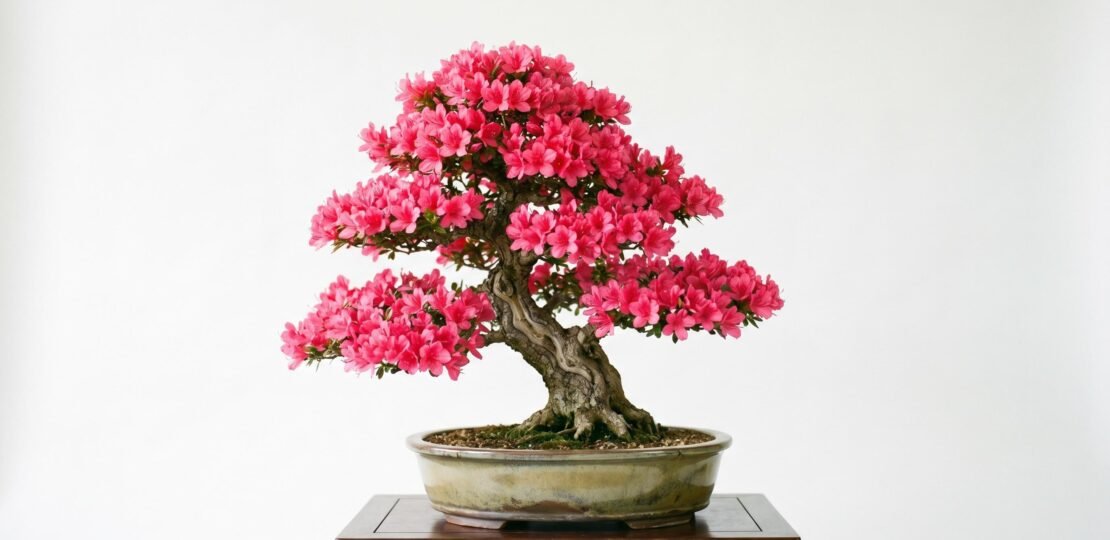
Azalea bonsai sit in a category of their own. Most flowering bonsai produce pretty blossoms as a seasonal bonus. The azalea, particularly the Satsuki azalea bonsai, builds its entire identity around the bloom. For three to four weeks each year, a well-tended azalea explodes into a cloud of pink, white, coral, or crimson flowers that can carry single-color, striped, and speckled patterns on the same tree.
That single trait makes azaleas the most popular flowering bonsai in Japan, where Satsuki shows draw thousands of visitors. But the same trait also makes azaleas unforgiving. Prune at the wrong moment and you remove an entire year of flowers. Use the wrong water and the leaves yellow within weeks. Ignore winter cold and the tree refuses to bloom at all.
Once you understand the rhythm of an azalea, though, the care becomes intuitive. We’ve taught hundreds of students to keep azalea bonsai alive for decades, and the principles below are the ones we drill from day one. Whether you’ve just received your first azalea or you’re trying to coax better blooms from a tree you’ve owned for years, this guide gives you the seasonal map that competitors leave out.
Placement and Sunlight by Season
Azaleas are outdoor trees. We say that first because the single most common beginner mistake is treating an azalea bonsai like a houseplant. Indoor placement starves the tree of light, denies it the temperature swings it needs, and almost always kills it within two seasons.
Spring and Fall, Full Sun Is Ideal
From mid-March through May, and again from September through October, place your azalea bonsai in a location that receives at least six hours of direct sunlight. Spring sun drives the energy reserves that fuel blooming. Fall sun helps the tree set next year’s flower buds in late August and September. Skimp on light during these windows and you’ll see fewer, smaller flowers the following spring.
Morning sun is gentler than late-afternoon sun, so an eastern or southeastern exposure works beautifully. If your only option is a south-facing balcony, that’s fine through spring and fall. Just be ready to adjust for summer.
Summer, Afternoon Shade Protects Blooms
Once daytime temperatures cross 85 degrees Fahrenheit, move your azalea so it receives morning sun and afternoon shade. Direct sun during a bloom cycle scorches petals within hours, turning vibrant pinks into brown crepe paper. Even after flowering, summer heat stress shows up as leaf curl, edge burn, and stalled growth.
Many growers build a simple shade structure using 30 to 50 percent shade cloth, or simply tuck the tree under the canopy of a larger plant. Air circulation matters too. A stagnant, hot corner invites spider mites, while a breezy spot under dappled shade keeps foliage healthy.
Winter, Cold Dormancy Is Essential
This is where most indoor growers lose their azaleas. Azalea bonsai need a sustained period of cold dormancy, roughly 1000 chill hours below 45 degrees Fahrenheit, to set and open flower buds normally. Without that cold period, the tree may push leaves but refuse to bloom.
The sweet spot for overwintering is between 32 and 45 degrees Fahrenheit. Azaleas tolerate brief dips to about 20 degrees once hardened off, but the small root mass of a bonsai is far more vulnerable than a landscape azalea. We suggest sheltering the tree in an unheated garage, cold frame, or against a north-facing wall once nighttime temperatures consistently drop below 25 degrees. For growers in colder zones, our guide to bonsai trees suited to cold climates covers winter protection in detail.
Watering Azalea Bonsai: The Most Common Mistake
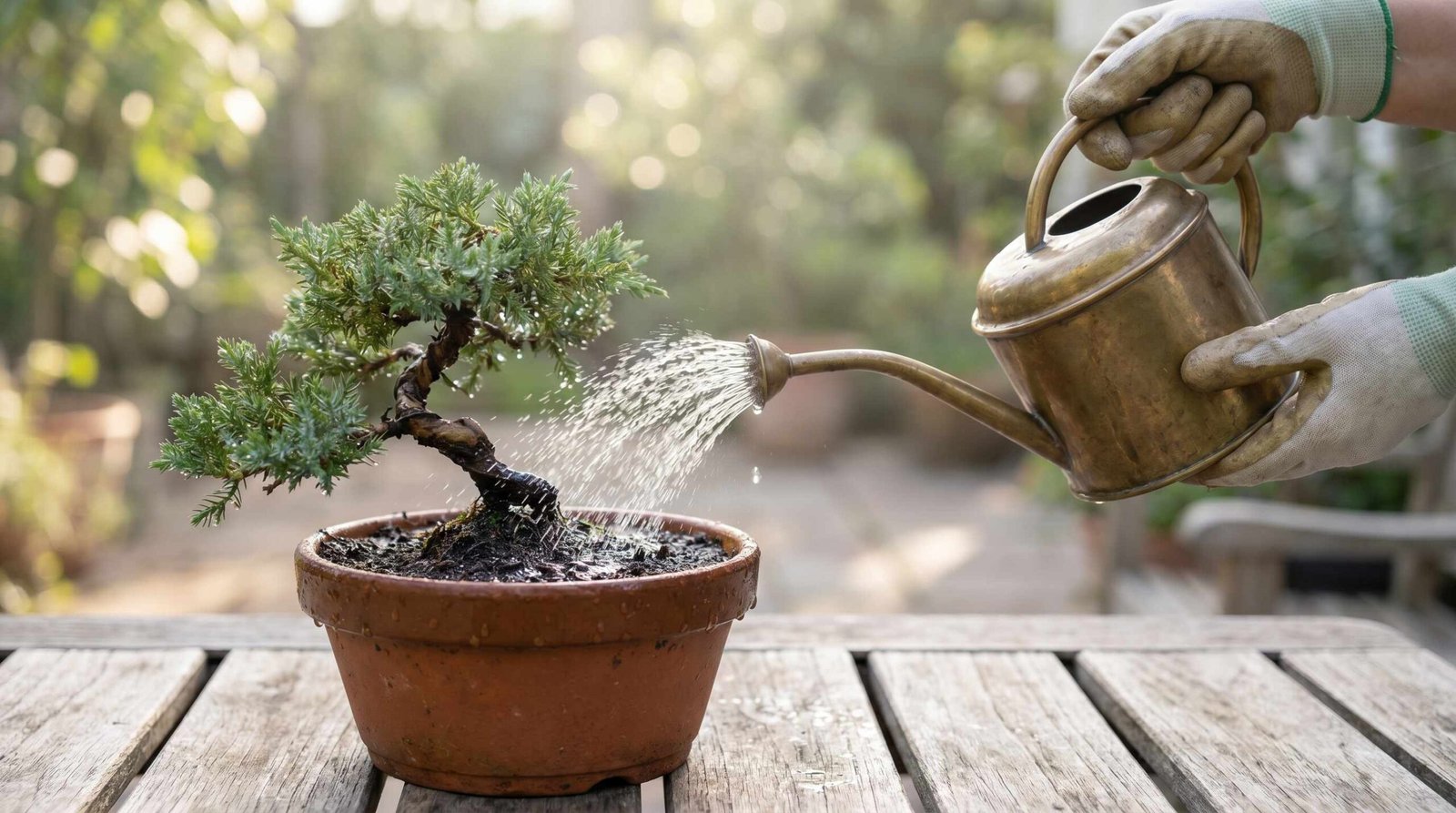
If we could fix one habit across every student, it would be watering technique. Azalea bonsai watering trips up beginners more than any other care task because azaleas need two contradictory things at once: consistent moisture and excellent drainage.
How Often to Water (By Season)
The honest answer is “when the soil tells you to,” but here are practical guideposts:
- Spring (March to May): Water every 1 to 2 days as growth accelerates.
- Summer (June to August): Water once or twice daily. On 90-degree days, check the soil surface every morning and again in late afternoon.
- Fall (September to November): Water every 2 to 3 days as growth slows.
- Winter (December to February): Water every 4 to 7 days if dormant outdoors, just enough to keep roots from freezing dry.
Test the top quarter-inch of soil with your finger. If it feels cool and slightly moist, wait. If it feels dry to the touch, water deeply until water flows freely from the drainage holes. Then water again, slowly, to fully saturate the kanuma particles.
Water Quality, Why pH Matters for Azaleas
Azaleas are calcifuges, meaning they actively reject alkaline conditions. They evolved on acidic mountain soils in Japan and the eastern United States, and they need a soil pH between 4.5 and 6.0 to absorb iron, manganese, and other micronutrients properly.
Most municipal tap water sits between pH 7.5 and 8.5. Worse, much of it carries dissolved calcium and magnesium (the “hardness”) that progressively raises soil pH with every watering. The result is chlorosis: yellowing leaves with green veins, the classic signal that iron is locked out by alkaline conditions.
The fix is straightforward. Collect rainwater whenever possible. A 30-gallon rain barrel handles a half-dozen azalea bonsai through most of the year. If rainwater isn’t available, filtered water or distilled water works well. For tap water in a pinch, you can acidify a gallon with a few drops of white vinegar (test with pH strips, aim for 5.5 to 6.0) or use a commercial azalea acidifier.
Signs of Overwatering vs Underwatering
Both extremes look similar at first glance: a wilted, sad-looking tree. The distinction matters because the treatment is opposite.
Overwatering signs: Soil stays soggy, leaves yellow uniformly (not just between veins), a sour smell from the pot, soft black roots, and brittle dropped leaves. Root rot is the usual outcome.
Underwatering signs: Soil pulls away from the pot edges, leaves curl inward and feel papery, the lightest branches start drying back, and the pot feels alarmingly light when lifted. Recovery is possible if caught early. Submerge the entire pot in a bucket of water for 10 minutes until air bubbles stop rising, then drain.
Soil Mix and Repotting
You can do everything else right and still fail an azalea if the soil is wrong. The wrong substrate doesn’t just slow growth, it slowly poisons the tree by holding water against the roots or raising pH past the azalea’s tolerance.
The Right Acidic Soil Mix (Specific Ratios)
The gold standard for azalea bonsai is pure kanuma, a Japanese volcanic pumice with a natural pH around 5.5 and excellent water retention. Kanuma turns visibly darker when moist, giving you a built-in moisture indicator. Pure kanuma works beautifully for refined azaleas in shallow show pots.
For developing trees or growers in dry climates, we suggest this mix:
- 70 percent kanuma (fine to medium grain, 3 to 6 mm)
- 20 percent akadama (fine grain)
- 10 percent fine peat or composted pine bark
Avoid generic “bonsai soil” blends from big-box stores. They typically contain limestone-based grits that push pH above 7, exactly the conditions an azalea cannot tolerate.
Pot Size and Drainage Requirements
Azaleas have shallow, fibrous, fine root systems, which means they prefer shallower pots than most species. A pot depth of 1 to 2 inches deeper than the root ball is generally appropriate for trained trees. Width should provide about 1 inch of clearance around the root mass on each side.
Drainage is non-negotiable. Look for pots with multiple drainage holes, at least one hole per 4 inches of pot width. Cover holes with plastic mesh to prevent soil washout while permitting fast water flow. We suggest unglazed pots in muted earth tones for refined azaleas, as the flowers provide enough color on their own. For developing trees in training, plastic colanders or mica training pots accelerate root development.
When and How to Repot (After Flowering Only)
Azalea bonsai repotting timing is non-negotiable. Repot only in the 2 to 3 weeks immediately after flowering ends, typically late May through mid-June in temperate zones. This timing lets the tree heal root wounds before the heat of summer and the bud-setting period of late summer.
Young azaleas (under 5 years) need repotting every 2 years. Mature azaleas (10+ years) can stretch to 3 or even 4 years between repottings. Signs that repotting is overdue: water runs off the surface without absorbing, roots circle visibly at the pot edges, or the tree’s vigor declines despite good care.
The technique is gentler than for other species. Comb out roots carefully, but avoid the aggressive root pruning some species tolerate. Remove no more than one third of the root mass, focusing on circling roots and old soil. Replant immediately, water in thoroughly with low-pH water, and keep the freshly repotted tree in full shade for 2 weeks while roots recover.
Pruning Azalea Bonsai: The Timing Is Everything
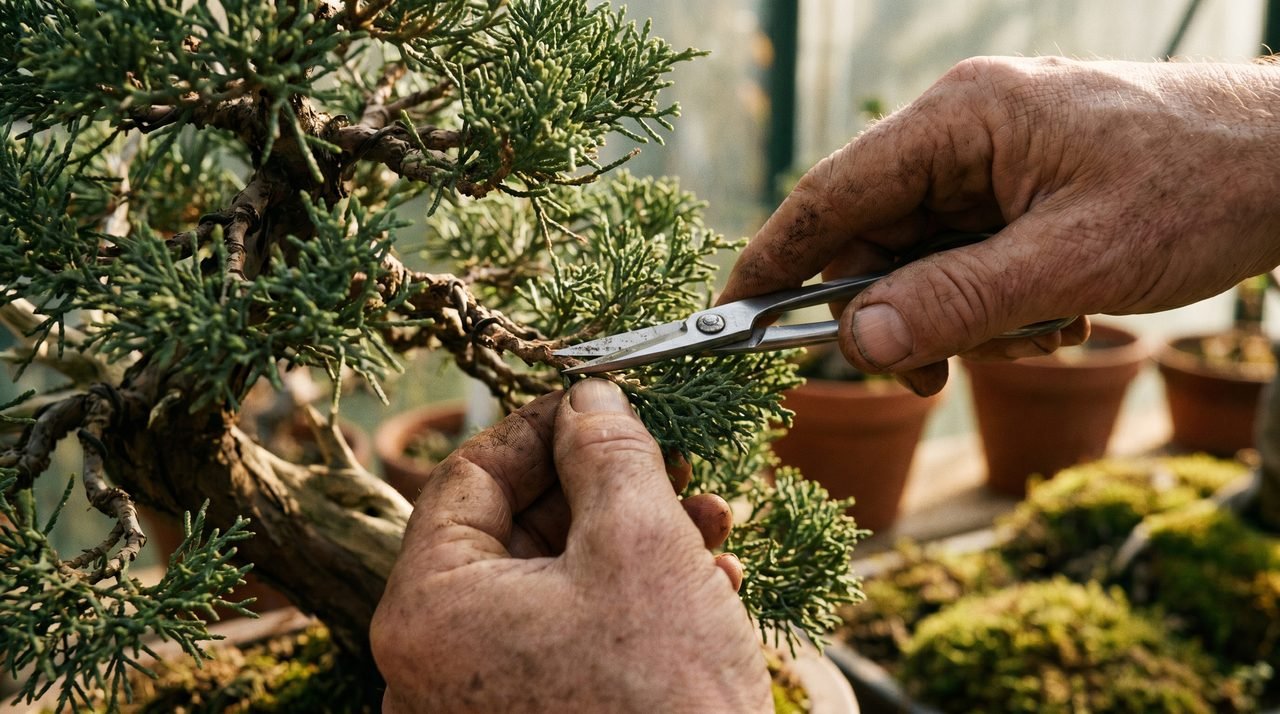
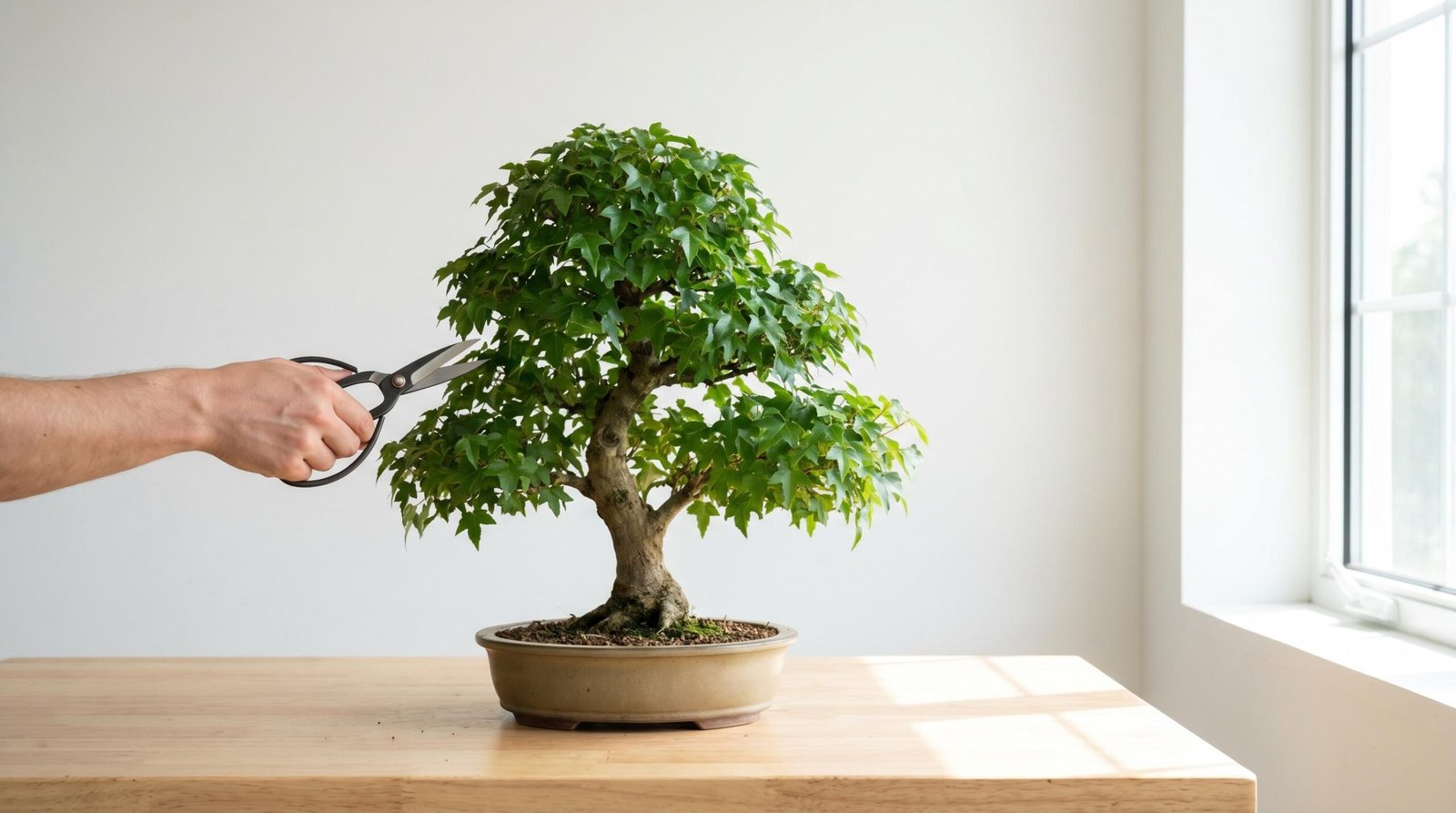
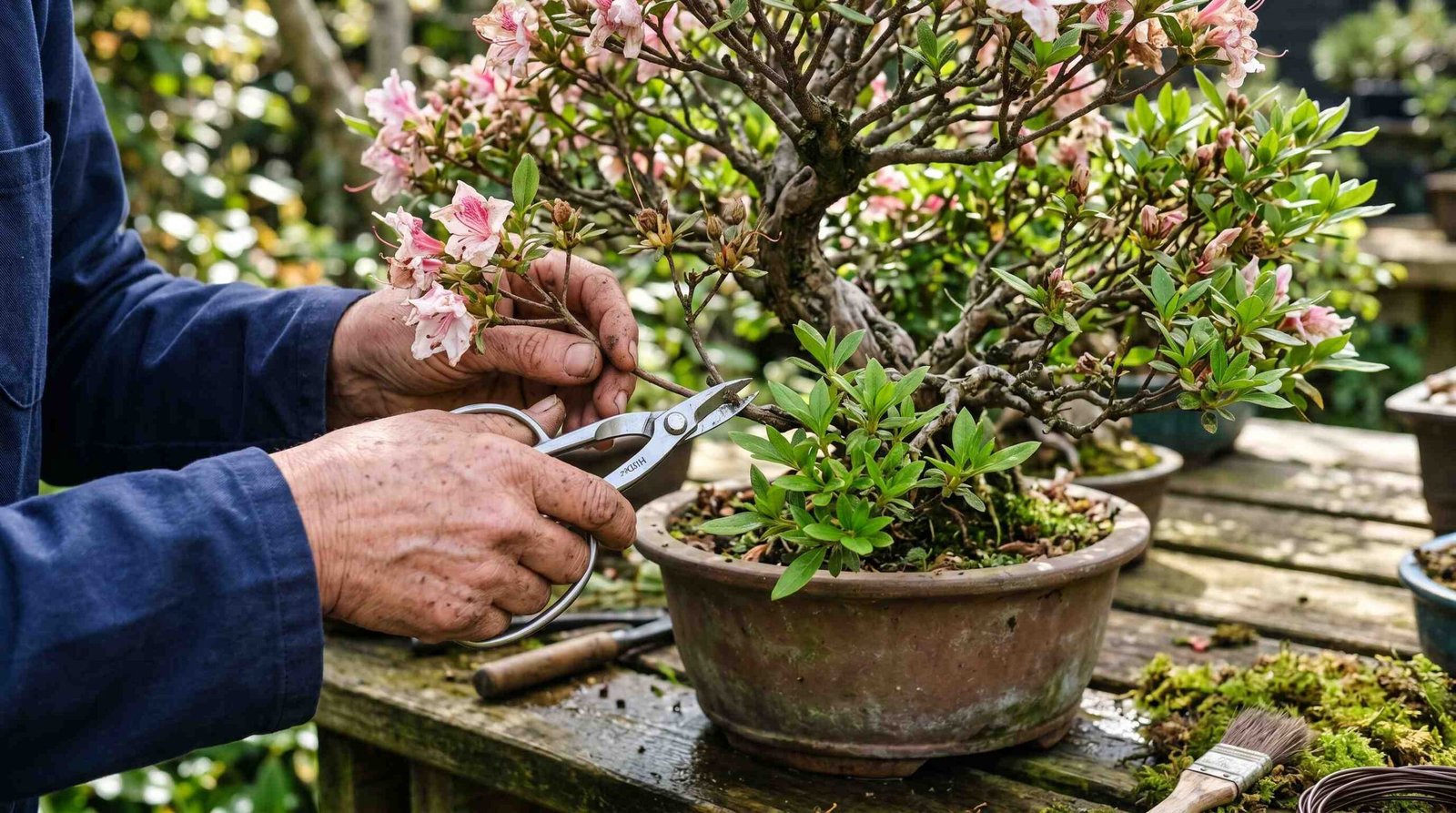
Azalea bonsai pruning is the area where botanical understanding pays the biggest dividend. Get the timing wrong and you sacrifice an entire year of flowers. Get the growth pattern wrong and your tree becomes lopsided over time.
The Basally-Dominant Growth Pattern Explained
Here is the single most important fact about azalea bonsai, and the one almost every beginner gets wrong: azaleas are basally dominant, not apically dominant. In plain English, the lower branches on an azalea grow more vigorously than the upper branches. This is the opposite of most trees, where the top dominates and pushes the strongest growth.
What does this mean in practice? If you prune an azalea evenly across the whole tree, the upper branches weaken and eventually die back while the lower branches turn into thick, dominant limbs that distort the silhouette. Within a few years, your carefully styled apex looks scraggly and the lower trunk looks bloated.
The correction is counter-intuitive but simple. Prune lower branches harder, and prune upper branches lightly or not at all. This redirects energy upward and maintains the conical or domed apex that gives a finished azalea its shape. Watch the tree across a full season and you’ll see the pattern: shoots near the base push 4 to 6 inches in spring, while apex shoots may push just 1 to 2 inches. Your pruning intensity should mirror that ratio in reverse.
Post-Flowering Pruning (The Critical 4-6 Week Window)
Azaleas set flower buds in late summer and fall, then carry those buds through winter to open the following spring. That means any pruning done from August through April removes next year’s flowers.
The only safe pruning window is the 4 to 6 weeks immediately after flowering ends, typically late May through early July depending on your climate and cultivar. During this window, complete the following tasks in order:
- Deadhead spent flowers by pinching each bloom at the base, taking the developing seed pod with it. Seed production drains energy the tree needs for new buds.
- Thin overcrowded shoots at every branch fork, leaving 2 to 3 shoots per fork rather than 4 or 5. Aim for outward-facing buds.
- Shorten extended shoots back to 2 to 3 leaf pairs to refine the silhouette.
- Stop all pruning by early July, even if the tree looks bushy. Late summer pruning removes the very buds you want for next year.
Structural Pruning for Shape
Heavy structural cuts (removing entire branches more than pencil-thick) should also happen in the post-flowering window, but with a twist. Major cuts heal slowly on azaleas and risk dieback. We suggest using a fresh, sharp concave cutter, sealing larger wounds with cut paste, and limiting yourself to one or two large cuts per year on mature trees.
Wiring follows pruning. Apply wire in early summer after the spring flush hardens, but check it weekly. Azalea bark is thin and scars easily, so wire bites in faster than on junipers or pines. Most growers remove wire after 6 to 10 weeks and reapply if needed.
Fertilizing Schedule
Azalea bonsai are moderate feeders with a strong seasonal pattern. Match the fertilizer to the growth phase and you’ll get healthier foliage, better blooms, and stronger root systems.
Pre-Bloom Fertilizer (Low Nitrogen)
From early March until the first flower buds show color (typically late April), feed with a low-nitrogen, higher-phosphorus formula such as 5-10-10. The goal here is to fuel flower development, not push leaf growth that would compete with the bloom. Apply liquid fertilizer at half-strength every 10 to 14 days, or use slow-release azalea-specific cakes placed on the soil surface.
Post-Bloom Through Summer
Once flowers fade and you’ve completed post-bloom pruning, switch to a balanced or slightly nitrogen-leaning fertilizer like 6-6-6 or 7-5-5. This is when the tree builds the energy reserves and new shoots that will support next year’s flowers. Continue feeding every 2 weeks at half-strength through late August.
Fall, No Fertilizer as Dormancy Approaches
Stop all fertilizer by September 1 in most climates. Late-season nitrogen pushes soft new growth that won’t harden before frost, and it disrupts the natural movement into dormancy. A common beginner mistake is applying fall fertilizer to “help with winter,” when the tree needs the opposite: a clean signal to slow down and rest.
Pests and Diseases
Azaleas attract a smaller pest list than some bonsai species, but the issues they do face can spiral quickly. Vigilance pays off here. The American Bonsai Society publishes seasonal pest alerts that can help you anticipate problems in your region.
Spider Mites (Most Common Problem)
Spider mites are the number one azalea bonsai pest. They thrive in hot, dry, stagnant conditions, exactly the summer environment that already stresses azaleas. The first sign is a faint silver stippling on upper leaf surfaces, followed by fine webbing under leaves and in branch crotches.
Catch them early and a strong jet of water knocked toward the underside of leaves every 3 days for 2 weeks usually breaks the cycle. For established infestations, we suggest a horticultural oil or insecticidal soap applied in the evening (never in full sun) every 7 days for three applications. Improving air circulation and avoiding water-stress are the best long-term preventatives.
Root Rot, Prevention and Treatment
Root rot in azaleas almost always starts with one of three causes: water that doesn’t drain freely, a pot that holds water too long, or a soil mix that’s broken down and compacted. The early signs are subtle: yellowing leaves without obvious cause, slow growth, and a strange sour smell when you sniff the soil.
If you suspect rot, slip the tree out of the pot. Healthy roots are white to pale tan and firm. Rotted roots are dark brown to black, slimy, and pull apart easily. Trim affected roots back to healthy tissue with sterilized scissors, repot into fresh kanuma, water with a half-strength solution of hydrogen peroxide (1 tablespoon 3% peroxide per gallon of water), and keep the tree in shade for 3 weeks.
Gall and Petal Blight
Azalea leaf gall (Exobasidium vaccinii) produces thick, pale green to pink fleshy distortions on new leaves in spring. It looks alarming but rarely harms the tree. Pick off galls by hand before they turn white with spores and dispose of them away from the garden.
Petal blight (Ovulinia azaleae) is more frustrating. Flowers develop water-soaked spots that spread rapidly and turn the entire bloom to slimy mush, often during a wet spring. There’s no rescue once it starts. Prevention means avoiding overhead watering during bloom, ensuring airflow, and disposing of fallen petals. Cornell University’s extension horticulture resources offer detailed fungal disease identification keys for azaleas.
Month-by-Month Azalea Bonsai Care Calendar
Here is the seasonal map we promised. Adjust by 2 to 3 weeks depending on whether you live in a warmer (zone 8 to 9) or cooler (zone 5 to 6) region. Times listed assume temperate Northern Hemisphere climate.
| Month | Watering Frequency | Fertilizer | Pruning Action | Notes |
|---|---|---|---|---|
| January | Every 5 to 7 days; just enough to prevent freeze-dry | None | None | Protect from temperatures below 20 degrees Fahrenheit. Check for rodents in storage. |
| February | Every 4 to 6 days as buds swell | None | None | Inspect flower buds. Move trees to brighter cold storage as light increases. |
| March | Every 2 to 3 days as growth resumes | Begin low-nitrogen (5-10-10) at half strength every 14 days | None | Move outdoors once nights stay above 28 degrees Fahrenheit. Watch for late frost. |
| April | Every 1 to 2 days | Continue low-nitrogen formula | None: do not touch developing buds | First flowers begin opening. Protect petals from sun and rain. |
| May | Daily; sometimes twice on hot days | Pause during peak bloom | Deadhead spent flowers immediately | Peak bloom period. Repot in last week if flowering has ended. |
| June | Daily, often twice | Switch to balanced 6-6-6 every 14 days | Main pruning window: thin shoots, shorten extended growth | Complete all major pruning by end of month. Apply wire if needed. |
| July | Twice daily on hot days | Continue balanced fertilizer | Light pinching only; stop major pruning | Move to afternoon shade. Begin spider mite monitoring. |
| August | Twice daily in heat | Final fertilizer application by mid-month | None: flower buds setting now | Reduce nitrogen. Maintain humidity around the tree. |
| September | Every 1 to 2 days | None | None | Move back to full sun as temperatures cool. Inspect for galls. |
| October | Every 2 to 3 days | None | None | Begin hardening for winter. Check pot drainage. |
| November | Every 3 to 5 days | None | None | Move to winter protection once nights drop below 25 degrees Fahrenheit. |
| December | Every 5 to 7 days | None | None | Full dormancy. Avoid disturbing the tree. Check moisture every week. |
FAQ
Why is my azalea bonsai not flowering?
The three most common causes are insufficient cold dormancy (winter temps stayed above 50 degrees Fahrenheit), summer pruning that removed flower buds, or too much nitrogen fertilizer in late summer pushing leaf growth instead of buds. Less commonly, very low light during the bud-setting period (August through September) reduces bloom count. Audit those four factors before assuming the tree is unhealthy.
Can I keep azalea bonsai indoors?
No, not as a permanent location. Azaleas need outdoor light, fresh air, and cold winter dormancy to thrive. You can bring a flowering azalea indoors for a few days to enjoy the bloom (place it in a cool, bright spot away from heaters), but it must return outside immediately afterward. Long-term indoor placement reliably kills azaleas within 1 to 2 seasons.
When should I repot my azalea bonsai?
Repot only in the 2 to 3 weeks immediately after flowering ends, typically late May through mid-June. Young azaleas need repotting every 2 years. Mature trees can stretch to 3 or 4 years between repottings. Never repot in fall, winter, or early spring before flowering, as the root disturbance compromises bloom development.
Why are my azalea bonsai leaves turning yellow?
Uniform yellowing usually indicates overwatering or root problems. Yellow leaves with green veins (interveinal chlorosis) point to high soil pH locking out iron, almost always caused by alkaline tap water. Switch to rainwater or filtered water, check that your soil is kanuma-based, and consider a chelated iron application for stubborn cases. Old-leaf yellowing in fall is normal and not a concern.
How long do azalea bonsai flowers last?
An individual flower opens for about 5 to 7 days. The whole tree’s bloom period spans 3 to 4 weeks because buds open in waves. Cool weather extends the display, while heat above 80 degrees Fahrenheit and direct afternoon sun can cut bloom time in half. Keeping the tree in dappled shade during bloom maximizes longevity.
What is the difference between Satsuki and Kurume azalea bonsai?
Satsuki azaleas (Rhododendron indicum) bloom in late May through June with large flowers, often 2 to 3 inches across, and famously produce multiple color patterns on a single tree. Kurume azaleas (Rhododendron obtusum) bloom earlier, April through May, with smaller, more numerous flowers around 1 inch across in a single color per cultivar. Satsuki are the connoisseur’s choice for show bonsai. Kurume make excellent garden and beginner bonsai with denser flower coverage.
Azalea bonsai reward patience more than almost any other species. The first year may feel like a series of small adjustments. By year three, when you watch a tree you’ve trained explode into a cloud of perfectly timed blooms, you’ll understand why generations of growers in Japan and beyond have dedicated decades to this single genus. Start with the calendar, get the watering right, and trust the basally-dominant growth pattern. The rest follows naturally.
RELATED POSTS
View all