

Bonsai Soil: The Best Mix for Beginners (Ingredients, Ratios, and Top Picks)
December 22, 2023 | by bonsailessons.com
BonsaiLessons.com is reader-supported. When you buy through links on our site, we may earn an affiliate commission at no extra cost to you.
Bonsai Soil: The Best Mix for Beginners (Ingredients, Ratios, and Top Picks)
Bonsai soil is the single most underrated factor in keeping a small tree alive. Most beginners obsess over pruning and styling, then lose their first tree to root rot caused by ordinary potting mix. The good news: once you understand the three core ingredients and the ratios that work, soil becomes a solved problem. This guide walks through what bonsai soil actually is, why your tree needs it, how to mix your own, and which pre-mixed bags are worth your money.
Why Bonsai Needs Special Soil
Bonsai trees live in tiny containers, often less than three inches deep. That changes everything about how soil behaves. In the ground, water filters down through layers of earth and roots can stretch toward moisture. In a bonsai pot, water has nowhere to go if the soil holds too much of it, and roots have nowhere to run if they need air. The medium has to do two contradictory jobs at once: drain fast and hold just enough moisture for the roots to drink between waterings.
Regular potting mix fails this test badly. It is built for indoor houseplants in deep plastic pots, packed with peat and fine organic matter that swells with water and stays saturated for days. Put a bonsai in that, and the roots will sit in a wet sponge until they suffocate. Root rot follows within weeks, often before the leaves show any obvious symptoms.
Garden soil is worse. The clay and silt particles in topsoil compact into a brick the moment you press it into a small container. Water beads up on the surface, oxygen never reaches the bottom of the pot, and root growth stalls. Even if you mix in sand or perlite, the underlying problem stays the same: ordinary dirt was never designed for bonsai geometry.
Real bonsai soil is granular and inorganic, made of small hard particles with gaps between them. Water drains through those gaps in seconds, but each particle absorbs a small amount of moisture that the roots can pull on for the next day or two. The analogy we like: bonsai roots need to breathe, not swim. Get that right and the rest of bonsai tree care becomes much easier.
The Three Core Ingredients
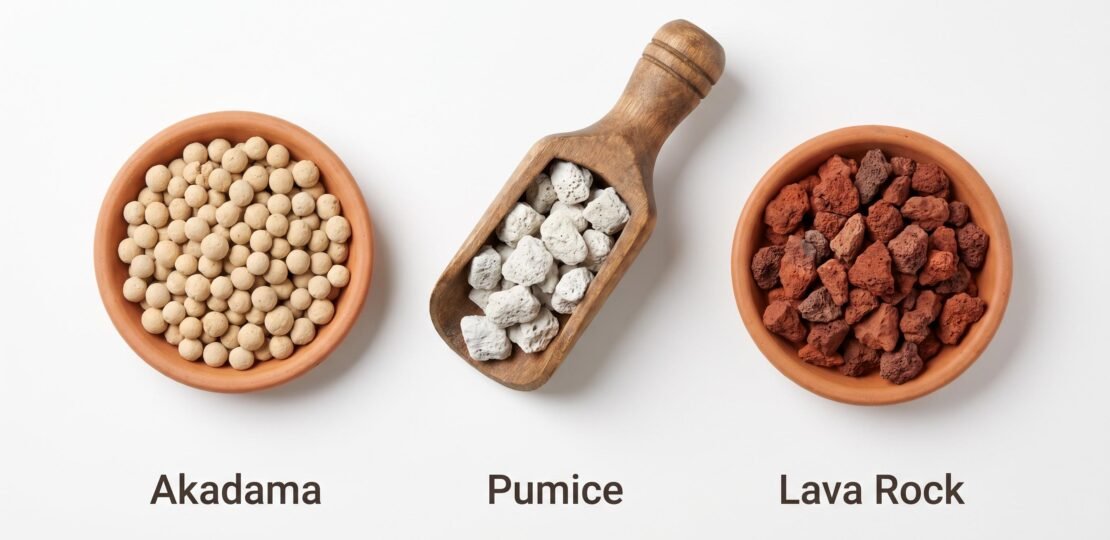
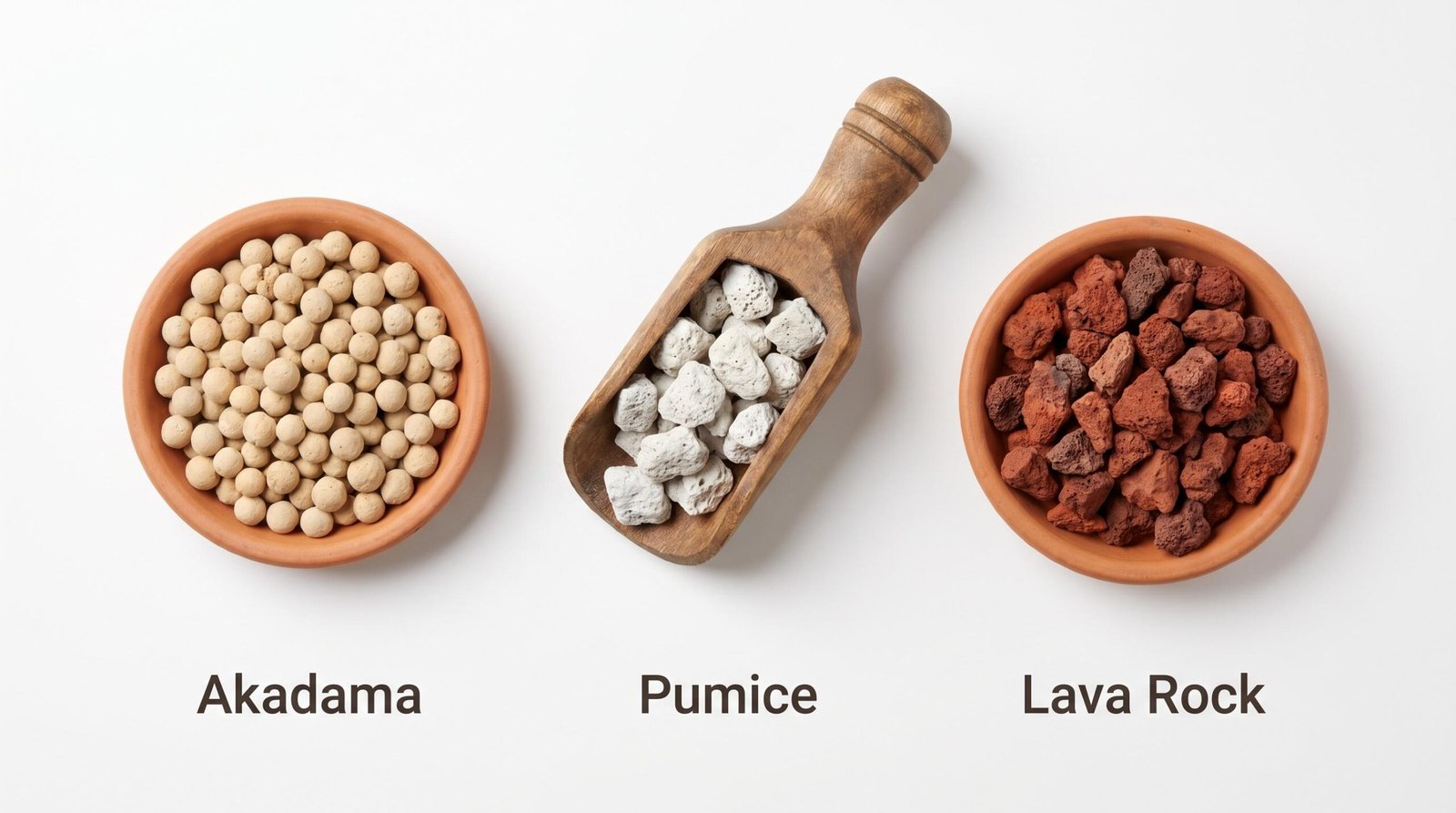
Almost every quality bonsai mix you will encounter, anywhere in the world, is built from three components: akadama, pumice, and lava rock. Each does a different job, and the ratio between them is what separates a mix tuned for a juniper from one tuned for a ficus. Here is what each ingredient brings.
Akadama
Akadama is a fired Japanese clay, harvested from volcanic deposits in the Tochigi region and baked into hard granules. It is the foundation of traditional bonsai soil for good reason. Each granule absorbs water, holds it briefly, and releases it back as the surrounding mix dries. That cycling effect keeps roots active without ever leaving them waterlogged.
Akadama also breaks down slowly, releasing trace minerals into the root zone as it does. The granules give roots something to grip and grow through, which encourages the fine ramification that bonsai growers want. After two to three years in a pot, akadama starts to lose its structure and turn to mud, which is one of the main reasons trees need to be repotted on a schedule. Buy “hard type” akadama in the 3-6mm particle size for most bonsai. The softer grades crumble too quickly to be worth the price.
Pumice
Pumice is volcanic rock, full of microscopic pores and air pockets. It is light, sharp-edged, and almost inert. In a bonsai mix it plays the role of drainage and aeration. Water flows through pumice and out the bottom of the pot almost instantly, but the porous surface still holds a thin film of moisture and the trace nutrients dissolved in your water.
The biggest advantage of pumice is that it does not break down. Unlike akadama, pumice keeps its shape and its drainage properties for years. It is the air in the mix, the component that guarantees roots will not suffocate even after the akadama starts to degrade. Most pre-mixed bonsai soils use pumice as the second-largest ingredient by volume.
Lava Rock
Lava rock is also volcanic, but denser and heavier than pumice. The pores are smaller, the edges sharper, and it adds real weight to a pot, which matters more than beginners realize. A top-heavy juniper in a shallow ceramic container can blow over in a stiff wind unless the mix has some mass to it. Lava rock provides that ballast.
It also drains beautifully while still holding some water in its pores, and it contributes trace minerals like silica and iron as roots run over its surface. The sharp edges keep the mix from compacting over time, since the particles wedge against each other rather than nesting together. Red and black lava are both fine; the color comes from oxidation, and either works. Look for 3-6mm particle size, same as the akadama.
Bonsai Soil Ratios by Tree Type
Equal thirds is the starting point. One part akadama, one part pumice, one part lava rock, sieved, mixed, and ready to go. That blend will keep almost any healthy tree alive, and it is what we suggest for any beginner who is not sure what kind of tree they have. From there, you adjust based on species. Trees that come from dry, rocky environments want more drainage. Trees that come from humid forests want more retention. The table below shows the adjustments worth making.
| Tree Type | Example Species | Akadama | Pumice | Lava Rock | Notes |
|---|---|---|---|---|---|
| Temperate outdoor (deciduous) | Japanese maple, oak, elm | 40% | 30% | 30% | Slightly more retention for root growth |
| Temperate outdoor (conifer) | Juniper, pine, spruce | 33% | 34% | 33% | Maximum drainage; conifers hate wet roots |
| Tropical / indoor (moisture-tolerant) | Ficus, schefflera | 50% | 25% | 25% | More akadama for moisture retention |
| Succulent-type / water-storing | Jade, portulacaria | 30% | 40% | 30% | Heavy drainage; these species rot easily |
| Beginner/general mix | Any species | 33% | 33% | 33% | Start here until you learn your tree’s preferences |
If you only want one mix that works across most trees, start with equal thirds. You can refine over time. A juniper bonsai will thank you for a drier mix, and a ficus bonsai growing on a windowsill will appreciate the extra akadama, but a general blend will not kill either one. The Royal Horticultural Society’s guidelines on bonsai growing media echo this point: drainage and aeration matter more than any single ratio.
Pre-Mixed vs. DIY: Which Should You Choose?
| Pre-Mixed Soil | DIY Mix | |
|---|---|---|
| Convenience | High | Low |
| Cost per batch | Higher per quart | Lower long-term |
| Consistency | Varies by brand | You control exactly |
| Best for | Beginners, small collections | Experienced growers, large collections |
| Risk | Buying low-quality mixes | Getting ratios wrong initially |
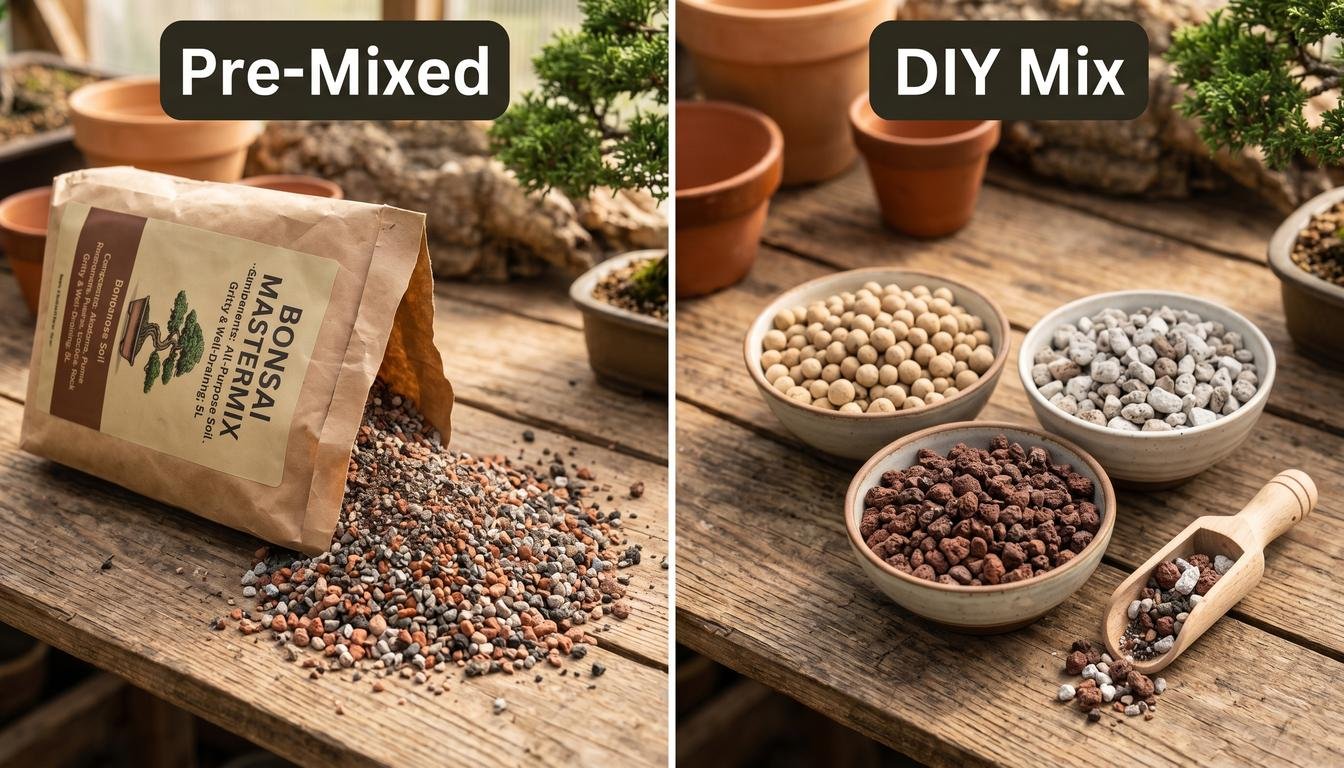
For most beginners, a quality pre-mixed soil is the right call. It removes the variable of getting ratios wrong, the cost of buying three separate ingredient bags, and the trouble of finding a sieve. You pay a small premium per quart, but you also skip the steep learning curve that comes with sourcing each component. If you have one or two trees, pre-mixed soil is hands-down the smarter buy.
The math changes once you have a small collection. Around the three-to-five tree mark, the cost per pot of pre-mixed soil starts to add up, and mixing your own from bulk bags pays for itself in a single repotting season. By then you will also know your watering habits well enough to tune the ratio to your climate. Hot dry summers call for more akadama; cool wet springs call for more pumice. That kind of fine-tuning is the real reason experienced growers mix their own.
The Best Pre-Mixed Bonsai Soils
Not every bag labeled “bonsai soil” deserves the name. Garden center bags are often just amended potting mix with a few decorative pebbles on top, and we have seen them turn to mud within months. The mixes below are the real deal: granular, inorganic, properly sieved, and worth the shelf space.
Bonsai Jack All-Purpose Mix. A clean blend of akadama, pumice, and lava rock in a roughly equal ratio, with particle size in the 3-6mm range. It works well for most outdoor temperate trees, deciduous and coniferous, and the bags come pre-sieved so dust is minimal. View on Amazon.
Tinyroots All-Purpose Bonsai Soil. A well-rated mix with a slightly higher organic content, which makes it a strong choice for tropical and indoor trees like ficus, schefflera, and Chinese elm. Holds moisture a touch longer than the Bonsai Jack blend, which suits indoor humidity levels. View on Amazon.
Professional Akadama (Itoigawa Hard Type). If you want to buy akadama on its own and source the pumice and lava rock separately, the Itoigawa hard type is the standard. Comes in 2-liter and larger bags, holds its structure well, and is the same grade used by most professional growers. View on Amazon.
Whichever mix you choose, sieve it first to remove dust and fines smaller than 2mm. Dust clogs drainage holes and compacts around roots. Even premium bags occasionally contain broken particles from shipping, and a two-minute sieve job before potting saves a lot of grief later.
How to Mix Your Own Bonsai Soil
Mixing your own bonsai soil is straightforward once you have the ingredients on hand. The process takes about fifteen minutes for a batch big enough to repot two or three small trees, and the results are usually better than the bagged equivalent because you control every variable. Here is how to do it.
- Gather your ingredients. Buy akadama, pumice, and lava rock in the 3-6mm particle size. Measure by volume, not weight; a single measuring cup works fine.
- Sieve each component separately. Use a bonsai soil sieve set with a 2mm mesh to remove all fines and dust. This step is non-negotiable. Fines are what cause compaction and drainage failure six months down the road.
- Decide your ratio. Use the table above as your guide. For a general mix, one cup of each ingredient. For a conifer mix, scale up the pumice slightly. For a tropical, scale up the akadama.
- Combine in a clean bucket. Pour all three components into a clean container and stir thoroughly with a trowel or your hand. The particles are sharp, so wear gloves if your skin is sensitive.
- Store dry. Keep the finished mix in an airtight container or zip-lock bag until you are ready to use it. Dry mix lasts indefinitely. Wet mix that has been exposed to air can grow mold or attract pests.
You can buy akadama, pumice, and lava rock separately and mix to your specs. If you want to add a small organic component, around 5-10% horticultural grit or fine pine bark, that is fine for deciduous trees. Just avoid peat-based mixes entirely. Peat compacts when dry, repels water once it has dried out, and holds far too much moisture when wet. Bonsai Clubs International’s repotting guidance covers this in more detail, including how mix composition interacts with root pruning.
When to Change Your Bonsai Soil
Soil does not last forever. Akadama, the workhorse of any quality mix, starts to lose its granular structure after two to three years. As the particles soften and crumble, they pack tighter together, drainage slows, and the roots run out of room to breathe. This is the silent killer of bonsai trees that have been left alone too long.
The signs are easy to spot once you know what to look for. Water pools on the surface of the soil instead of draining straight through. Roots circle the inside of the pot, visible if you tilt the tree out for a peek. The tree looks stressed in the heat of summer despite regular watering, with leaves that wilt by midday or yellow at the edges. Any one of these is a signal to repot.
The typical schedule depends on growth rate. Fast-growing tropical and deciduous trees, including ficus and jade, want repotting every two years. Slower-growing conifers like junipers, pines, and spruce can go three to five years between repots. Older trees in larger pots can stretch even further, since the soil volume is greater and the roots take longer to fill it. Our repotting guide walks through the full process, from when to time it to how aggressively to prune the roots. While you are at it, give how you water a fresh look, because the right watering rhythm depends on the soil mix sitting in the pot.
Common Bonsai Soil Mistakes to Avoid
| Mistake | Why It’s a Problem | What to Do Instead |
|---|---|---|
| Using regular potting mix | Retains too much water; compacts | Use an inorganic or semi-inorganic bonsai mix |
| Using garden soil | Compacts severely in a pot; no drainage | Replace entirely with bonsai mix |
| Skipping the sieve | Fines clog drainage and compact roots | Always sieve before use |
| Using the same mix for all species | Tropical and conifer needs differ | Adjust ratios by species type (see table above) |
| Never changing the soil | Akadama degrades; roots get pot-bound | Repot on schedule (2-5 years depending on species) |
| Buying cheap “bonsai soil” from garden centers | Often just amended garden soil, not real bonsai mix | Buy from specialist retailers or make your own |
Frequently Asked Questions
Can I use regular potting soil for bonsai?
No. Regular potting soil is built around peat and fine organic matter that swells with water and stays saturated. In a shallow bonsai pot, that combination smothers the roots and leads to rot. Even cactus or succulent mixes, which drain better than standard potting soil, lack the granular structure that bonsai roots need to grip and grow through. Use a proper bonsai mix, either pre-blended or DIY from akadama, pumice, and lava rock.
What is akadama?
Akadama is a fired Japanese clay granule, harvested from volcanic deposits in the Tochigi region. It is the foundation of most traditional bonsai soil mixes. Each granule absorbs and releases water in a cycle, providing the moisture retention that roots need while still allowing fast drainage. The 3-6mm hard type is the grade most growers use.
How often should I change bonsai soil?
Every two to five years, depending on species and pot size. Fast-growing trees like ficus and jade want repotting every two years. Slower trees like junipers and pines can wait three to five. Watch for water pooling on the soil surface, roots circling the pot, or summer stress; any of those means it is time.
Can I make bonsai soil without akadama?
Yes. You can substitute with calcined clay, which is the same material used in some absorbent cat litter brands like Oil-Dri or in lightweight aggregates like Haydite. The performance is not quite as good (it does not cycle moisture quite the same way), but it is a reasonable budget substitute. Avoid any product that softens or breaks down quickly when wet.
What particle size is best for bonsai soil?
3-6mm for most trees. That size gives enough void space between particles for water to drain quickly while still holding the moisture and root structure you need. For shohin (small bonsai under six inches), use 1-3mm, since the pots are tiny and larger particles leave too little soil contact with the roots.
Is peat moss okay in bonsai soil?
Generally avoid it. Peat compacts when dry, repels water once it has dried out (a property called hydrophobia), and holds far too much moisture when wet. None of those traits help a bonsai. If you want a small organic component for a deciduous tree, fine pine bark or horticultural grit is a better choice, at no more than 10% of the total mix.
RELATED POSTS
View all

Bonsai Styles Explained: All 20+ Classic Forms (With Difficulty Ratings)
May 23, 2026 | by Ian
Best Bonsai Trees for Beginners: 8 Species Ranked by Forgiving Factor
May 26, 2026 | by Ian
Bonsai Seeds: The Complete Buying Guide (Plus Which Species to Actually Grow)
December 22, 2023 | by bonsailessons.com