

Bonsai Starter Kit Guide: Seed Kits vs Live Tree Kits (What to Know Before You Buy)
December 22, 2023 | by bonsailessons.com
This page contains affiliate links. If you purchase through our links, we may earn a small commission at no extra cost to you. We only suggest kits we’d actually use.
What Is a Bonsai Starter Kit?
A bonsai starter kit is a bundled package designed to launch a beginner into the hobby, typically containing either seeds or a young pre-grown tree along with a pot, soil, basic tools, and a care guide. Two main types exist: seed kits, which grow a tree from scratch over many years, and live tree kits, which include a juvenile tree ready for immediate shaping.
Seed Kit vs Live Tree Kit: The Decision That Changes Everything
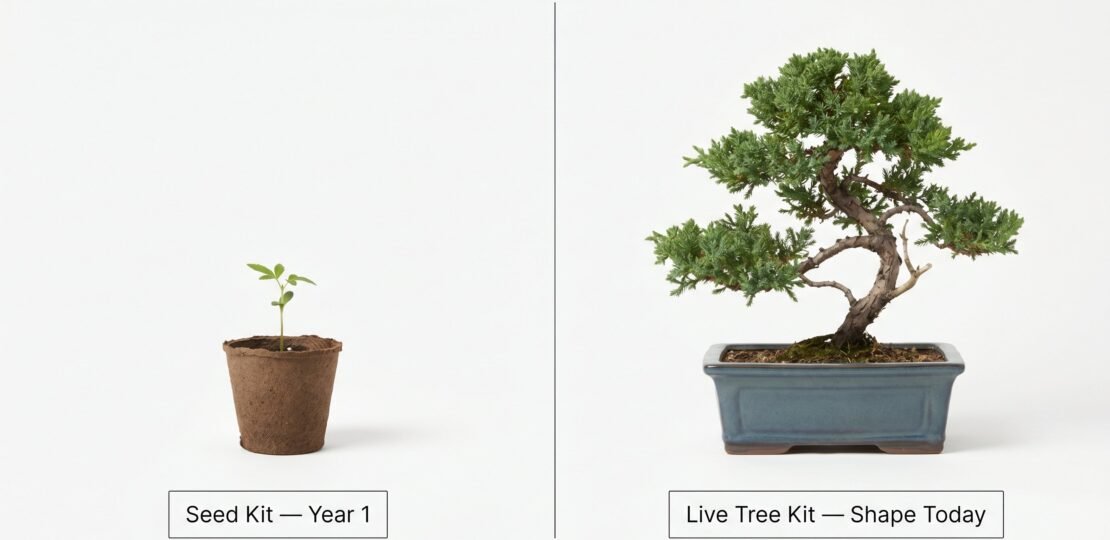
Here’s what nobody tells you before you click “buy” on that twenty-dollar Amazon kit: most products labeled as “bonsai starter kits” are actually seed kits. You’re buying four packets of seeds, a few biodegradable pots, and a compressed soil disc. You are not buying a bonsai tree. You are buying the raw materials to grow one, slowly, over a span of years that most beginners never expected.
This single misunderstanding is the number one reason new bonsai enthusiasts quit the hobby within the first year. They expected progress in months. What they got was a seedling, then a slightly taller seedling, then a patch of dead seedlings because the included instructions were too generic to keep specific species alive.
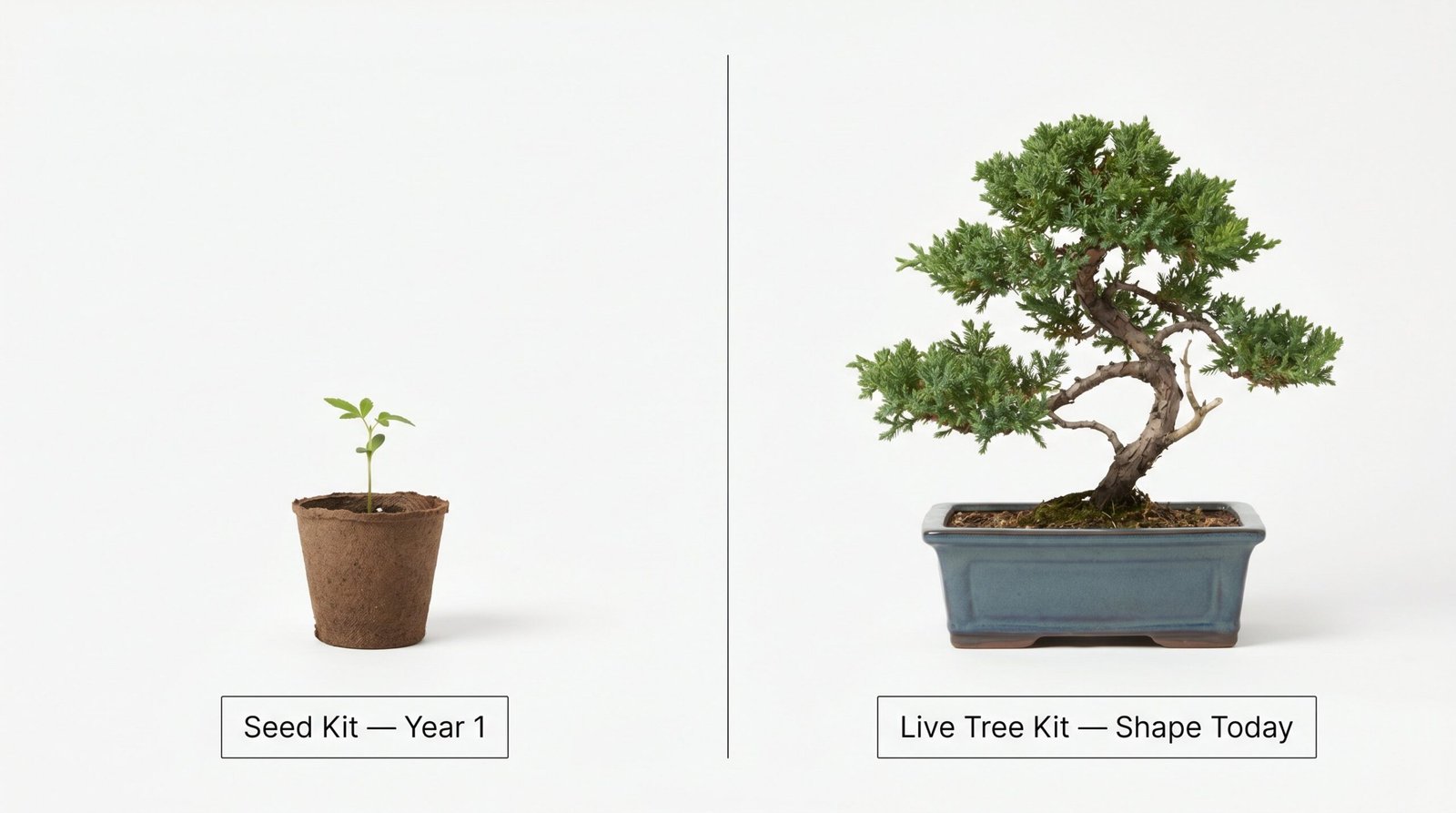
So let’s be honest about the timeline. A seed-grown bonsai takes between 10 and 25 years before it resembles the styled, miniature, gnarled-trunk tree you imagined when you placed the order. Year one yields sprouts. Year two gives you a young seedling roughly the height of a pencil. Years three through five produce a slender sapling that still looks nothing like a bonsai. Real shaping, with proper wiring and pruning, generally begins somewhere between year five and year ten, depending on species. The NC State Cooperative Extension’s bonsai overview walks through how seed growth progresses through those early years and why patience is the central virtue of growing from seed.
A live tree kit changes the math entirely. You skip the first three to ten years of waiting because the tree is already grown. The day it arrives, you can wire branches, study the trunk for movement, prune for taper, and start the actual craft of bonsai. This is the kit type most adult beginners actually want, even though the marketing of cheaper seed kits often pulls them in a different direction.
| Kit Type | What You Get | Time to First Styling | Price Range | Best For |
|---|---|---|---|---|
| Seed Kit | Seeds, pots, soil disc, care guide | 10-25 years (full bonsai), 1-2 years (seedling stage) | $15-$35 | Patient growers, kids and education, gift curiosity |
| Live Tree Starter Kit | Pre-grown tree (3-10 yrs old), pot, tools, soil | Immediately, shape and train from day one | $45-$189 | Committed beginners, adults wanting real results |
| Tools-Only Kit | Clippers, wire, rake, soil scooper | n/a (requires separate tree purchase) | $25-$60 | People who already own a bonsai tree |
Bonsai Seed Kits Explained
A typical seed kit contains three to five packets of seeds (often Japanese Black Pine, Japanese Red Maple, Wisteria, Jacaranda, or Rocky Mountain Bristlecone Pine), four to six small biodegradable pots, a compressed peat or coco coir soil disc, wooden plant markers, and an instruction card. The presentation is usually gorgeous. The box looks like a thoughtful gift, which is exactly why these dominate gift-giving season.
Honest assessment: seed kits are wonderful as a slow growing project or a gift, but only if expectations are calibrated correctly. The activity of pre-soaking seeds, performing cold stratification in a refrigerator for species that need it, and watching the first cotyledons unfurl is genuinely rewarding. The trouble starts when buyers expect a bonsai tree to appear within a year of planting.
Different species in these kits demand different germination treatments. Japanese Black Pine seeds typically need 24 to 48 hours of warm-water soaking. Japanese Red Maple seeds require cold stratification, usually 90 to 120 days in a refrigerator inside damp paper towels or vermiculite, before they will sprout reliably. Wisteria seeds germinate quickly without stratification but produce notoriously vining, hard-to-shape young plants. Most kit instruction cards mention these requirements in a single line, which is rarely enough.
Who should buy a seed kit: kids who love plant experiments and have a parent willing to help, gift recipients who are curious but not yet committed, hobbyists who want to document a multi-decade growing journey, and anyone who already owns a finished bonsai and wants a long-term side project.
Who should not buy a seed kit: anyone expecting a shapeable bonsai in under five years, gift recipients who have explicitly said they want a real bonsai, and impatient beginners who’ll lose interest by the time the first true leaves emerge.
If you do grow from seed, see our guide on how to grow bonsai from seed for realistic timelines, stratification schedules by species, and the small adjustments that dramatically improve germination rates.
Live Tree Bonsai Starter Kits Explained
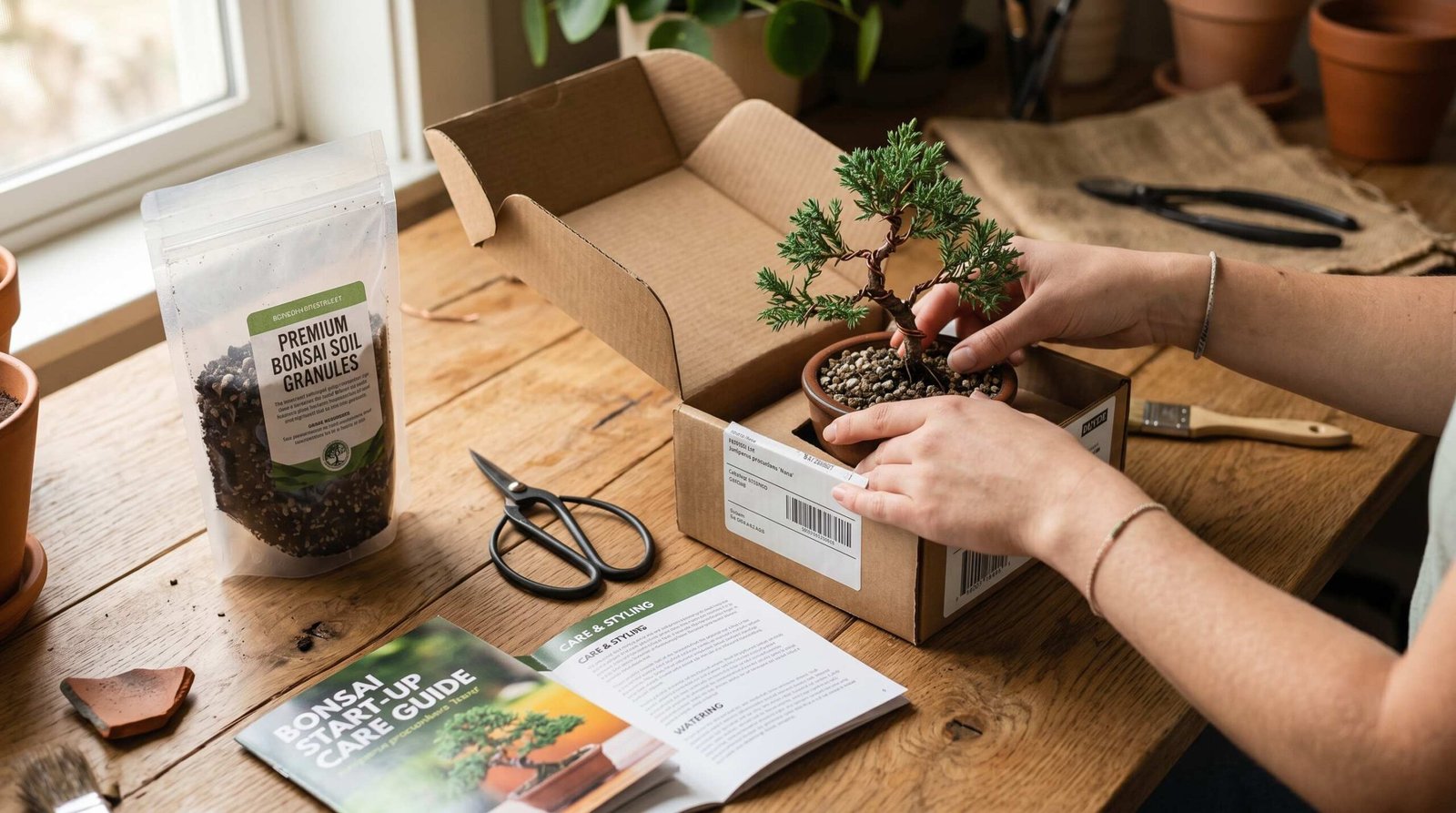
A live tree starter kit hands you the thing you actually pictured when you searched “bonsai.” You open the box and there is a tree. It has a real trunk with bark, real branches, and a small canopy. It sits in a ceramic or plastic training pot filled with proper bonsai soil. You can pick up the included scissors and make a meaningful pruning decision the same afternoon it arrives.
What’s typically inside: a young trained tree between three and ten years old, a ceramic or plastic training pot, a specialized bonsai soil blend (usually a mix of akadama, pumice, and lava rock or a similar fast-draining substrate), training wire in one or two gauges, a drainage mesh square, and basic care tools such as a root rake, a chopstick for working soil, and bonsai scissors. Higher-end kits add a humidity tray, fertilizer pellets, and a species-specific care guide.
Why this format works for beginners: you can begin shaping immediately, observe seasonal changes through actual leaf-out and leaf-drop cycles, and develop hands-on skills within the first weeks. Mistakes are recoverable on a young pre-grown tree in a way they simply are not on a fragile seedling. Virginia Tech Extension’s guide to bonsai cultivation emphasizes that container choice, soil drainage, and species selection are the three early decisions that determine whether a beginner’s tree survives the first year, and a good live tree kit makes all three decisions for you.
Price Tiers for Live Tree Kits
Budget ($45-$75): Juniper procumbens ‘Nana’, Ficus retusa, or Jade trees with basic tools. This is a strong entry point. The trees are typically three to five years old and trained into a basic informal upright shape. The tools are functional, not heirloom quality, but they work.
Mid-range ($75-$125): Larger trees (five to eight years old), proper ceramic glazed pots rather than plastic, a fuller tool set including concave cutters, and access to flowering or fruiting species like Azalea or Pomegranate. Care guides at this tier tend to be species-specific.
Premium ($125-$189): Eight to fifteen year old trained trees with established branching and trunk taper, Japanese Red Maple or Trident Maple options, advanced tool sets with grade Japanese steel, and pots from specialist potters. At this tier, the kit feels less like a starter and more like a real beginning.
Species Commonly Included in Live Tree Kits
Juniper procumbens ‘Nana’: the hardiest and most forgiving option, outdoor-only, ideal for total beginners who want a tree that can survive minor mistakes. Ficus retusa: the best choice for indoor growing, tolerates lower humidity and inconsistent watering. Jade (Portulacaria afra): succulent foliage, water-storing trunk, extremely forgiving of under-watering, slow growing. Chinese Elm: versatile indoor or outdoor tree, fast growing, responds beautifully to pruning. Azalea: flowering, more demanding on soil pH and water but spectacular in spring.
For species-specific care once your tree arrives, see our juniper bonsai care guide if your kit includes a juniper, and our guide on how to prune a bonsai before you make your first cut.
Tools-Only Bonsai Kits
This kit type is for people who already own a tree (often a nursery stock conifer or a pre-bonsai purchased separately) and want a proper tool set without paying for a tree they don’t need. It’s also the right choice for hobbyists upgrading from the basic scissors that came with a starter kit two years ago.
What’s typically included: concave cutters (the signature bonsai tool for clean branch removal), branch scissors, leaf trimmer, knob cutter, bonsai training wire in multiple gauges (usually 1mm, 2mm, and 3mm aluminum or copper), a root rake, a soil scoop, and a tool roll for storage.
Price ranges from $25 to $65 for serviceable starter sets and $80 to $200 for professional Japanese sets from brands like Kaneshin, Masakuni, or Tian. The jump from a beginner set to a Japanese set is real, both in cutting precision and in how the tools hold their edge over years of use. See our full breakdown in our bonsai tools for beginners guide for which specific tools matter most in your first two years.
What to Look for in a Bonsai Starter Kit
Not all kits are built equally, and the marketing photos rarely tell you what’s actually inside the box. Here are the six checkpoints we run through before suggesting any kit.
| What to Check | What to Look For | Red Flag |
|---|---|---|
| Soil quality | Gritty, fast-draining mix (akadama, pumice, or lava rock blend) | Compressed “soil disc” that turns to mud when wet |
| Pot drainage | Drainage holes with mesh cover | Decorative pot with no drainage |
| Species named clearly | Specific species (Juniper procumbens, Ficus retusa) | “Bonsai tree” with no species listed |
| Tree age (live kits) | 3-10 years old stated clearly | No age mentioned |
| Tool material | Stainless steel or carbon steel | Chrome-plated tools (rust quickly) |
| Instructions | Species-specific care guide | Generic one-size-fits-all card |
Soil quality. We suggest avoiding kits with compressed soil discs; once wetted, these turn to dense mud that drains poorly and can suffocate roots. A proper bonsai soil mix should look gritty and feel like aquarium gravel mixed with small pebbles. If you can’t see distinct particles in the photo, walk away. Our bonsai soil guide covers exactly what bonsai roots actually need and why standard potting soil kills bonsai within months.
Pot drainage. Every bonsai pot needs at least one drainage hole, ideally with a mesh square to prevent soil washout. Decorative pots without drainage are a death sentence. If a kit ships with a sealed-bottom pot, the seller does not understand bonsai, and you should not trust the rest of the contents.
Species named clearly. A trustworthy kit names the exact species: Juniper procumbens ‘Nana’, Ficus microcarpa, Portulacaria afra. Vague listings that say only “bonsai tree” or “live bonsai” usually ship a generic tropical that may or may not match the marketing photo. Knowing the species lets you find proper care information and predict mature behavior.
Tree age for live kits. A reputable seller states the tree’s age. Three to five years gives you a slender starter. Five to ten years gives you visible character. Anything claiming “mature” without an age number is marketing, not specification.
Tool material. Look for stainless steel or carbon steel. Chrome-plated tools shed their plating within a season and then rust. Carbon steel holds an edge better but needs occasional oiling. Stainless steel is more forgiving for beginners who leave tools damp after a session.
Instructions. A species-specific care guide is the marker of a thoughtful kit. Generic instruction cards that apply the same watering and light advice to a Juniper and a Ficus will kill at least one of them. The best kits ship printed guides or QR codes linking to detailed species-specific content.
Bonsai Starter Kit Recommendations
Budget Pick: Planters’ Choice Bonsai Starter Kit ($15-$25)
What’s included: four seed varieties (typically Rocky Mountain Bristlecone Pine, Black Poui, Norway Spruce, Flame Tree), four biodegradable peat pots, four soil pucks, plant markers, and a step-by-step instruction booklet. [AFFILIATE: Planters’ Choice Bonsai Starter Kit on Amazon]
Best for: gift giving, classroom projects, and curious beginners who want to test their interest at low risk.
What we like: beautiful packaging, clear instructions for the seed-soaking phase, and a reasonable assortment of species that offer varied germination experiences.
What to watch for: the soil pucks are convenient but underperform compared to proper bonsai soil; once your seedlings reach two inches, transplant them into a real bonsai soil mix.
Mid-range Pick: Eastern Leaf Juniper Live Tree Kit ($55-$75)
What’s included: a four to six year old Juniper procumbens ‘Nana’ trained in informal upright style, a ceramic training pot, fast-draining bonsai soil, training wire, drainage mesh, bonsai scissors, a root rake, a humidity tray, and a species-specific care card. [AFFILIATE: Eastern Leaf Juniper Bonsai Starter Kit]
Best for: committed beginners who want a real bonsai tree from day one.
What we like: the tree arrives already showing genuine bonsai character, the soil is the real deal, and the scissors are sharp enough for accurate pruning. Junipers are also the most forgiving species for first-time mistakes.
What to watch for: junipers are outdoor trees. If you live in an apartment with no balcony or outdoor space, choose a Ficus kit instead. Junipers will slowly decline indoors no matter how attentive you are.
Premium Pick: Bonsai Outlet Trained Juniper or Red Maple Kit ($125-$189)
What’s included: an eight to fifteen year old trained tree with established branching, a glazed ceramic pot from a specialist potter, premium bonsai soil, a full tool set including concave cutters and a knob cutter, copper training wire in three gauges, fertilizer pellets, and a detailed species-specific care manual. [AFFILIATE: Bonsai Outlet Premium Trained Bonsai Kit]
Best for: adult beginners who know they are committed, gift-givers who want to give something serious, or hobbyists upgrading from a starter to a real specimen.
What we like: the tree has real movement and visible age, the pot is heirloom-grade, and the tools will last a decade with basic care. The species-specific manual reads like a chapter of a textbook, not a card.
What to watch for: the higher the price, the more important shipping conditions become. Order during mild weather, avoid summer heat waves and winter freezes, and inspect the tree the day it arrives.
Frequently Asked Questions
Do bonsai starter kits actually work?
Yes, but only when expectations match the kit type. Seed kits work as multi-year growing projects but will not produce a styled bonsai for at least a decade. Live tree kits work immediately because the tree is already grown. Tools-only kits work if you already own a tree. The kits that “don’t work” are usually ones bought with the wrong expectations, not kits that are inherently broken.
How long does it take to grow a bonsai from a kit?
From a seed kit, expect 10 to 25 years before the tree resembles a styled bonsai, with the first five years producing only seedlings and saplings. From a live tree kit, you can begin styling the same week the tree arrives, though developing serious refinement still takes years of consistent pruning and wiring. The pre-grown nature of live kits compresses the timeline dramatically and is the main reason adult beginners prefer them.
What’s the best bonsai kit for a complete beginner?
A live tree kit with a Juniper procumbens ‘Nana’ or a Ficus retusa is our suggestion for most complete beginners. Junipers are the most forgiving outdoor species and tolerate occasional missed waterings. Ficus is the best indoor species, handling lower humidity and irregular light. Avoid starting with a Japanese Red Maple or an Azalea as your first tree; both are gorgeous but demand more refined care than a beginner typically has time to give.
Can I grow bonsai indoors from a starter kit?
Yes, if you choose the right species. Tropical and subtropical species, including Ficus, Jade, Chinese Elm, and Hawaiian Umbrella (Schefflera), can live indoors year round given a bright south or east-facing window. Temperate species, including Juniper, most pines, and most maples, require outdoor seasonal cycles and will slowly die indoors regardless of care quality. Read the species name before buying, not after.
What should I do first when I receive a bonsai starter kit?
Open the box immediately and inspect the tree (if it’s a live kit) for shipping damage, dryness, or yellowing. Water the soil thoroughly until water runs from the drainage holes, then place the tree in its target location (indoor near a bright window or outdoor in dappled morning sun, depending on species). Do not prune, wire, or repot in the first two weeks; let the tree acclimate to its new environment first. Read the species-specific care guide before making any other decisions.
Is a seed kit or a live tree kit better as a gift?
It depends on the recipient. A seed kit is the better gift for someone curious but unsure, for kids, or for someone who enjoys long-term projects without urgency. A live tree kit is the better gift for an adult who has expressed real interest in bonsai, who wants something to display and tend immediately, or who has the disposable income to appreciate a serious specimen. If you don’t know the recipient’s commitment level, a budget live tree kit with a Jade or Ficus splits the difference and almost always lands well.