Ficus Bonsai Care: The Complete Beginner’s Guide (Indoors, Watering & Pruning)
May 13, 2026 | by Ian

Some links below are affiliate links, we may earn a small commission at no extra cost to you.
Quick Answer: Care for a ficus bonsai by placing it in bright indirect light (a south or west window) and leaving it there. Water when the top half-inch of soil feels just dry. Use a fast-draining bonsai soil mix, fertilize every two weeks during spring and summer, and keep temperatures above 60°F year-round. Prune new shoots back to two or three leaves once they reach six to eight.
Ficus is the species most often handed to new bonsai growers, and for good reason. It tolerates indoor air, forgives missed waterings, heals fast from pruning cuts, and grows enthusiastically under conditions that would kill a juniper or pine in weeks. The trade-off: it has opinions. Move it across the room and you might find half its leaves on the floor by morning. Let the soil pack down with peat and you’ll watch the roots rot from the inside out. This guide walks you through every variable that actually matters, from species identification through aerial root cultivation, with a seasonal calendar you can bookmark and a troubleshooting section that points you to the deeper resources when something goes wrong.
Which Ficus Species Do You Have? (Species ID Table)
Most “ficus bonsai” sold at garden centers and big-box stores belong to one of five species. Knowing which one you have changes nothing about basic care, but it does affect leaf size goals, branch flexibility, and how aggressively you can defoliate.
| Species name | Common name | Leaf size | Trunk character | Beginner rating |
|---|---|---|---|---|
| Ficus retusa / Ficus microcarpa | Banyan fig, Chinese banyan, Tigerbark ficus | 1-2 inches, oval, glossy dark green | Smooth pale grey, develops aerial roots readily, tapers well | Excellent |
| Ficus benjamina | Weeping fig | 2-4 inches, pointed tip, light to medium green | Smooth grey, weeping branch habit, slim trunks | Moderate (more sensitive to light changes) |
| Ficus ginseng (marketed name for F. microcarpa) | Ginseng ficus, pot belly fig | 1-2 inches, oval, very glossy | Bulbous swollen base (tuberous root cutting) with grafted small-leaf top | Excellent |
| Ficus rubiginosa | Rusty fig, Port Jackson fig | 2-3 inches, dark green above, rust-coloured fuzz beneath | Heavy trunks, rugged bark, prolific aerial roots | Very good |
| Ficus salicifolia (now F. nerifolia) | Willow leaf fig | 2-3 inches, narrow, willow-shaped | Slim, elegant, fine ramification | Good |
One clarification worth making upfront: “Ficus ginseng” is not a separate species. It’s a marketing name for Ficus microcarpa grown from a tuberous root cutting, which produces the characteristic swollen pot-belly trunk. The small-leafed crown is usually grafted on, which is why you’ll sometimes see two different leaf shapes on a single tree (the graft line typically shows as a faint scar). Care is identical to any other F. microcarpa.
For a complete beginner, we suggest Ficus retusa, F. microcarpa, or the “ginseng” form. They tolerate low humidity better than F. benjamina, recover faster from mistakes, and produce aerial roots more reliably. Detailed species information for F. benjamina is available through NC State’s plant profile for Ficus benjamina if you want to dig deeper into its botanical characteristics.
Light, the Most Important Variable
Get the light right and ficus forgives almost everything else. Get it wrong and no amount of careful watering will save you. The minimum threshold is four hours of bright light per day. The ideal is a south or west window with direct morning sun and bright indirect light through the afternoon.
Here’s the single most important thing to know about ficus and light: do not move the tree once you’ve placed it. Ficus acclimates to its specific light environment by adjusting leaf size, leaf thickness, and chlorophyll concentration. When you move it, even from one window to another, those acclimated leaves suddenly become inefficient, and the tree responds by dropping them. This is the most common cause of panic among new owners. For a full troubleshooting guide to ficus leaf drop, see our ficus bonsai leaf drop guide.
Summer outdoors is excellent for ficus when nighttime temperatures stay above 60°F (15°C). The tree will grow noticeably faster, leaves will toughen, and you’ll see better internodal compression. Bring it back inside before nights drop below 55°F. Make the transition gradually if you can, two weeks of partial sun exposure before full move-out, and the same in reverse when bringing it back. The UMaine Extension indoor ficus guidance reinforces this point about gradual transitions reducing stress responses.
If your home doesn’t have a south or west window with strong light, supplement with a full-spectrum LED grow light positioned 8-12 inches above the canopy. Twelve to fourteen hours per day is plenty. We’ve seen ficus thrive entirely under artificial light, particularly in northern apartments during winter.
Watering Your Ficus Bonsai
The “finger test” is the most reliable watering method we know. Press your fingertip into the top half-inch of soil. If it comes back damp or you can feel any cool moisture, wait. If it feels dry to the touch, water thoroughly. Don’t water on a schedule, water when the tree needs it. A ficus in a sunny west window in July may need water every day. The same tree in February will go three days between waterings.
“Water thoroughly” means soaking the soil until water runs out of the drainage holes for several seconds. Half-watering creates dry pockets in the root mass, and dry pockets cause the fine feeder roots there to die back. Pour or pool water on the surface, let it soak in, then water again until the runoff comes clean and steady from the drainage holes. If your pot sits in a drip tray, empty it. Roots sitting in standing water for more than a few hours risk rot.
Chlorinated municipal tap water is fine for ficus. If you want to be cautious, let the watering can sit uncovered for thirty minutes before use, which dissipates most of the chlorine. Reverse osmosis or distilled water works but isn’t necessary. Rainwater, where available, is ideal.
| Overwatering signs | Underwatering signs |
|---|---|
| Yellowing leaves starting from the inner canopy, soft mushy soil that stays wet, fungus gnats, blackened roots when you inspect | Crispy leaf tips, leaves curling inward, soil pulling away from the pot edges, sudden mass leaf drop after the soil went bone dry |
For detailed troubleshooting on each pattern, our ficus bonsai leaf drop guide walks through diagnosis step by step.
Soil and Potting Mix
Ficus wants soil that drains in seconds and holds just enough moisture to keep the roots happy between waterings. The standard mix used by most experienced growers is 40% akadama, 40% pumice, and 20% lava rock by volume. This combination holds water at the particle surfaces, releases it as the roots demand, and never compacts.
Avoid two things absolutely: garden soil and peat-based houseplant potting mix. Both compact within months, suffocate the fine feeder roots, and create the wet anaerobic conditions that cause rot. If you inherited a ficus in nursery soil from a big-box store, plan to repot it in proper bonsai soil at your next spring repotting window. It will transform the tree’s vigour.
If mixing your own substrates feels overwhelming when you’re just starting, a pre-made bonsai soil mix works well. For those who want to mix their own, akadama soil component is the foundation ingredient, available in fine, medium, and coarse grades. Use medium grade for ficus.
Temperature and Humidity
Ficus is a tropical species, originally native to the warm understorey of Southeast Asia, India, and northern Australia. Indoor temperatures of 65-85°F are ideal. The hard floor is 60°F sustained; below that, growth stops. Below 50°F, leaf drop begins. Frost is fatal, even a single night.
Humidity tolerance is wider than most beginners expect. Ficus grows well at 40-60% relative humidity, which is the normal range in most heated homes. To stimulate aerial root development you need 80% or higher, which we’ll cover later. The thing to watch for isn’t low humidity itself, it’s rapid humidity swings. A tree positioned six inches from a forced-air heating vent experiences brutal cycles, and that’s what kills leaves.
Keep your ficus away from heating vents, radiators, fireplace mantles in winter, and direct airflow from air conditioning. A simple humidity tray filled with pebbles and water, placed under the pot, raises local humidity by 10-15% and acts as a buffer during heating season. The pot should sit on the pebbles, not in the water.
Seasonal Care Calendar
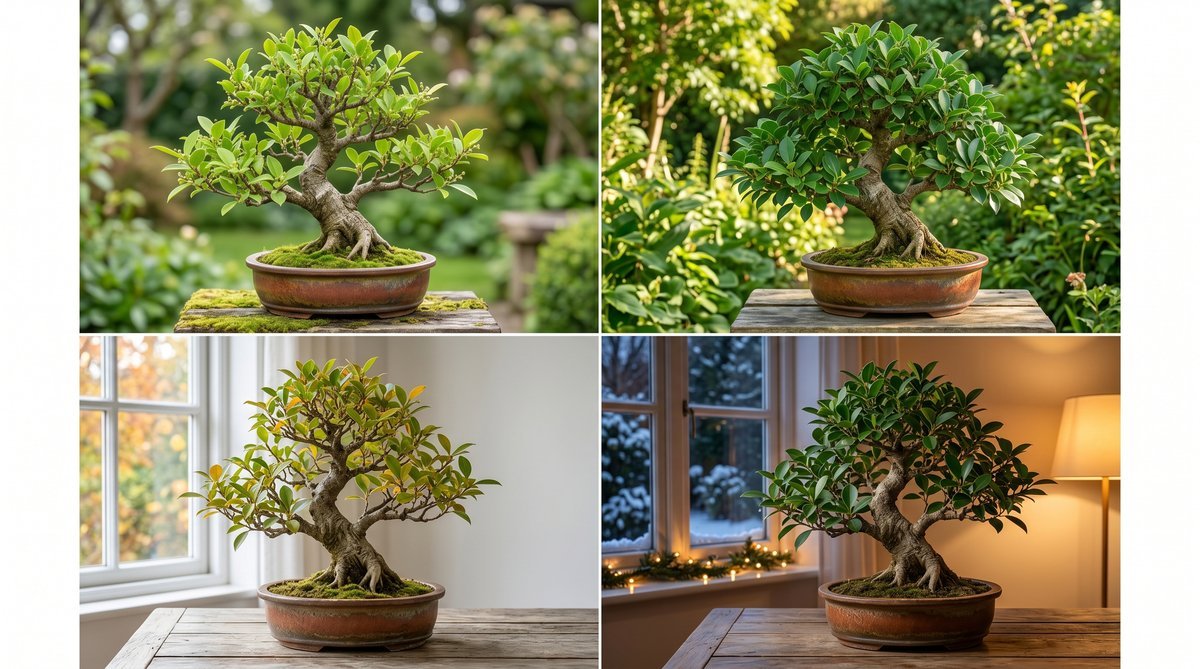
| Season | Light | Watering frequency | Fertilizing | Key tasks |
|---|---|---|---|---|
| Spring (Mar-May) | Bright indirect; resume direct morning sun | Every 2-3 days as growth resumes | Resume balanced fertilizer every 2 weeks | Watch for new growth flush, repot if due, structural pruning before bud break, move outdoors when nights consistently above 60°F |
| Summer (Jun-Aug) | Outdoors in bright indirect or morning sun | Daily, sometimes twice daily in heat | Every 2 weeks, balanced | Active pruning, pinching new shoots back to 2-3 leaves, partial defoliation on vigorous trees, wire while branches are supple |
| Fall (Sep-Nov) | Bring indoors before nights drop below 55°F | Every 3-4 days, decreasing as growth slows | Reduce to monthly through October, stop in November | Monitor for leaf drop during transition, clean pests off before bringing inside, position in final winter location |
| Winter (Dec-Feb) | Brightest available indoor light | Every 5-7 days; only when top half-inch is dry | None | Maintain warmth above 60°F, avoid heating vents, light pinching only, plan spring repotting |
Fertilizing Schedule
Fertilize ficus every two weeks from spring through early fall with a balanced liquid feed (NPK around 10-10-10 or similar). Dilute to half the label strength for bonsai. Full-strength houseplant fertilizer is too concentrated for the small soil volume in a bonsai pot and burns the fine feeder roots over time.
Reduce to monthly feeding in October as growth slows, then stop entirely from December through February. Feeding a dormant or semi-dormant tree pushes weak growth and risks salt buildup in the soil.
Organic pellet fertilizers are an excellent alternative for new growers. They release nutrients slowly over six to eight weeks and are nearly impossible to overdose. Place pellets on the soil surface, replace when they crumble, and the tree feeds itself. A balanced liquid bonsai fertilizer (10-10-10) is the most flexible option for adjusting feeding strength through the season.
Pruning Ficus Bonsai
Ficus is the most forgiving tree in bonsai when it comes to pruning. Cuts heal in weeks rather than years, the milky latex sap acts as a natural seal against pathogens, and even hard chopback usually produces new buds within a month.
There are two kinds of pruning you’ll do. Structural pruning, where you remove large branches or set the tree’s silhouette, is best done in early spring before the new growth flush. The tree is gathering energy, sap is rising, and large cuts will heal quickly. Maintenance pruning, where you pinch back new shoots to maintain shape and force back-budding, happens year-round whenever a shoot extends to six or eight leaves. Cut back to two or three leaves. New buds will appear at the cut within two to three weeks during the growing season.
For branches thicker than 5mm, use clean concave cutters. They create a slightly inset wound that calluses flat against the trunk rather than leaving a stub or pimple-like swelling. Regular scissors leave protruding stubs that take years to heal and often die back into the trunk. A pair of concave branch cutters is worth the small investment if you plan to keep working ficus for more than a season or two. For a step-by-step guide to pruning technique, see our walkthrough on how to prune a bonsai tree.
Leaf size reduction through partial defoliation is one of ficus’s most useful tricks. In midsummer, on a vigorous and well-fertilized tree, you can cut off each leaf at the base of its blade, leaving the petiole (the small leaf stalk) attached. The tree responds by pushing new leaves that are typically 30-50% smaller. Do this only on healthy trees, only in the growing season, and never on a recently repotted specimen. Full defoliation, removing leaves and petioles together, is a more aggressive version reserved for very healthy display trees.
Wiring Ficus Bonsai
Wire ficus during active growth from late spring through summer, when branches are supple and the cambium is generating new tissue. Branches set quickly under wire, often within three to five weeks for thinner material, which means you must check your wire constantly.
Aluminum wire is the right choice for ficus, particularly for beginners. It’s softer than copper, easier to apply, and gentler on the smooth bark. Copper is unnecessarily aggressive for a species that holds wire so briefly. Use 1mm to 3mm aluminum depending on branch thickness; the wire should be roughly one-third the diameter of the branch you’re bending.
Check your wire every three to four weeks during the growing season. Ficus thickens fast, and wire that starts loose can bite into the smooth grey bark within a month or two, leaving spiral scars that take years to fade. Remove wire before it marks, then rewire if the branch hasn’t fully set. For technique, see our bonsai wiring guide.
Repotting Ficus Bonsai
Repot young, vigorous ficus every two to three years. Established trees in finished bonsai pots can go three to five years between repottings. The signal is root behaviour: when you see roots circling the pot’s edges, emerging from drainage holes, or pushing the tree up out of the pot, it’s time.
The best repotting window is late spring, when daytime temperatures are consistently above 65°F and the tree is just beginning its main growth flush. Repotting in winter, when the tree is semi-dormant, risks root rot in cold wet soil. Repotting in midsummer heat stresses the tree at exactly the wrong time.
You can safely root-prune up to one-third of the root mass on a healthy ficus. Comb out the roots, cut back the heaviest woody roots first, then trim the fine feeder mass evenly. Set the tree into fresh bonsai mix, work the soil into the root spaces with a chopstick to eliminate air pockets, water thoroughly, and place the tree in a warm humid spot out of direct sun for two weeks while it recovers. Resume normal light after that. For a full step-by-step repotting walkthrough, see how to repot a bonsai tree.
Aerial Root Development
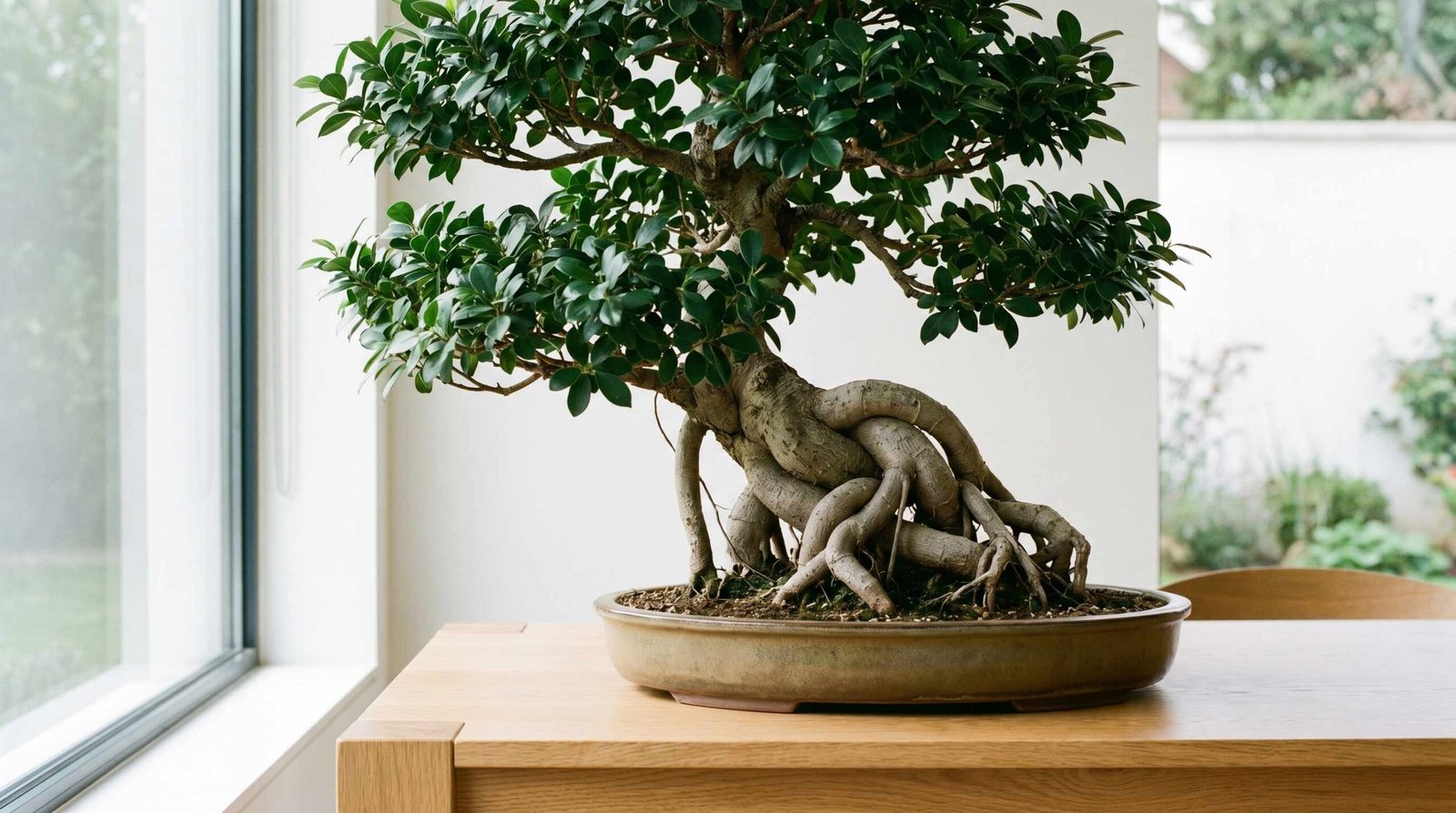
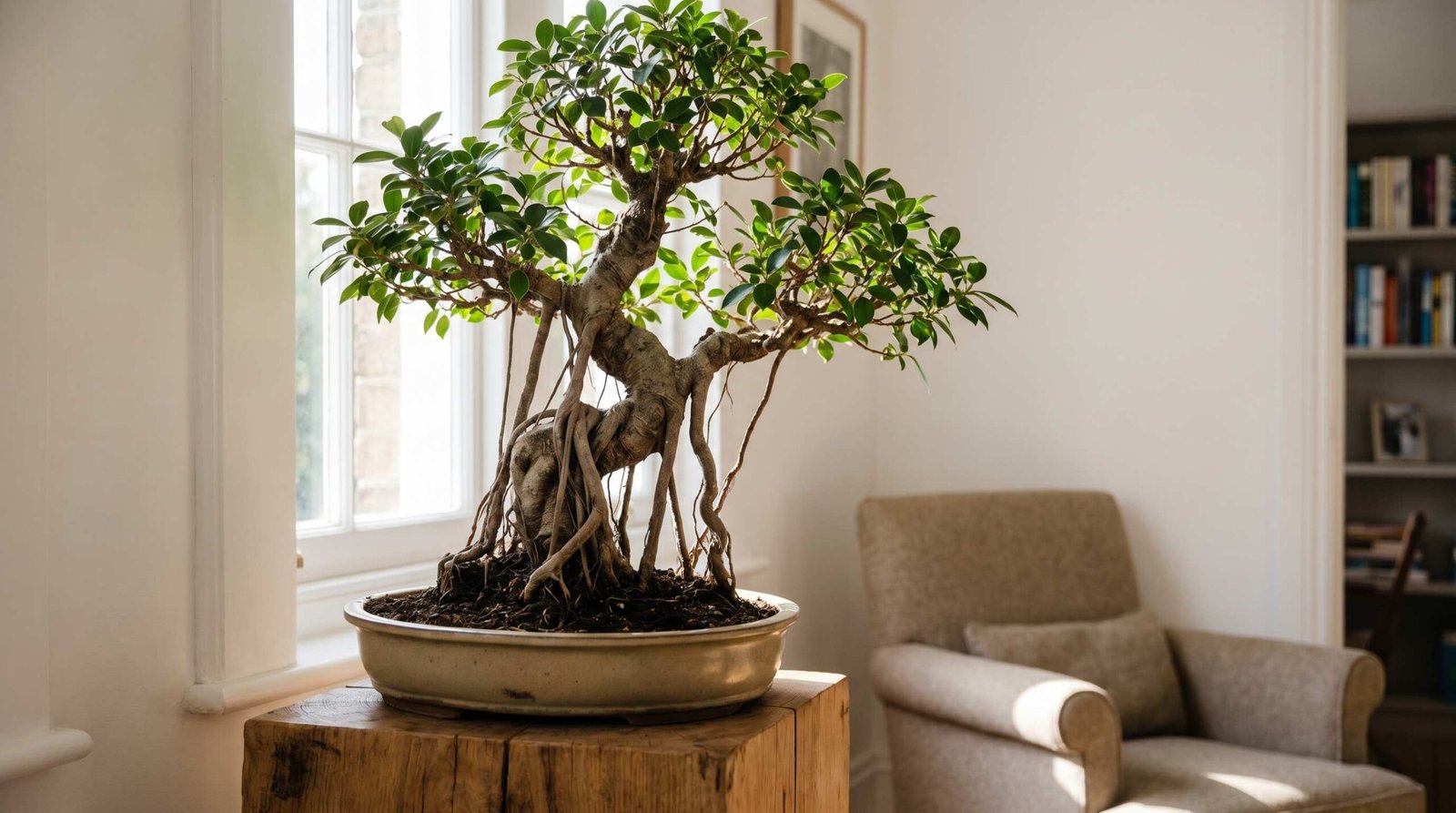
Aerial roots are the visual signature of the banyan-style ficus, those cascading curtains of pale wood reaching from branch to soil. They’re ornamental rather than functional in bonsai cultivation, but they transform a young tree into something that looks ancient. Getting them to form indoors takes patience and a specific set of conditions.
The trigger is sustained high humidity, 80% or higher, for weeks at a time. In tropical climates ficus produces aerial roots in the open air. In a heated indoor home, you have to create a microclimate. The standard technique: tent the entire tree (or just the branches you want to root) with a clear plastic bag, leaving a small vent at the top to prevent fungal issues. Mist daily inside the tent. Keep temperatures above 70°F. Place the setup in bright indirect light, never direct sun, because the bag will cook the tree.
Roots typically appear from young, actively growing shoots first. Old hardened wood is much slower to respond. Once an aerial root reaches the soil, it thickens and becomes structural. You can encourage this by guiding the descending root through a clear plastic tube filled with moist sphagnum, which protects it and channels growth down to the pot. Or leave them hanging as ornament. The Clemson Extension research on weeping ficus covers aerial root behaviour in landscape ficus, which translates directly to bonsai cultivation.
Common Mistakes Table
| Mistake | What happens | Fix |
|---|---|---|
| Moving the tree too often | Leaf drop as a stress response, dropped leaves often within 48 hours of relocation | Place once, leave it. Choose the spot carefully, then commit. |
| Letting soil dry out completely | Leaf drop, damage to fine feeder roots that takes weeks to recover | Use the finger test daily; water as soon as the top half-inch reads dry. |
| Placing near heating vents | Dry air, sudden humidity swings, leaf drop, often spider mites | Use a humidity tray and position the tree away from forced air vents. |
| Overwatering in winter | Root rot, yellowing leaves, soil that stays wet for days | Reduce frequency October through February when growth slows; water only when needed. |
| Using garden soil or peat-based potting mix | Compaction, anaerobic root zone, root rot, slow death over months | Repot into fast-draining bonsai mix at the next spring window. |
| Ignoring wire until it bites in | Spiral scars on smooth bark that take years to fade, sometimes permanent | Check wire every 3-4 weeks during the growing season; remove before it marks. |
Leaf Drop and Troubleshooting
Ficus drops leaves as its primary stress signal. It’s the equivalent of a cat puffing up its tail. The tree isn’t necessarily dying, it’s telling you something has changed. The five most common triggers, in order of frequency, are location change (acclimation to new light), letting the soil go bone dry, sudden cold exposure (a draft, an open window, transition outdoors-to-indoors in fall), overwatering combined with cold (root rot), and pest infestation (scale insects and spider mites are the usual culprits).
The diagnostic approach: check soil moisture first, then inspect the underside of leaves and the leaf axils for pests, then reconsider whether anything about the tree’s location has changed in the last two weeks (new heating cycle, moved closer to a window, daylight savings shift). Ficus rarely dies from leaf drop alone. Healthy trees can lose 80% of their leaves and recover fully within a season, given stable conditions.
We’ve covered ficus leaf drop in depth in our ficus bonsai leaf drop guide, which covers every common scenario with a diagnostic flowchart and recovery protocols for each cause.
Is Ficus Bonsai Good for Beginners?
Ficus is arguably the single best species for someone learning bonsai. It tolerates indoor conditions that would kill most traditional bonsai species. It grows fast enough that you see your work pay off in the same season. It heals from pruning errors within weeks. It backbuds reliably, which means even severe chopback usually produces new growth at the right places. And it’s widely available and inexpensive, so you can practice on a sacrificial tree before committing to a more expensive specimen.
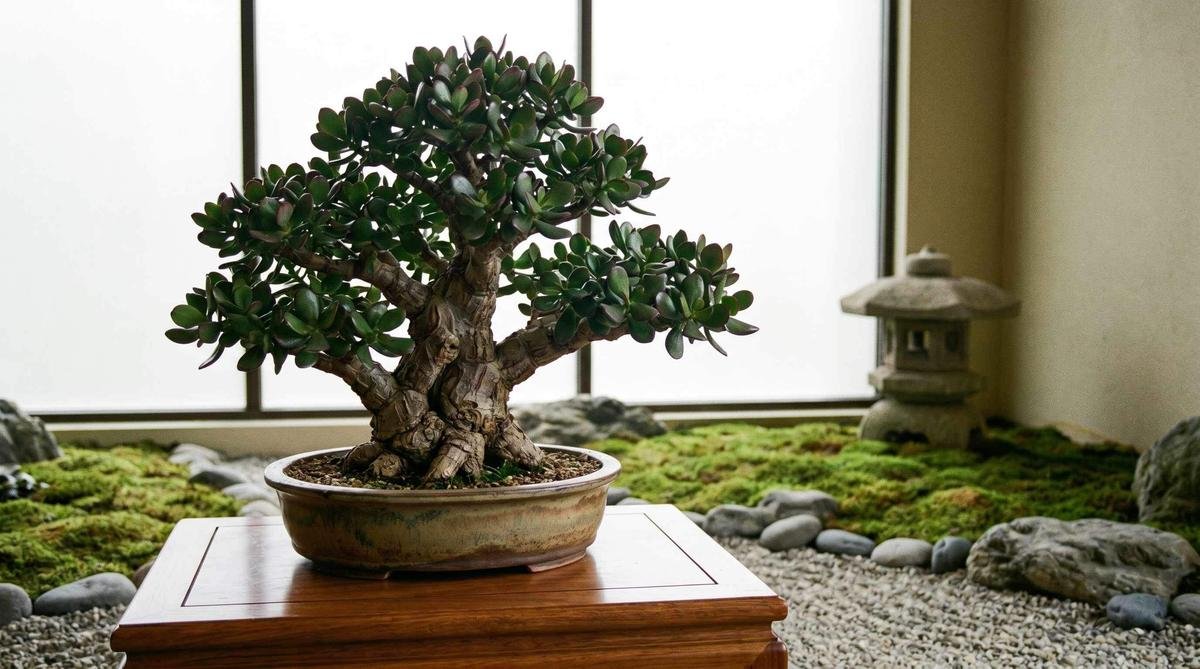
If you’re looking for another forgiving indoor species to grow alongside your ficus, jade bonsai is equally beginner-friendly with a completely different aesthetic, succulent leaves, drought tolerance, and slow growth. For a broader survey of options, see our guide to the best indoor bonsai trees.
Our specific recommendation: start with a Ficus retusa or “ginseng” ficus. Pick up some beginner bonsai tools, set up a south or west window, and commit to leaving the tree there. By the second season you’ll know enough about ficus to start branching out into more demanding species.
FAQ
How do you care for a ficus bonsai tree?
Place it in bright indirect light or direct morning sun, ideally a south or west window, and leave it there. Water when the top half-inch of soil reads just dry to the touch. Use fast-draining bonsai soil. Fertilize every two weeks from spring through early fall. Keep temperatures above 60°F year-round. Prune new shoots back to two or three leaves once they reach six to eight.
Why is my ficus bonsai dropping leaves?
The most common cause is sudden location or light change. Ficus acclimates to its specific light environment and drops leaves when conditions shift, even moving across the same room can trigger it. Other causes include letting the soil dry out completely, cold drafts, overwatering, and pest infestations. Stabilize conditions and most trees recover fully within four to eight weeks.
How often should I water a ficus bonsai?
Water when the top half-inch of soil feels dry, not on a fixed schedule. Frequency varies from daily in summer heat to once every five to seven days in winter. Always water thoroughly until the runoff comes clean from the drainage holes, and never let the pot sit in standing water for more than a few hours.
Can a ficus bonsai live indoors year-round?
Yes, ficus thrives indoors year-round provided it gets at least four hours of bright light per day and temperatures stay above 60°F. Summer outdoors accelerates growth and toughens leaves, but it’s not required. Many growers keep ficus indoors permanently, particularly in northern climates with short summer windows.
Which ficus bonsai is best for beginners?
Ficus retusa, Ficus microcarpa, or the marketed “ginseng” ficus (which is F. microcarpa grown from a tuberous root cutting). These species tolerate low humidity, recover quickly from mistakes, and produce aerial roots more reliably than Ficus benjamina, which is more sensitive to environmental changes.
How do I get aerial roots on my ficus bonsai?
Aerial roots require sustained humidity at 80% or higher and temperatures above 70°F. The standard technique is tenting the tree with a clear plastic bag (vented at the top) and misting daily for several weeks. Roots emerge most readily from young, actively growing shoots rather than old hardened wood. Once they reach soil, they thicken into structural roots.
Is ficus ginseng a real bonsai species?
“Ficus ginseng” is a marketing name, not a botanical species. It’s Ficus microcarpa grown from a tuberous root cutting, which produces the characteristic swollen pot-belly trunk. The small-leafed crown is usually grafted onto the root stock. Care is identical to any other F. microcarpa, and they make excellent beginner bonsai.
What soil mix is best for ficus bonsai?
A fast-draining bonsai mix of roughly 40% akadama, 40% pumice, and 20% lava rock works well for ficus. Pre-made bonsai soil blends are convenient for new growers. Avoid garden soil and peat-based houseplant potting mix, both compact within months and create the wet anaerobic conditions that cause root rot in ficus.
RELATED POSTS
View all