How to Water a Bonsai Tree: The Complete Beginner’s Guide
Quick Answer: Water your bonsai when the top half-inch of soil feels slightly dry to the touch, not on a fixed schedule. Push your finger about 1 cm into the soil. If it feels dry, water thoroughly until liquid drains freely from the bottom holes. Frequency varies by species, season, pot size, and soil composition, typically every 1 to 4 days.
You just brought home your first bonsai. The pot is small. The soil is unfamiliar. And somewhere in the back of your mind, a quiet voice is asking: am I going to kill this thing within a month?
Here’s the truth most beginner guides skip. The single biggest cause of bonsai death in new owners isn’t pruning mistakes, sun exposure, or pest infestations. It’s water. Specifically, it’s getting the watering wrong, and almost always in the same direction: too much, too often, with too little understanding of what the tree actually needs.
The good news is that watering a bonsai correctly is a skill anyone can learn within a few weeks. The bad news is that the conventional advice you’ll find on most sites stops at “stick your finger in the soil.” That’s a starting point, not a system. This guide goes deeper, and by the end you’ll know exactly how to read your tree, your pot, and your soil so you can water with quiet confidence rather than nervous guesswork.
Why Watering Is the Hardest Part of Bonsai
If you’ve ever owned a houseplant, you probably know the basic rhythm: water when it looks thirsty, don’t drown it, move on with your day. Bonsai breaks that rhythm. The shallow pots, the specialized soil mixes, and the deliberately restricted root systems all combine to make watering a much higher-stakes activity than it is for a pothos on your windowsill.
Most beginners assume their bonsai died from drought. The withered look, the brittle leaves, the bare branches all point to thirst. But the actual cause of death, somewhere between 60 and 80 percent of the time, is the opposite. The tree was watered too often. Its roots sat in damp soil for too long. Anaerobic bacteria moved in. The root tips rotted. And as the roots died, the tree lost its ability to absorb water at all. By the time the leaves started drooping, the damage was already irreversible. The tree wasn’t underwatered. It was starving in a wet grave.
This is the misdiagnosis trap, and we’ll cover it in detail later. For now, just internalize this: a wet, sad-looking bonsai is usually thirstier than a dry, sad-looking bonsai. The cure is rarely more water.
The second reason watering trips up beginners is that there’s no fixed schedule. None. Watering “every Tuesday and Friday” is one of the fastest ways to kill a tree, because the tree doesn’t care what day of the week it is. It cares about temperature, humidity, light, season, growth stage, and soil moisture, all of which shift constantly. We’ll break this into the four variables that actually drive frequency in a minute.
If you want to zoom out before diving in, our complete bonsai tree care guide covers light, pruning, fertilization, and the full picture of what your tree needs. This article focuses specifically on the watering question, which is where most beginners struggle hardest.
The Finger Test: How to Know When to Water
Forget the calendar. The most reliable signal your tree gives you lives in the soil itself. The finger test takes three seconds and tells you almost everything you need to know.
Here’s how to do it correctly:
- Push your index finger straight down into the soil, about 1 cm or half an inch deep.
- Pull your finger out and feel the soil that comes with it.
- If the soil feels cool and slightly moist, wait. If it feels dry and crumbly, water now. If it’s actively wet, wait longer.
That’s the whole test. The phrase “slightly dry” is doing a lot of work in this context, so let’s define it carefully. Slightly dry means the surface and the first half-inch of soil have no visible dampness, the particles don’t cling to your finger, and the color of the soil has lightened compared to when it was freshly watered. It does not mean bone-dry, dust-dry, or pulling-away-from-the-pot-walls dry. By the time you see those signs, you’re already late.
The finger test also calibrates over time. After a few weeks of paying attention, you’ll start to notice that the surface of the soil tells you a lot before you even reach down. Akadama lightens to a tan-pink color when it dries. Dark organic mixes turn a paler shade. The pot itself becomes lighter to lift. These visual and tactile cues stack up into a real intuition.
If you’d rather have a numerical reading, particularly while you’re learning, a soil moisture meter takes the guesswork out of the equation. Push the probe into the soil and the dial gives you a moisture reading on a 1 to 10 scale. We suggest watering most species when the reading drops to around 3 or 4. Meters aren’t perfect, especially in shallow bonsai soil, but they’re a useful training tool while your fingers learn the job.
The 4 Variables That Control Watering Frequency
If you only remember one thing from this guide, make it this: your watering frequency is the output of four inputs working together. Change any one of them and the rhythm shifts. Once you understand the system, you stop asking “how often should I water?” and start asking “what do my four variables look like today?”
Variable 1: Species
Different species evolved in different environments and they bring those preferences into the pot. Junipers and pines are mountain plants that tolerate dryness well. Ficus is tropical and likes consistent moisture. Jade is a succulent that wants to dry out fully between waterings. Azaleas demand near-constant moisture and acidic conditions. Treating them all the same is like feeding a desert lizard and a tropical frog the same diet.
The species-specific cheatsheet table further down handles this in detail, but the principle is simple. Learn what your species prefers, and let that preference be the baseline you build from.
Variable 2: Season
Bonsai are seasonal creatures. In late spring through summer, they’re actively growing, pushing new leaves and roots, transpiring heavily, and drinking like they mean it. A juniper that needs water every other day in July might only need it once a week in October, and possibly only once every ten days in deep winter dormancy.
The general rule looks like this: as temperatures climb and daylight extends, frequency increases. As temperatures drop and the tree slows down, frequency decreases. Overwatering in winter is the single most common cause of beginner-killed bonsai because owners keep watering at summer pace into a dormant tree.
Variable 3: Pot Size
Bonsai pots are shallow on purpose. Shallow pots dry out fast. A 4-inch shohin pot can lose all of its moisture in a single hot afternoon, while a 12-inch shallow oval might hold water for two or three days under the same conditions. If you’ve just done some repotting your bonsai into a smaller training pot, expect frequency to climb sharply.
Beyond size, pot material matters too. Unglazed clay breathes and loses water through the walls. Glazed ceramic holds moisture longer. Plastic training pots hold water the longest, which is one reason they’re popular for nursery stock and recovering trees.
Variable 4: Soil Composition
This is the variable most beginners ignore, and it’s arguably the most powerful one. Traditional bonsai soil mixes use granular components like akadama, pumice, and lava rock. These mixes drain fast, hold a moderate amount of water, and let oxygen reach the roots. Cheap nursery soil or organic potting mix holds water much longer and chokes off oxygen.
If your bonsai is still in the dense black soil it came in, you’ll need to water less often than a tree in proper bonsai mix, but the trade-off is that roots suffer from poor aeration and root rot becomes a real risk. We cover the transition in our repotting guide. For now, just know that two trees of the same species in the same pot can need watering at completely different intervals if their soils differ.
How to Water a Bonsai Properly
Knowing when to water is half the job. Knowing how to water is the other half. There are two reliable methods, each suited to different situations.
Method 1: Overhead Watering (Watering Can)
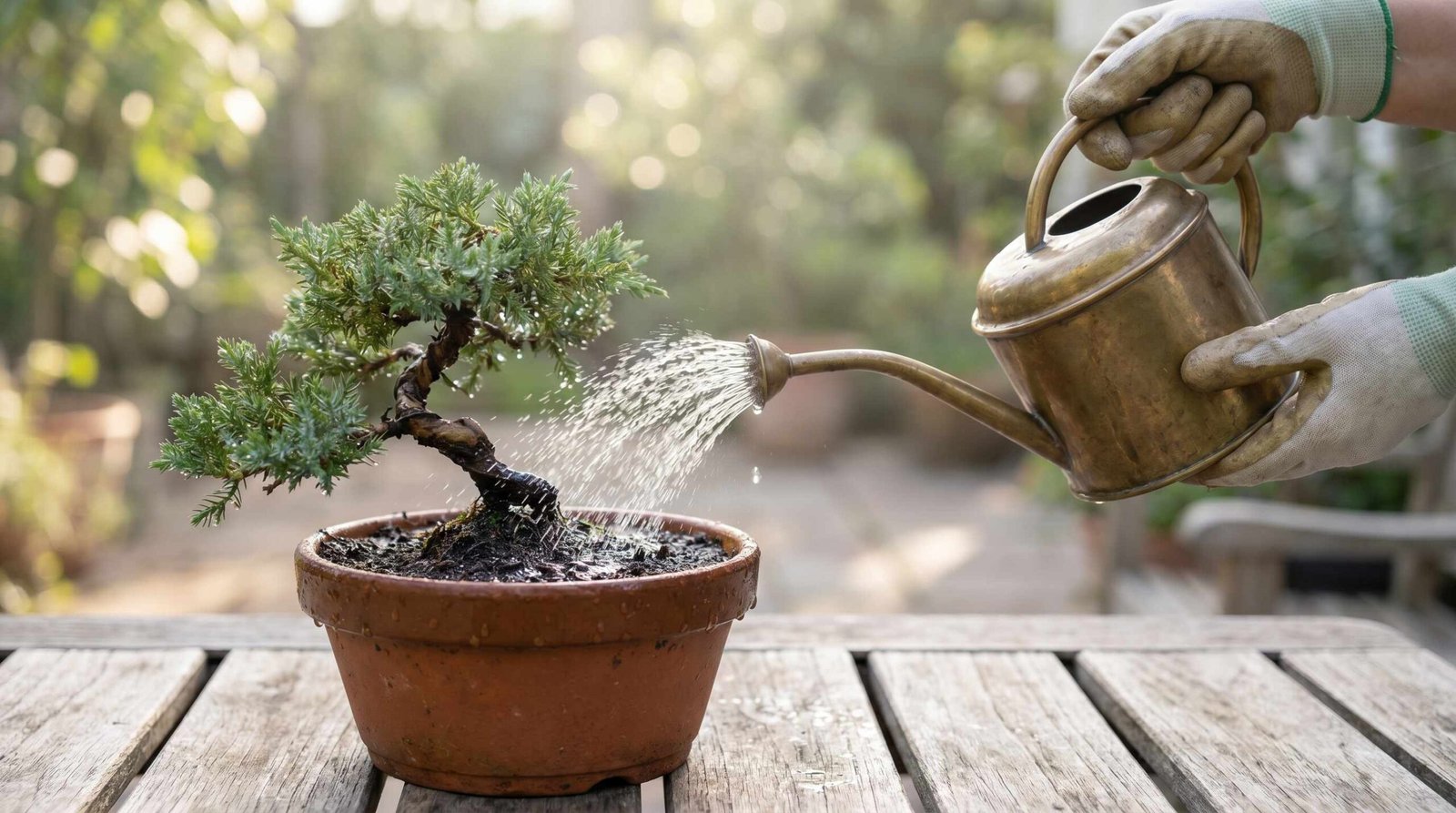
This is the standard approach and the one you’ll use most days. Pour water gently over the entire soil surface using a fine-spray rose attachment that breaks the stream into small droplets. You want a soft, even shower that wets the soil without blasting particles out of the pot.
Water until liquid runs freely from the drainage holes at the bottom. Then wait thirty seconds and water again. The first pass wets the surface, and the second pass saturates the deeper layers. Bonsai soil is hydrophobic when bone-dry, which means water can run off the surface and out the drainage holes without ever soaking the root zone. A double-pass watering prevents this.
We suggest investing in a proper fine-spray bonsai watering can rather than using a kitchen jug or the garden hose. The fine rose head distributes water gently enough that you won’t displace soil, expose roots, or knock over a top-heavy tree.
Method 2: Immersion or Dishpan Method
If your soil has dried out completely and water is running straight through without absorbing, or if you’re working with an extremely shallow shohin pot that’s hard to water from above, immersion is the better option. Fill a dishpan or sink with two to three inches of room-temperature water. Lower the bonsai pot in until water reaches just below the soil surface. Hold it there until air bubbles stop rising, usually 30 to 90 seconds. Lift it out and let it drain.
Immersion saturates the soil more thoroughly than any overhead pour, which is exactly why you don’t want to do it every time. Constant immersion compacts soil, washes out fines, and can leave roots sitting in oversaturated conditions for too long. We suggest using it as a corrective tool, not a routine.
| Method | When to Use | Pros | Cons |
|---|---|---|---|
| Overhead Watering | Daily and routine watering, healthy trees, all sizes | Fast, gentle on soil, washes leaf dust, mimics rain | Can run off if soil is bone-dry, requires double-pass |
| Immersion/Dishpan | Bone-dry soil, hydrophobic mix, very shallow pots, post-vacation rescue | Deep saturation, guarantees full root contact | Time-consuming, can wash out fines, risks overwatering if done routinely |
One additional tip: water in the morning when possible. Morning watering gives the tree all day to use the moisture and lets surface water evaporate before nightfall, which reduces the risk of fungal issues. Evening watering is acceptable, especially in hot summer weather, but try to avoid soaking the foliage as the sun is setting.
Species-Specific Watering Cheatsheet
Below is a quick reference for the six most common beginner species. These are general guidelines for healthy trees in proper bonsai soil. Adjust for your local climate, pot size, and indoor or outdoor placement.
| Species | Moisture Preference | Summer Frequency | Winter Frequency | Notes |
|---|---|---|---|---|
| Juniper | Slightly dry between waterings | Every 1-2 days | Every 5-10 days | Outdoor species; tolerates dryness but punishes overwatering. See juniper bonsai care for the full breakdown. |
| Ficus | Consistently moist, never soggy | Every 1-3 days | Every 4-7 days | Top indoor species; drops leaves if soil dries out completely. See ficus bonsai care. |
| Jade | Dry between waterings | Every 4-7 days | Every 14-21 days | Succulent; stores water in leaves. Overwatering is the #1 killer here. |
| Japanese Maple | Evenly moist, never bone-dry | Every 1-2 days, possibly twice daily in heat | Every 7-10 days | Outdoor species; sensitive to dry roots in hot wind. Use rainwater when possible. |
| Chinese Elm | Moist with brief drying | Every 1-2 days | Every 4-7 days | Forgiving beginner tree; adapts to indoor or outdoor placement. |
| Azalea | Constantly moist, acidic water | Every 1-2 days, sometimes daily | Every 3-5 days | Demanding; never let soil fully dry. Sensitive to hard water and chlorine. |
For more species-specific guidance, the New York Botanical Garden maintains an excellent reference FAQ on bonsai watering that aligns closely with these principles.
Overwatering vs. Underwatering: How to Tell the Difference
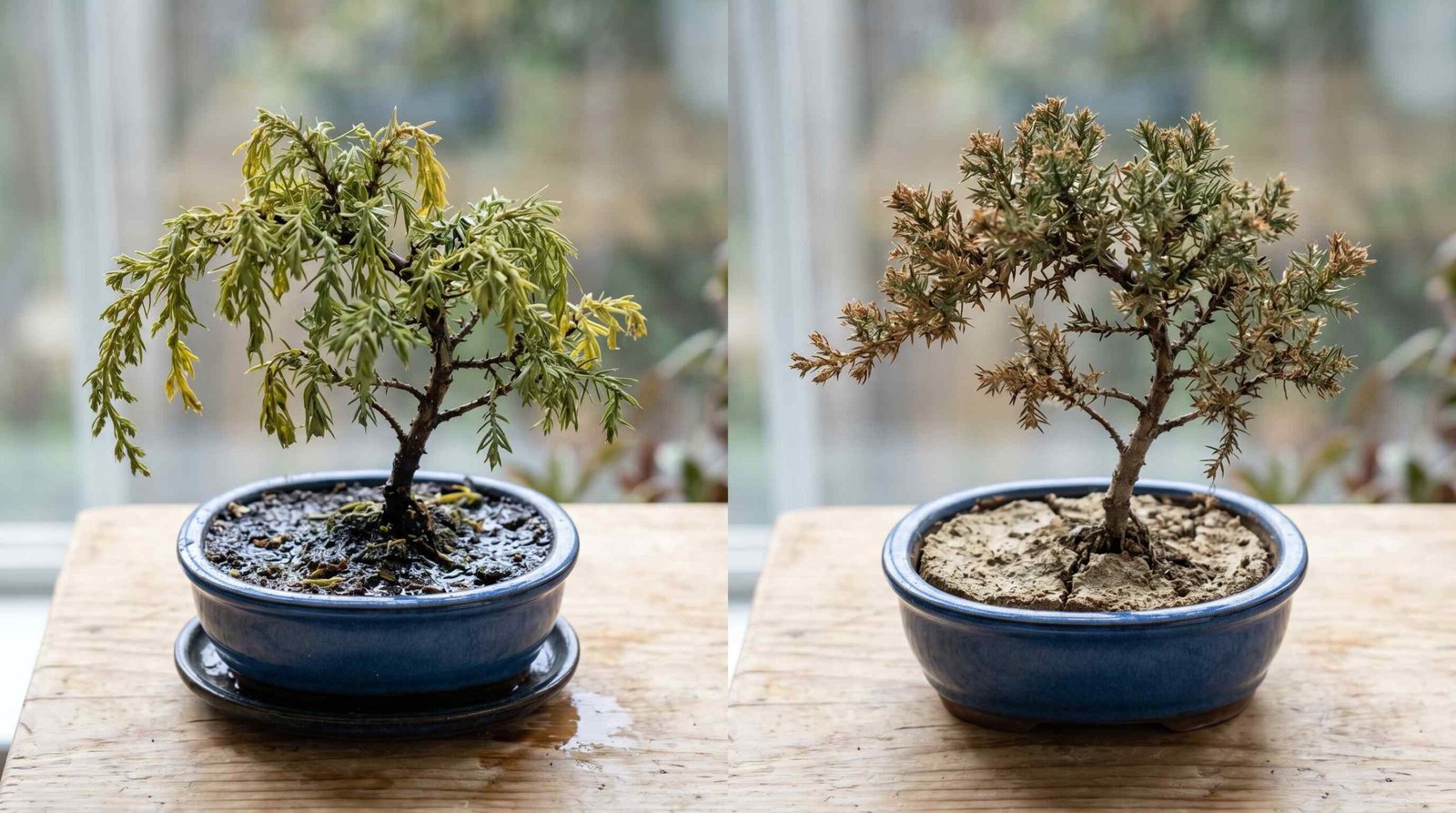
Here’s the cruel irony at the heart of beginner bonsai care: overwatered and underwatered trees look almost identical. Both show drooping foliage. Both show yellowing leaves. Both look stressed and sad. And because most owners default to “my tree looks thirsty, I’d better water it more,” the overwatered trees get pushed deeper into root rot until they die.
This is the misdiagnosis trap, and it’s the single most common path to a dead first bonsai. Let’s break down the actual differences so you can read your tree correctly.
Signs of Overwatering
- Soil is wet or damp every time you check it, even days after the last watering.
- Yellowing leaves that drop easily when touched.
- Soft, mushy trunk base or a slight wobble in the trunk.
- A sour or musty smell rising from the soil.
- Fungus gnats hovering around the pot.
- Green algae or moss growing aggressively on the soil surface.
- Black, mushy roots if you carefully lift the tree from the pot.
Signs of Underwatering
- Soil is bone-dry and pulling away from the inner pot walls, leaving visible gaps.
- Leaves are crispy, brown at the edges, and brittle to the touch.
- Foliage droops but the leaves stay attached firmly.
- The pot feels noticeably light when lifted.
- Water runs straight through the drainage holes without absorbing on first pour.
- Visible wilting that recovers within an hour or two of a thorough watering.
The crucial diagnostic distinction sits in the soil itself. Always check the soil before reacting to leaf symptoms. Wet soil plus sad leaves means stop watering, not water more. Dry soil plus sad leaves means water now and water thoroughly.
What to Do If You Suspect Overwatering
If you’ve been watering on a schedule and your tree is showing the overwatering symptoms above, stop watering immediately. Move the bonsai to a brighter, breezier spot to help the soil dry out. Do not water again until the soil reads dry on the finger test, even if that takes a week or longer. If the tree is in dense organic soil rather than proper bonsai mix, consider an emergency repot into a fast-draining mix to save what’s left of the root system. Trim any black, mushy roots cleanly and dust the cuts with cinnamon, which has mild antifungal properties.
Recovery from mild overwatering takes weeks. Recovery from severe root rot is sometimes impossible. Catching it early is everything.
Does Water Quality Matter?
Most beginners pour straight from the tap and never think twice. For many species in many regions, that works fine. For sensitive species, hard-water regions, or trees you plan to keep for years, water quality starts to matter more than people expect.
Tap Water
Municipal tap water typically contains chlorine, chloramine, fluoride, and dissolved minerals. Chlorine in particular can stress sensitive species over time. The simple fix is to fill your watering can the day before and let it sit out overnight. Chlorine off-gasses on its own within 12 to 24 hours. Chloramine doesn’t off-gas, but it’s at low enough levels in most water supplies that bonsai tolerate it.
Hard Water
If you live in a hard-water area, you’ll eventually see a white mineral crust forming on the soil surface and around the rim of the pot. That’s calcium carbonate building up. It raises the pH of your soil over time, which is a problem for acid-loving species like azaleas and Japanese maples. If you notice mineral crust, scrape it off gently every few months and consider switching to rainwater or filtered water for sensitive species.
Rainwater
Rainwater is the gold standard for bonsai. It’s soft, slightly acidic, free of chlorine, and exactly what trees evolved to drink. If you have outdoor space, set up a clean food-grade barrel or several open buckets to collect rain. We suggest covering the collection container with a fine mesh to keep debris and mosquitoes out. A single moderate rainfall can give you weeks of bonsai water.
Filtered Water
Carbon-filter pitchers remove most chlorine and many sediments. Reverse osmosis water is even purer but lacks the trace minerals trees actually use, so we suggest mixing RO water 50/50 with tap if it’s your only option. Bottled spring water works too but gets expensive fast for a collection of trees.
Watering When You’re Away (Vacation Tips)
A week-long trip is a real problem for bonsai. Most species can’t go more than two to three days without water in summer, and sometimes not even that long. Here are three workable approaches for short-to-medium absences.
Capillary Mat (Wicking) Method
A self-watering capillary mat draws water from a reservoir up into a fabric pad through capillary action. Set your bonsai pots on the mat, fill the reservoir, and the soil pulls moisture up through the drainage holes as needed. This is the most reliable hands-off solution for absences of up to two weeks, and it works particularly well for indoor trees.
Ask a Friend or Neighbor
Don’t say “water my bonsai.” Most non-bonsai people will either drown it or underwater it dramatically. Instead, leave specific written instructions: “Check the soil with your finger every other day. If it feels dry, water gently with this watering can until water comes out the bottom holes. Stop and walk away. Do not water if the soil feels damp.” Specific instructions get specific results.
Avoid Self-Watering Globes
You’ve seen them on garden center shelves: the glass orbs you fill with water and stick spike-down into the soil. We suggest avoiding them for bonsai. They release water inconsistently, often too fast for the small soil volume of a bonsai pot, and they sit in the soil disturbing root structure. The capillary mat approach is far more reliable.
For longer absences, indoor trees fare better than outdoor trees because temperature, humidity, and light are more stable. If you’re going to be away for more than ten days, see if a local bonsai club member or a fellow enthusiast will tree-sit. The community is generally welcoming, especially for short stints.
Indoor vs. Outdoor Watering
Most temperate bonsai species, including juniper, pine, and Japanese maple, are outdoor trees that require seasonal cold and direct sun. A handful, including ficus, jade, and Chinese elm, can live indoors as part of a collection of indoor bonsai trees. The watering differences are worth flagging.
Indoor bonsai live in lower light, lower humidity, and more stable temperatures. They generally need less frequent watering than the same species outdoors, but they’re more vulnerable to overwatering because the soil dries slowly in still air. Outdoor bonsai face wind, direct sun, and dramatic temperature swings, which dry the soil far more aggressively. A juniper in August on a sunny patio might need water every single day. The same tree in a winter garage might need water once every two weeks.
For juniper specifically, the NYBG’s guidance on juniper watering reinforces a key point: junipers are outdoor trees and don’t tolerate being kept inside, no matter how careful your watering is. If you’re trying to grow a juniper on your desk, the watering is the symptom and the placement is the problem.
FAQ
How often should I water a bonsai tree?
There’s no fixed schedule. Most beginner bonsai need water every 1 to 4 days in growing season and every 5 to 14 days in winter dormancy, but the exact frequency depends on species, pot size, soil composition, and season. Use the finger test: water when the top half-inch of soil feels slightly dry to the touch.
Can I use tap water for bonsai?
Yes, in most cases. If your tap water is chlorinated, fill your watering can the day before so chlorine can off-gas overnight. If you have hard water, watch for mineral crust on the soil surface and consider switching to rainwater or filtered water for sensitive species like azaleas and Japanese maples.
Should I water bonsai from the top or bottom?
Top watering with a fine-spray watering can is the standard method for daily care. Bottom watering through immersion is best used as a corrective tool when soil has dried out completely or won’t absorb water on first pour. Don’t rely on immersion as your everyday method.
What does an overwatered bonsai look like?
An overwatered bonsai has soil that stays wet for days, yellowing leaves that drop easily, a possibly mushy or soft trunk base, fungus gnats around the pot, and sometimes a sour smell from the soil. Black, mushy roots confirm root rot. The leaves often look identical to underwatering, which is why so many beginners misdiagnose the problem.
What does an underwatered bonsai look like?
An underwatered bonsai has bone-dry soil that pulls away from the inner pot walls, crispy brown leaf edges, brittle foliage, a noticeably light pot, and leaves that wilt but recover quickly after a thorough watering. Water runs through the soil without absorbing on first pour.
How do I water an indoor bonsai differently from an outdoor one?
Indoor bonsai generally need less frequent watering than outdoor trees of the same species because indoor air is calmer, light is lower, and temperatures are more stable. However, indoor trees are more vulnerable to overwatering because the soil dries slowly. Always check with the finger test rather than watering on a schedule, and increase frequency near sunny windows or in dry heated rooms.
Should I mist my bonsai leaves?
Misting can raise humidity briefly and rinse dust off foliage, which tropical species like ficus appreciate. However, misting does not replace proper soil watering, and frequent misting in low-airflow environments can encourage fungal issues. We suggest occasional light misting for tropical indoor species and skipping it entirely for outdoor conifers.
Can I water a bonsai with ice cubes?
No. Ice cubes deliver water too slowly and too cold for healthy root function. Cold water can shock the root system, especially for tropical species like ficus and jade. Always water with room-temperature water, applied generously enough to fully saturate the soil and drain from the bottom holes.
RELATED POSTS
View all

How to Repot a Bonsai Tree: Step-by-Step Guide for Beginners (2026)
May 12, 2026 | by Ian
Why Are My Bonsai Tree Leaves Turning Yellow? (7 Causes and Fixes)
May 25, 2026 | by Ian