This post contains affiliate links. If you purchase through these links, we earn a small commission at no extra cost to you.
Chinese Elm Bonsai Care: The Complete Beginner’s Guide (Indoor, Outdoor and Leaf Drop Explained)
Quick Answer
Chinese elm bonsai (Ulmus parvifolia) is a semi-evergreen species that thrives both indoors and outdoors. Give it 4-6 hours of bright light, water when the top half inch of soil begins to dry, fertilize during the growing season, pinch new shoots back to 1-2 leaves, and repot every 2-3 years in early spring. Kept indoors it stays leafy year-round, but grown outdoors it drops its leaves in winter, which is perfectly normal.
Walk into any bonsai nursery and you will see Chinese elm everywhere. There is a reason for that. It is one of the most forgiving species a beginner can buy, with a willingness to bud back from old wood, a tolerance for the occasional missed watering, and a growth rate that lets you actually see your training pay off within a single season. If you have just brought one home and you are nervously eyeing every leaf for signs of trouble, you are not alone.
Here is the part that catches almost every new owner off guard. Chinese elm is semi-evergreen, which means the same tree can keep its leaves year-round in one location and drop them entirely in another. We will explain exactly why that happens, what triggers it, and how to tell normal leaf behaviour from real distress. The semi-evergreen mystery is the single biggest source of beginner panic with this species, and almost no other care guide addresses it properly.
This guide walks through everything you need: placement decisions, watering rhythm, fertilizing schedule, pruning techniques, repotting timing, soil mix, wiring, pest control, and the most common problems and their fixes. The NC State Extension Gardener Plant Toolbox describes Ulmus parvifolia as native to China, Korea, and Japan, where it has been cultivated for centuries as both a landscape tree and as bonsai. That long horticultural history is part of why the species responds so well to training, and why it forgives the inevitable beginner stumbles.
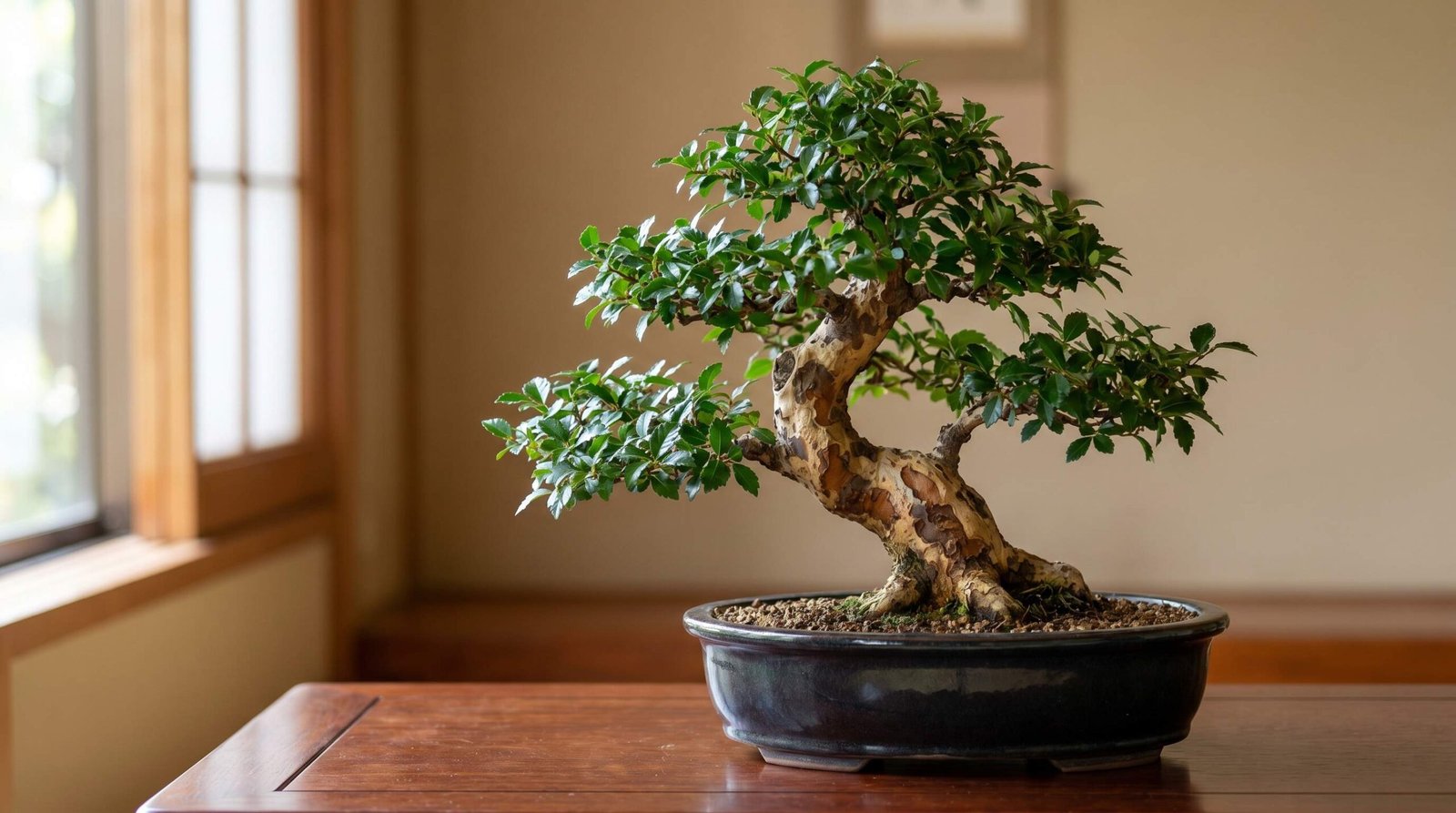
What Makes Chinese Elm a Great Beginner Bonsai
The botanical name is Ulmus parvifolia, in the family Ulmaceae. The species epithet parvifolia translates roughly to “small-leaved,” which hints at why this tree is so well suited to bonsai work. The naturally small leaves rarely need much encouragement to scale down further, and on a well-developed specimen they can reduce to less than half an inch across.
The natural range stretches across eastern Asia, from central and southern China through Korea and into Japan, with populations found in mixed forests, river valleys, and rocky hillsides. That broad range matters more than it sounds. A tree adapted to such varied conditions tends to handle the artificial micro-environments of bonsai cultivation with grace. Heat, mild drought, root confinement, and recovery from heavy pruning are all things Chinese elm shrugs off.
Beginner mistakes are inevitable, and Chinese elm is built to forgive them. Forget to water for a day in summer? The tree will wilt slightly and bounce back after a soak. Prune a little too aggressively in spring? It will respond with vigorous backbudding within weeks. Move it to a new location? Expect a brief sulk and then full adaptation. This combination of resilience, fast growth, and willingness to ramify makes it one of the few species we suggest for a true first bonsai.
Ramification deserves a closer look because it is where Chinese elm really shines. Ramification is the development of fine, dense twig structure. Every time you pinch a new shoot, the tree responds by pushing out two or more shoots from below the cut. Repeat that process across a few growing seasons and you build the cloud-like silhouette that classical Chinese elm bonsai are famous for.
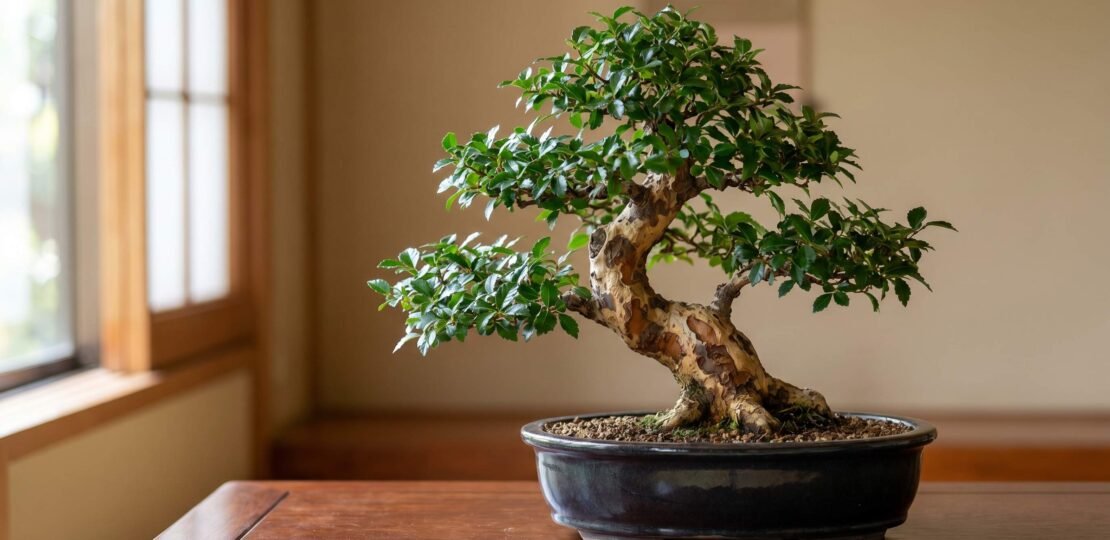
The bark is another distinctive feature. Mature Chinese elm develops what is called lace bark, where patches of grey-brown outer bark flake off in irregular plates to reveal lighter orange, cream, and pinkish tones beneath. The pattern is unique to each tree and only improves with age. Some cultivated varieties such as Seiju, Yatsubusa, and Hokkaido are prized for the speed and intensity at which they develop this character.
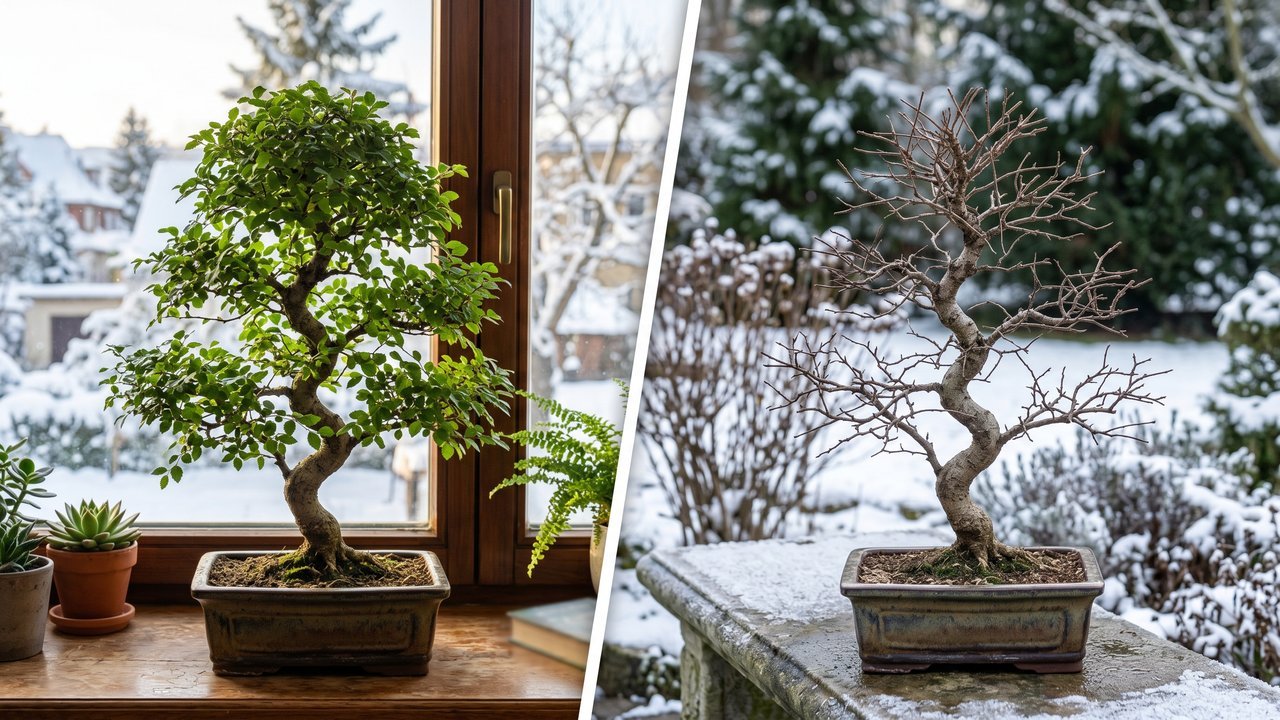
Then there is the semi-evergreen behaviour, which is where this species gets genuinely interesting and where most beginners get confused. Botanically, a semi-evergreen tree is one that can hold its leaves through mild winters but will drop them when temperatures fall low enough. Chinese elm sits squarely in this category, and the environment you provide determines which behaviour you see.
Kept indoors in stable household temperatures of roughly 65 to 75 degrees Fahrenheit, the tree never receives the temperature drop that signals winter dormancy. It continues producing leaves, may slow growth somewhat in the shorter daylight months, but stays visually evergreen. Move that same tree outdoors and expose it to a real autumn, and you will see leaves turn yellow and drop within a few weeks of the first cool nights. The tree is identical genetically. Only the environment changed.
There is also natural variation between individuals. Two seedlings from the same parent tree can express the semi-evergreen tendency differently. One might cling to its leaves stubbornly even outdoors in a mild climate. Another might begin shedding as soon as nights cool, regardless of where you keep it. This is normal genetic variation and not a sign of anything wrong with your particular tree.
For more on the underlying principles that apply across all species, our general bonsai care principles guide is a useful companion to this article.
Chinese Elm Bonsai Care at a Glance
| Care Factor | Requirement |
|---|---|
| Light | 4-6 hours of direct sun; full sun preferred outdoors |
| Watering | Water when top 1/2 inch of soil begins to dry |
| Fertilizing | Balanced NPK spring/summer; low-nitrogen autumn |
| Pruning | Pinch back in growing season; structural pruning late autumn |
| Repotting | Every 2-3 years (young trees), early spring |
| Temperature | USDA Hardiness Zones 4-9; protect below 15°F (-9°C) |
| Semi-evergreen | Keeps leaves indoors year-round; drops leaves outdoors in winter |
Placement: Indoor vs Outdoor
The Semi-Evergreen Behavior Explained
This is the single most misunderstood aspect of Chinese elm care, so it earns its own deep dive. Picture a Chinese elm sitting on a windowsill in a heated apartment. The temperature hovers around 70 degrees year-round. Daylight hours change with the seasons, but the temperature signal that normally triggers dormancy never arrives. Without that signal, the tree’s internal calendar stays stuck in growing mode. It produces leaves, holds them, replaces old ones gradually, and behaves for all practical purposes like an evergreen.
Now picture the same tree placed on an outdoor bench in October. Nighttime temperatures drop into the forties. The leaves register that drop through a complex hormonal response, chlorophyll breaks down, the abscission layer at the base of each leaf petiole begins to form, and within a few weeks the leaves yellow and fall. The tree is not dying. It is responding exactly the way an outdoor deciduous tree should respond.
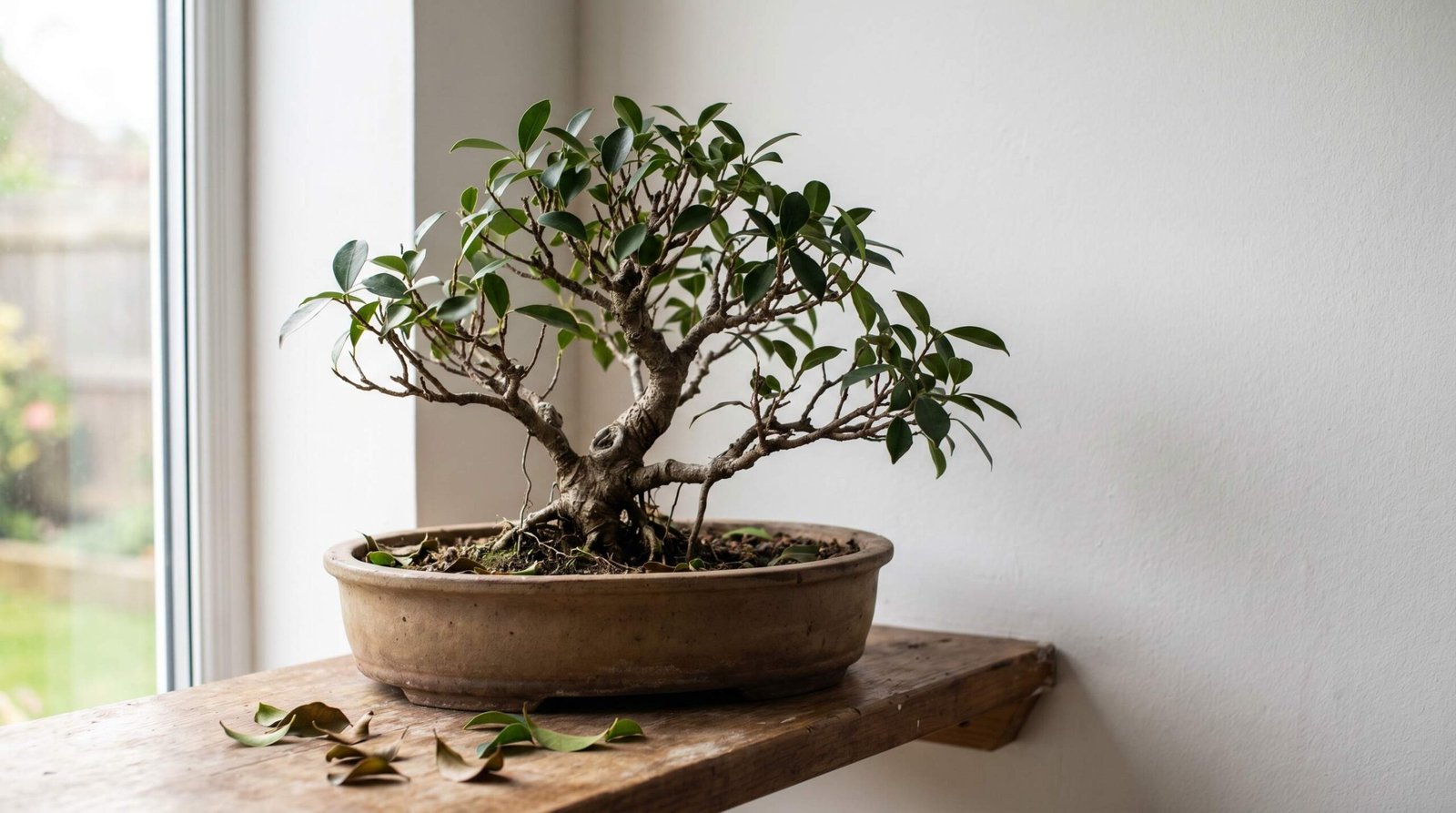
Normal leaf drop looks gradual. Leaves yellow or turn light brown over a period of one to three weeks, falling steadily rather than all at once. You can usually see it coming days in advance as the foliage takes on autumn colour. By midwinter the tree stands bare, the branch structure exposed, with healthy buds visible at the nodes ready to push out in spring.
Stress leaf drop is different and concerning. It happens fast, often within 48 to 72 hours, and the leaves are typically still green or only partially yellowed when they fall. Causes include a sudden temperature swing, a cold draft from an open window or door, severe over or underwatering, a sharp drop in humidity, or relocation to a much darker spot. If your tree drops most of its leaves in a few days while still appearing green, look at what changed in its environment over the previous week.
You can move a Chinese elm between indoor and outdoor environments, but do it gradually. A tree that has spent winter indoors should not be thrown onto a sunny bench in spring. Start in shade or dappled light for a week, then move to morning sun for a week, then to its summer position. Reverse the process in autumn before bringing it indoors so the temperature gradient is gentle. Sudden transitions are the number one cause of dramatic leaf drop in this species.
Some individual trees lean strongly evergreen and some lean strongly deciduous, and there is no way to predict this from looking at a young tree. If your Chinese elm consistently holds leaves through winter even when outdoors in a mild climate, that is just its personality. If another tree drops its leaves the moment temperatures dip below sixty, that is also normal. Both behaviours are healthy expressions of the species’ semi-evergreen nature.
Growing Chinese Elm Indoors
Indoor cultivation works well for Chinese elm, which is one of the few traditional bonsai species that genuinely tolerates household conditions. The key is bright light. A south-facing window is ideal in the Northern Hemisphere, with west-facing as a strong second choice. East-facing windows can work if the tree is positioned right at the glass. North-facing windows alone are not enough, and you will need to supplement with a grow light positioned 6 to 12 inches above the canopy for at least 10 to 12 hours per day.
Humidity around 40 to 50 percent suits Chinese elm well. Most homes sit in that range naturally, though winter heating can dry the air down to 20 percent or lower in cold climates. A humidity tray under the pot helps, as does grouping plants together. Misting is largely cosmetic and does little for sustained humidity, so do not rely on it.
Temperature stability matters more than the exact temperature. Avoid cold drafts from doors and windows, and keep the tree well away from heating vents, radiators, and fireplaces. A spot two feet back from a sunny window typically offers the best combination of light and protection from temperature extremes. If a window gets extremely cold at night in winter, move the tree slightly inward in the evening and return it to the glass in the morning.
Indoor trees do not require a winter dormancy period. This is a frequent point of debate among bonsai enthusiasts, but the practical reality is that Chinese elm kept warm year-round will continue to grow, ramify, and respond to training without ill effect. Growth slows in the shorter days of winter regardless of temperature, giving the tree a natural rest period even without a true cold dormancy.
Growing Chinese Elm Outdoors
Outdoors, Chinese elm reveals its full deciduous character and its remarkable cold tolerance. According to the University of Minnesota Urban Forestry Research, Chinese elm is cold-hardy in USDA Zones 4-9 and resistant to Dutch elm disease, which makes it one of the most adaptable elms available to growers in temperate climates. As a landscape tree it can shrug off winters that would kill many other ornamental species.
Summer placement should give the tree full sun in cooler climates and morning sun with afternoon shade in hot southern regions. Strong morning light through about 1 pm gives Chinese elm the energy it needs without the leaf scorch that can develop under intense afternoon sun in zones 8 and 9. A spot that catches a light breeze helps with both transpiration and pest control.
Winter protection becomes the central concern outdoors. Chinese elm can tolerate temperatures down to about 15 degrees Fahrenheit (-9 degrees Celsius) without trouble, but below that point the roots become vulnerable. The trunk and branches handle cold far better than roots confined in a shallow bonsai pot, because the soil mass is small and freezes through quickly. We suggest moving outdoor Chinese elms into an unheated garage, shed, or cold frame when overnight temperatures are forecast to drop below 15 degrees. The space should stay above 20 degrees but well below 50 to maintain dormancy.
Mulching the pot helps for trees that stay outside in marginal cold. Bury the pot in mulch up to the first branches, or sink the pot into a garden bed for the coldest months. Both approaches buffer the root mass against rapid temperature swings.
Spring transition is the mirror image of autumn protection. Do not rush the tree back outdoors. Wait until nighttime temperatures stay reliably above 40 degrees Fahrenheit (4 degrees Celsius), and even then move it out gradually over a week or two. A late frost on freshly emerging leaves can set the tree back significantly.
Watering Your Chinese Elm Bonsai
Watering is the single skill that separates thriving bonsai from struggling ones. The core rule for Chinese elm is simple: water when the top half inch of soil begins to dry, but do not let the pot dry out completely. Stick a finger or a wooden chopstick into the soil. If it comes out with damp particles clinging to it, wait. If it comes out clean and dry an inch down, water now.
Frequency varies dramatically by season, pot size, soil mix, and ambient conditions. A small Chinese elm in a shallow pot during a hot July afternoon may need water twice a day. The same tree indoors in February might go three days between waterings. Build the habit of checking daily rather than watering on a schedule. The soil tells you what the tree needs.
Watering technique matters as much as timing. Soak the soil thoroughly from above, ideally with a fine rose on a watering can or a gentle hose nozzle, until water drains freely from the holes in the bottom of the pot. Then wait a minute and water again to ensure even saturation. Shallow, partial waterings cause salts to accumulate and roots to grow toward the surface, both of which weaken the tree over time.
| Symptom | Cause |
|---|---|
| Yellowing leaves, mushy soil surface, no new growth | Overwatering |
| Crispy leaf edges, very lightweight pot, wilting shoots | Underwatering |
| Sour or moldy smell from the soil | Overwatering with poor drainage |
| Leaves curling inward and going dull | Early underwatering |
| Black spots on lower leaves, soft branches | Chronic overwatering, possible root rot |
If you want to go deeper on the topic, see our complete guide to watering bonsai for technique, timing, and water quality considerations across all common species.
Fertilizing Chinese Elm Bonsai
Bonsai live in remarkably small volumes of soil, and the nutrients that volume can hold are quickly used up by a vigorous tree like Chinese elm. Regular fertilizing is not optional. Without it, growth slows, leaves shrink and pale, and the ramification you are trying to build never quite materializes.
| Season | Fertilizer Type | N-P-K Target | Frequency |
|---|---|---|---|
| Spring | High nitrogen for vigorous shoot growth | 7-3-3 or similar | Every 2 weeks (liquid) or monthly (organic) |
| Summer | Balanced for sustained growth | 5-5-5 or 6-6-6 | Every 2 weeks (liquid) or monthly (organic) |
| Autumn | Low nitrogen, higher P and K for root development | 0-6-4 type | Every 3-4 weeks |
| Winter (indoors) | Half-strength balanced | 5-5-5 diluted | Once monthly |
Spring is the season where Chinese elm benefits most from a nitrogen push. New shoots want to extend, leaves want to expand, and the tree is hungry. A higher nitrogen ratio fuels that flush of growth and supports the ramification work you do with pinching. As temperatures peak in summer, shift to a balanced formula that keeps the tree fed without forcing leggy growth.
Autumn fertilizing is where many beginners go wrong by either stopping completely or continuing high nitrogen too long. Both are mistakes. The tree still wants nutrients heading into winter, but it wants phosphorus and potassium for root strength and cold hardiness, not nitrogen that will push tender new growth right before the cold sets in. A low-nitrogen autumn feed sets up a stronger spring.
Indoor trees that keep growing through winter benefit from a half-strength balanced feed once monthly to keep the foliage healthy. Outdoor trees in dormancy need no winter fertilizer at all.
For application, a balanced liquid fertilizer works fast and lets you adjust ratios easily across the seasons. slow-release organic pellets such as Biogold sit on the soil surface and feed continuously over several weeks, which suits the patient rhythm of bonsai care and reduces the risk of overfeeding. Many growers use both: organic pellets as the steady baseline and liquid as a targeted boost when the tree shows hunger.
Pruning Chinese Elm Bonsai
Maintenance Pruning (Pinching)
Maintenance pruning is what builds the famous Chinese elm ramification. The rule is straightforward: once a new shoot has grown 3 to 4 leaves, cut or pinch it back to 1 or 2 leaves. The tree responds by pushing two or more new shoots from below the cut, each of which you treat the same way once it extends. Over a single growing season this process can double or triple the twig density of a young tree.
Use clean, sharp scissors for this work. Tearing the shoot rather than cutting it cleanly causes dieback at the wound and slows healing. We suggest pinching with your fingernails only on very soft new growth; once the stem has firmed even slightly, switch to scissors.
Chinese elm is famously forgiving here. If you trim too aggressively in spring, the tree will simply respond with more vigorous backbudding. If you miss a few shoots and they extend to 8 or 10 leaves, you can still cut them back hard and the tree will bud again from older wood. Few species are this generous with new growth, which is part of why Chinese elm is recommended for learning fundamental pruning skills.
Structural Pruning
Structural pruning removes whole branches to shape the tree’s silhouette and refine its design. The best time for this work is late autumn after the outdoor tree has dropped its leaves, because you can see the entire branch structure clearly without foliage obscuring the lines.
For indoor trees that keep their leaves year-round, late autumn through early winter still works well, because the tree slows its growth rate during the shorter daylight months and tolerates major cuts better than during peak summer growth. You may need to clip away leaves around the area you are working on to see the branches clearly.
Look for and remove crossing branches, branches growing back toward the trunk, branches growing straight up or straight down from a main branch, and any branch that breaks the silhouette you are working toward. Cut close to the next branch junction or to the trunk, never leaving a stub.
For larger cuts, sharp concave branch cutters create a slight depression in the wood that heals flush rather than leaving a raised scar. This matters especially on Chinese elm because the bark is decorative and a poorly healed cut can mar the visual for years. Seal larger wounds with a bonsai cut paste if you want to speed healing and reduce dieback.
Our step-by-step pruning guide covers technique in more detail with diagrams and species-specific notes.
Repotting Chinese Elm Bonsai
When to Repot
Young Chinese elms under 10 years old need repotting every 2 to 3 years. The roots grow fast in this species, and a young tree can fill its pot with a dense root mass that strangles itself if left too long. Established trees over 10 years can usually go 3 to 5 years between repottings, as their growth rate slows and root expansion follows suit.
Early spring is the right time, specifically the window just before the buds begin to swell but after the worst of winter cold has passed. This timing lets the tree pour its energy into root regeneration just as growth is about to begin, so recovery is fast and the tree barely registers the disturbance.
Signs that repotting is overdue include roots circling the inside of the pot or growing out the drainage holes, water draining very slowly during watering, the tree drying out unusually fast between waterings, and visibly stunted spring growth despite proper feeding. If you tip the tree out of the pot and the rootball holds the pot’s shape like a solid plug, it needs work.
Best Soil Mix for Chinese Elm
Drainage is everything for Chinese elm. The species tolerates a wide range of conditions in the ground, but in the confined volume of a bonsai pot the margin for error is narrow. Waterlogged soil leads quickly to root rot, while overly dry soil can be hard to rewet. The solution is a mostly inorganic mix that drains fast, holds moisture in the particles themselves, and resists compaction.
For outdoor Chinese elms, we suggest a mix of 40 percent akadama, 40 percent pumice, and 20 percent lava rock. This blend drains quickly, which is exactly what you want for a tree sitting in the rain. The akadama holds moisture, the pumice provides air space, and the lava rock contributes long-term structure that resists breaking down.
For indoor trees in slower-drying environments, shift to 50 percent akadama, 30 percent pumice, and 20 percent lava rock. The extra akadama provides a bit more water retention to match the gentler indoor evaporation rate.
Each component has a specific role. Akadama is a fired Japanese clay that absorbs water into its particle structure while leaving air pockets between particles, giving you both retention and aeration in one ingredient. Pumice is a porous volcanic stone that drains freely and adds aeration, with modest water retention. Lava rock is a denser volcanic material that drains well, resists breakdown for many years, and gives the mix the structural integrity to stay open over time.
As noted in UF IFAS publication ST652, Chinese elm is adaptable to a wide range of soil conditions, which means the species tolerates various mixes in the ground. The inorganic bonsai mix described above gives you precise control over drainage in the much smaller world of a bonsai pot, where any deviation toward waterlogging causes problems quickly.
Quality matters when sourcing components. akadama for bonsai soil is the foundation, and cheap substitutes tend to break down within a year, defeating the purpose. Pumice and lava rock are more forgiving, but consistent particle size of 2 to 5 millimetres gives the best balance for trees in the 6 to 18 inch range. For a step-by-step walkthrough of the repotting process itself, our repotting guide covers root work, pot selection, and recovery care.
Wiring Chinese Elm Bonsai
Chinese elm takes wire well. The branches are flexible when young, hold the position you set after a few months under wire, and respond to the bends with new growth that fills out the shape. The clip-and-grow method also suits this species beautifully, and many practitioners use both techniques in combination depending on the branch in question.
Late autumn after leaf drop is the prime wiring window for outdoor trees, because you can see every branch and twig clearly with no foliage in the way. For indoor trees, choose a period of slower growth in late autumn or early winter when the wire is less likely to bite into rapidly expanding bark.
Aluminum wire in 1.5 to 3 millimetre gauges covers most of what you will do on a Chinese elm. Use the thinner gauges for fine twigs and the heavier gauges for primary and secondary branches. Copper wire holds bends more reliably but is harder to work with for beginners, so we suggest starting with aluminum until your technique is consistent.
Chinese elm grows fast, and that growth is the main risk with wire. The branches thicken quickly during the growing season, and a wire left too long will press into the soft new bark and leave permanent scars. Check wired branches weekly during spring and summer. Remove the wire as soon as you see the spiral pattern starting to mark the bark, even if you do not feel the bend has fully set. A scarred branch is far worse than rewiring a branch that has not quite held its shape.
The clip-and-grow method offers an alternative or complement to wiring. Instead of bending a branch with wire, you prune to a bud that points in the direction you want the new growth to go. The new shoot extends from that bud in the desired direction, you let it thicken, then prune again to redirect growth further. This approach is slower than wiring but creates more natural, less mechanical-looking taper and movement. Chinese elm responds well because of its strong back-budding tendency.
For a thorough walkthrough of wiring fundamentals, see our beginner wiring guide. If you are building out a kit, our essential bonsai tools roundup covers the minimum set you need to handle pruning, wiring, and repotting on Chinese elm and similar species.
Common Chinese Elm Problems
Leaf Drop and Yellowing
Normal indoor leaf drop is minor and cyclical. Old leaves yellow individually, fall, and are replaced by new ones throughout the year. Expect to find a few yellow leaves in the canopy or on the soil surface every couple of weeks. This is the tree refreshing its foliage, nothing more.
Stress leaf drop is sudden and dramatic. The tree sheds a substantial portion of its leaves within a few days, often with the leaves still green or only partially yellowed. The cause is almost always a sharp environmental change in the previous week or so. Look for temperature swings, a new location, a draft you did not notice, a forgotten watering, or a sudden hot dry stretch from a furnace kicking on.
| Symptom | Likely Cause | What To Do |
|---|---|---|
| Sudden mass leaf drop, leaves still green | Cold draft, sudden temperature change, or relocation shock | Stabilize location and temperature, do not overwater. New leaves will push within 3-6 weeks. |
| Gradual yellowing, lower leaves first | Overwatering or poor drainage | Let soil dry more between waterings; check pot drainage holes for blockage. |
| Crispy brown edges on otherwise green leaves | Underwatering or very low humidity | Increase watering frequency; add a humidity tray indoors. |
| Pale leaves, weak new growth | Insufficient light or nutrient deficiency | Move closer to light source or add grow light; resume regular feeding. |
| Sticky leaves, distorted new shoots | Aphid infestation | Rinse foliage with water spray; treat with insecticidal soap. |
| Outdoor tree losing leaves in autumn | Normal dormancy response | Nothing required. Buds will push in spring. |
Pests and Diseases
Spider mites are the most common indoor pest. Look for fine webbing in branch crotches and a stippled bronze look on the upper leaf surfaces. They thrive in dry indoor air. Treat by rinsing the entire canopy with a stiff water spray every few days for a week, then apply insecticidal soap to both upper and lower leaf surfaces. Increasing humidity around the tree discourages return.
Scale insects appear as small brown or tan bumps along branches and the undersides of leaves. They are mobile only as juveniles, then settle and form their protective shell. Treat by dabbing each scale with a cotton swab dipped in rubbing alcohol to dissolve the protective coating, then apply a systemic insecticide drench to the soil to kill any survivors and reach the next generation.
Aphids cluster on tender new growth, leaving a sticky residue called honeydew and causing leaves to curl and distort. They are easily managed. Knock them off with a strong water spray, then follow up with insecticidal soap to deal with any that remain. Repeat applications a week apart usually resolve the issue.
Elm leaf beetle affects outdoor trees in some regions, chewing characteristic notches into the leaf edges. The damage is generally cosmetic on bonsai-scale trees and easily managed by hand-picking or with a light application of neem oil or insecticidal soap. A healthy tree shrugs off mild infestations.
The bigger disease story for Chinese elm is what it does not get. The species is notably resistant to Dutch elm disease, the fungal disease that devastated American elm populations across North America through the twentieth century. The University of Minnesota highlights this resistance specifically when discussing why Chinese elm has become so widely planted as a replacement for the lost American elms. For bonsai purposes it means you do not need to worry about the most serious disease that affects the elm family.
Frequently Asked Questions
Is Chinese elm bonsai indoor or outdoor?
Chinese elm bonsai can be grown indoors or outdoors successfully, which is one of the species’ main advantages. Outdoors it behaves like a deciduous tree, dropping leaves in autumn and going dormant through winter. Indoors it stays leafy year-round because the stable temperature never triggers dormancy. We suggest outdoor growing during the warmer months if your climate allows, with optional indoor placement in winter or year-round.
How often should I water my Chinese elm bonsai?
Water when the top half inch of soil begins to dry, which usually means daily during summer and every two to four days in cooler months. Frequency depends heavily on pot size, soil mix, temperature, and humidity, so check the soil rather than following a strict schedule. Always water thoroughly until water drains from the bottom of the pot, never give shallow sips.
Why is my Chinese elm bonsai dropping leaves?
Gradual leaf drop in autumn on an outdoor tree is normal dormancy and nothing to worry about. Sudden mass leaf drop indoors usually points to a sharp environmental change such as a cold draft, a relocation, a temperature swing, or major over or underwatering. If most leaves fall within a few days while still green, look at what changed in the tree’s environment over the previous week.
When should I repot my Chinese elm bonsai?
Repot young Chinese elms every 2 to 3 years and established trees every 3 to 5 years, always in early spring just before the buds swell. Signs that repotting is overdue include roots circling the pot, water draining very slowly, and the tree drying out unusually fast between waterings. Spring timing lets the tree pour energy into root regeneration just as the growing season begins.
Why is my Chinese elm bonsai losing leaves in winter?
An outdoor Chinese elm losing leaves in winter is showing perfectly normal deciduous behaviour. The cool autumn temperatures trigger dormancy, and the tree sheds its leaves the way any temperate deciduous tree would. New buds will push in spring. An indoor tree losing leaves in winter is different and usually points to a cold draft, a heating vent drying the air, or another environmental stressor that needs identifying.
How do you prune a Chinese elm bonsai?
For maintenance, pinch or cut new shoots back to 1 or 2 leaves once they have grown 3 to 4 leaves, which builds the fine ramification this species is known for. For structural work, prune in late autumn after leaf drop when the branch structure is fully visible. Use sharp scissors for soft growth and concave branch cutters for larger cuts, and remove any crossing, inward-growing, or design-disrupting branches.
What soil mix is best for Chinese elm bonsai?
A free-draining inorganic mix works best, typically 40 percent akadama, 40 percent pumice, and 20 percent lava rock for outdoor trees. Indoor trees can shift toward 50 percent akadama, 30 percent pumice, and 20 percent lava rock to allow a touch more water retention. The mix should drain freely within seconds when you water, holding moisture in the particles themselves rather than as standing water in the pot.
How much sunlight does a Chinese elm bonsai need?
Chinese elm needs 4 to 6 hours of direct sunlight daily as a minimum. Outdoors it tolerates full sun in cooler climates and benefits from afternoon shade in zones 8 and 9. Indoors it does best on a south or west-facing windowsill, with a supplemental grow light if your natural light is limited. Insufficient light leads to pale leaves, leggy growth, and weak ramification.