Why Are My Bonsai Tree Leaves Turning Yellow? (7 Causes and Fixes)
This post may contain affiliate links. If you buy through our links, we may earn a commission at no extra cost to you.
Quick answer: Bonsai tree leaves turn yellow most often because of overwatering, which suffocates the roots and triggers chlorosis. Other common causes include underwatering, low light, nutrient deficiencies (especially nitrogen and iron), root-bound soil, pests like spider mites, and environmental stress from drafts or sudden location changes. The fix depends on the cause, so diagnose before treating.
Yellow leaves on a bonsai are a warning light, not a death sentence. We’ve seen thousands of bonsai owners panic over a few yellow leaves only to discover the tree was simply thirsty, hungry, or stressed. The trick is reading the pattern of yellowing correctly, then matching the fix to the cause. This guide walks through every realistic reason your bonsai leaves are turning yellow, how to confirm what’s actually wrong, and exactly what to do about it. For a broader foundation on keeping a bonsai healthy in the first place, Virginia Tech’s bonsai care guidelines are an excellent reference to bookmark alongside this troubleshooting guide.
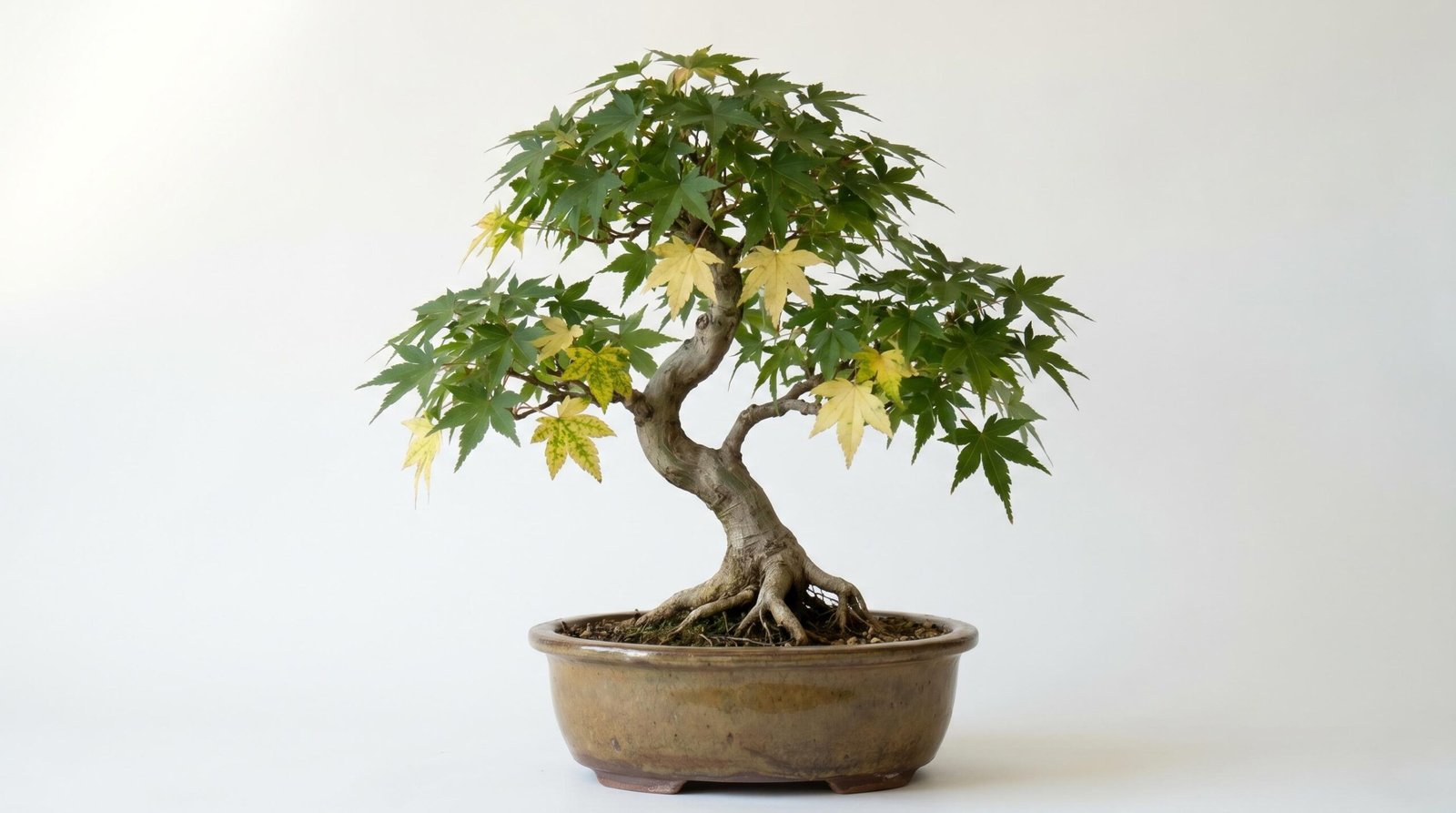
Is Bonsai Leaf Yellowing Normal?
Sometimes yes, sometimes no. The first question to ask is whether your species and the time of year explain the color change.
When Yellowing Is Normal (and Expected)
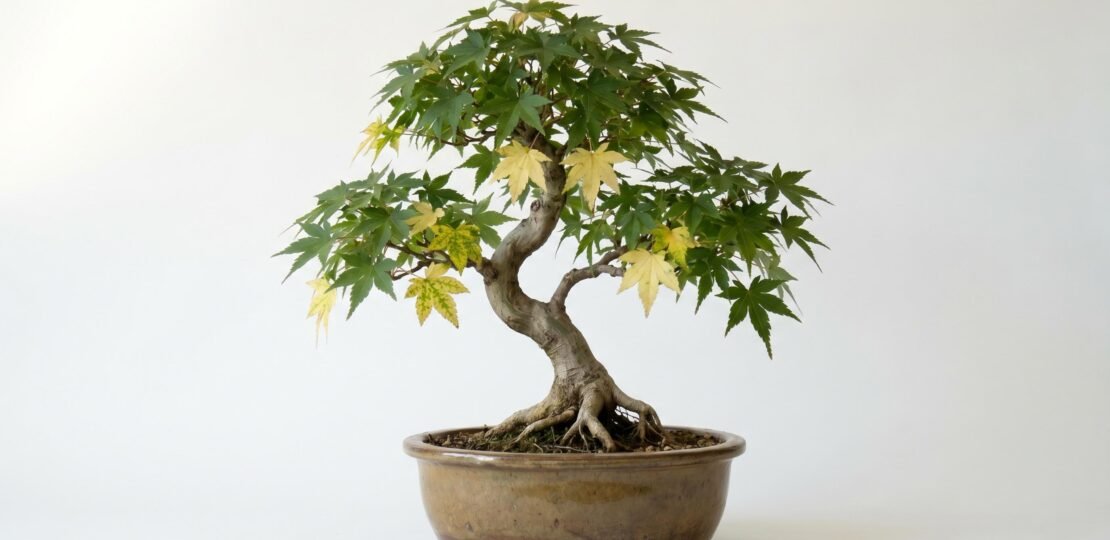
Deciduous bonsai species shed their leaves every autumn. Japanese maples, Chinese elms grown outdoors in cold climates, trident maples, Japanese larch, ginkgo, and beech all turn yellow, orange, or red before dropping their leaves between October and December in the northern hemisphere. This is healthy seasonal behavior, not a problem. If your maple is glowing gold in November, take a photo. Don’t reach for the fertilizer.
Some evergreen species also change color in winter. Junipers, particularly procumbens and shimpaku, often shift to a bronze or purple-yellow tint when temperatures drop below freezing. The foliage greens back up in spring. This bronzing is a cold-acclimation response, not damage.
When Yellowing Is a Problem
Yellowing becomes concerning when it happens in summer, when it appears suddenly over days rather than weeks, or when it shows up on a species that should be holding green leaves. Tropical bonsai like ficus, jade, and Brazilian rain tree should stay green year-round indoors. Yellowing in those species almost always points to a husbandry issue.
A few species-specific notes worth filing away. Ficus is notorious for dropping yellow leaves whenever it gets moved, even just a few feet. The tree is reading the change in light angle as a seasonal shift and recalibrating. Junipers, despite the winter bronze tint, should never go yellow in summer. Pines yellow internally as old needles age out, typically two-to-three-year-old needles in autumn. That inner yellowing is normal. Outer-needle yellowing on a pine is not.
Diagnosing the Cause: What Your Leaves Are Telling You
The pattern of yellowing is your fastest diagnostic clue. Before you change anything, look at the tree and ask which of the patterns below matches. Use this table as a starting point, then dig into the specific cause section below for confirmation and treatment.
| Symptom | Most Likely Cause | Urgency | Fix |
|---|---|---|---|
| All leaves yellowing at once | Severe overwatering, root rot, or sudden environmental shock | High | Check roots immediately, repot if rotten, stabilize environment |
| Older or inner leaves yellow first | Nitrogen deficiency or natural leaf turnover | Low to medium | Apply balanced fertilizer during growing season |
| Yellow tips and crispy edges | Underwatering or salt buildup from tap water | Medium | Water more consistently, flush soil with rainwater or distilled water |
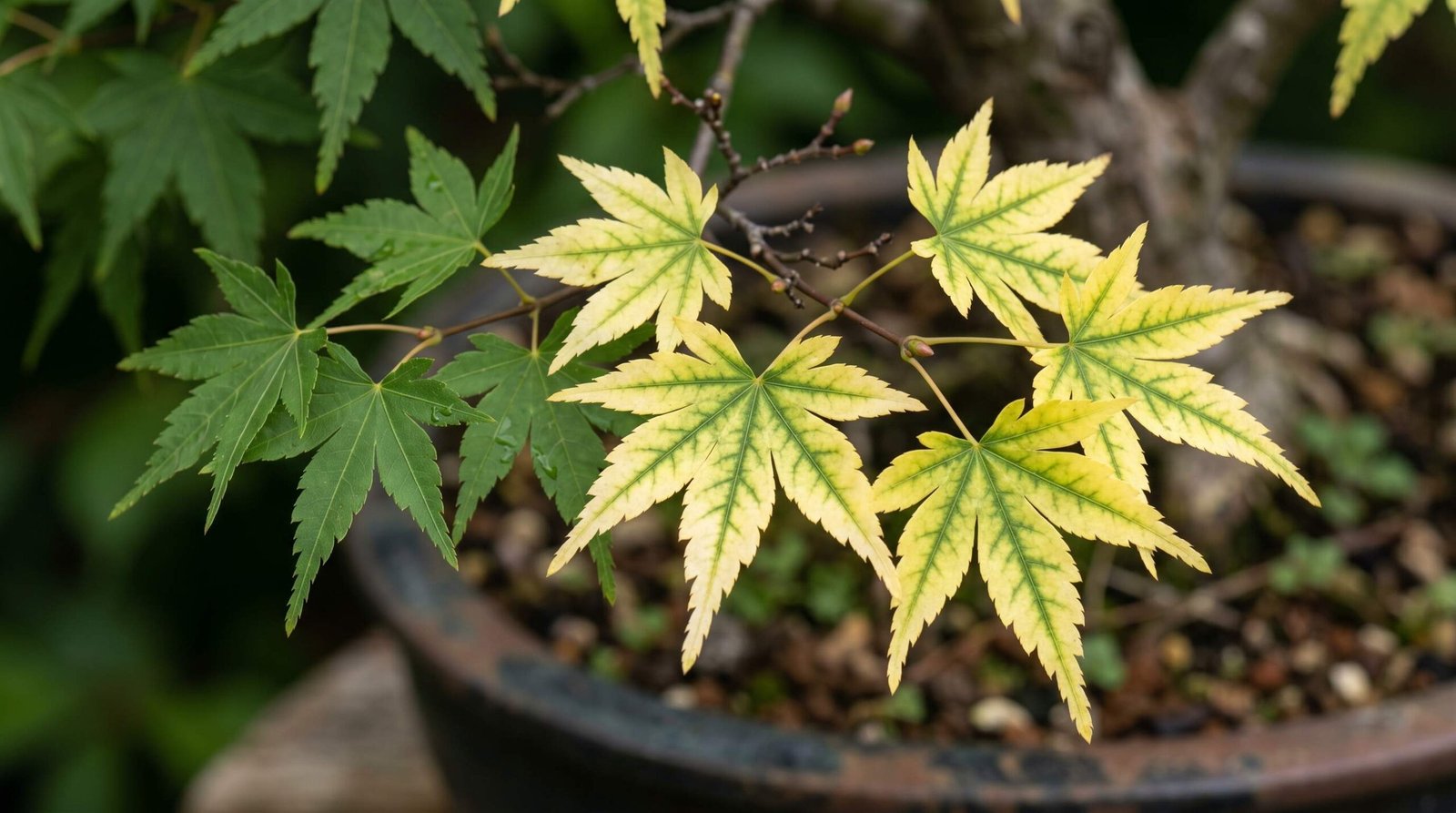
| New growth yellow, veins still green | Iron deficiency (chlorosis), high soil pH | Medium | Apply iron chelate, check soil pH, repot in fresh substrate |
| Yellow with tiny spots or stippling | Spider mites or other sap-sucking pests | High | Treat with neem oil or insecticidal soap, isolate the tree |
| Yellow leaves dropping rapidly | Environmental shock (commonly ficus) or root damage | Medium to high | Return tree to stable location, reduce watering, wait it out |
| Yellow despite correct watering | Light deficiency, pest pressure, or root-bound pot | Medium | Move closer to light source, inspect roots, repot if needed |
Cause 1: Overwatering (The Most Common Culprit)
Overwatering kills more bonsai than every other cause combined. If your tree is yellowing and you’re watering on a fixed schedule (every two days, every Tuesday, etc.), this is almost certainly your problem.
How to Identify Overwatering
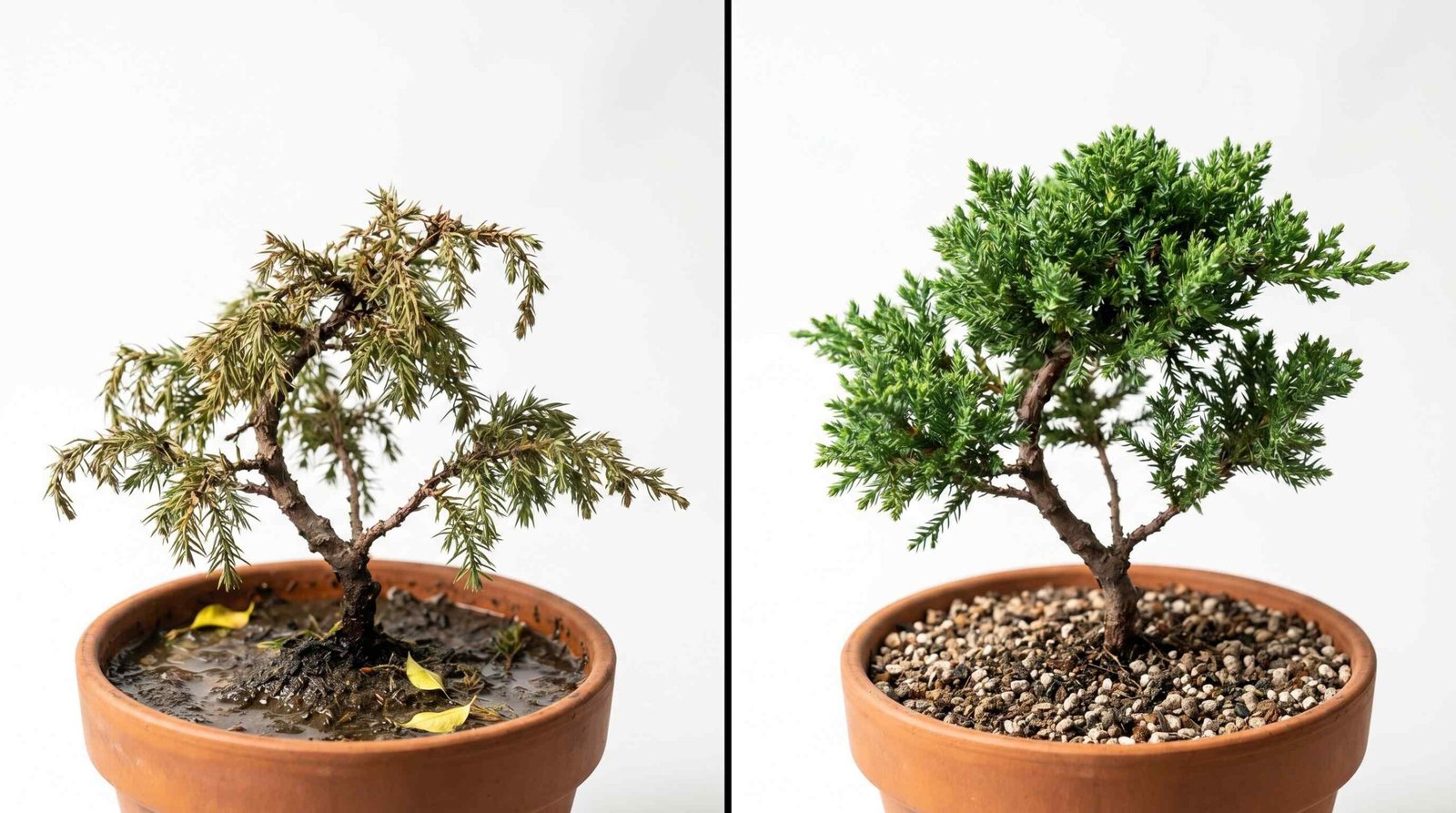
The soil stays soggy for days after watering. The pot feels heavy when lifted. Moss on the surface looks slimy or has algae growth. If you tip the tree gently out of the pot, the roots are grey, brown, or black instead of healthy creamy white. A sour or sulfurous smell coming from the soil is a confirmed red flag. The leaves themselves often yellow uniformly across the canopy and feel limp rather than crispy.
Why It Happens
Beginners are taught to keep plants moist, and that advice carries over from houseplant care. Bonsai pots are shallow, and the soil should be a fast-draining mix of inorganic granules, not standard potting soil. When standard potting soil is used (or when the pot drains poorly), water sits in the root zone, oxygen gets pushed out, and the roots suffocate. Suffocated roots can’t take up water or nutrients, so the leaves yellow even though the soil is soaking wet. This is the cruel irony of overwatering: the symptoms can look like drought.
The Fix
Stop watering immediately and let the soil dry until the top inch is bone dry to the touch. Then water thoroughly until it runs out of the drainage holes, and wait again. We suggest checking moisture with a wooden chopstick pushed two inches into the soil; if it comes out damp, do not water. If the roots are already rotting, you’ll need to slip the tree out of the pot, cut away any black or mushy roots with sterilized scissors, and repot into a fresh well-draining substrate. Replacing the soil entirely with a proper akadama, pumice, and lava rock mix gives the remaining healthy roots a chance to recover. For the full method, our guide on watering your bonsai correctly covers the chopstick test, the bottom-watering method, and how to read each species’ specific thirst signals.
Recovery Timeline
Mild overwatering with no root damage clears up in two to four weeks. The yellow leaves themselves will not turn green again, but new growth will come in healthy. Root rot is a months-long recovery, and roughly a third of bonsai with advanced root rot don’t survive. The earlier you catch it, the better the odds.
Cause 2: Underwatering
Underwatering is the opposite extreme and produces a noticeably different yellowing pattern. The leaves yellow at the tips and edges first, then progress inward. The texture goes crispy rather than limp. The soil pulls away from the sides of the pot, and the pot feels light when lifted.
How to Identify Underwatering
Push your finger into the soil. If it’s bone dry more than half an inch down and the tree is in active growth, you’ve been watering too little or too infrequently. Some bonsai owners assume their tree is fine because the surface looks damp, but a fast-draining bonsai soil dries from the bottom up in some pot shapes. Always check below the surface.
The Fix
For acute drought, use the soak method. Submerge the entire pot in a basin of room-temperature water up to the soil line and leave it for ten to fifteen minutes. Bubbles will rise as air is displaced from the substrate. Pull the pot out, let it drain, and return the tree to its normal spot. Going forward, check the tree daily and water when the top inch reads dry rather than waiting a set number of days.
Recovery Timeline
Mild underwatering reverses in one to two weeks if caught before the foliage crisps completely. Severely dehydrated bonsai with widespread crispy leaves may shed those leaves and push new ones in the next flush, which can take a full growing season to look normal again.
Cause 3: Insufficient Light
Indoor bonsai are almost always under-lit. A spot that feels bright to your eye is dimmer than full sun by a factor of ten or more. Tropical species like ficus, jade, and Brazilian rain tree need the brightest window in the house, ideally a south-facing window in the northern hemisphere or a north-facing window in the southern hemisphere.
How to Identify Light Deficiency
The yellowing here is pale and weak rather than the deep yellow of nutrient issues. New leaves come in small, spaced far apart on the stem (leggy growth), and the entire canopy looks washed out. Branches reach toward the nearest light source. Internodes (the distance between leaves on a stem) get longer over time. The tree feels alive but never seems to thrive.
The Fix
Move the tree to your brightest window. If natural light isn’t available, a full-spectrum LED grow light positioned six to twelve inches above the canopy on a fourteen-hour daily timer solves the problem cleanly. Outdoor species should not be kept indoors year-round under any circumstance; junipers, pines, and maples need outdoor light and seasonal temperature cycles to stay alive.
Recovery Timeline
Three to six weeks to see new growth coming in with healthy color and tight internodes. Existing yellow leaves typically don’t recover, but the new flush will look noticeably different.
Cause 4: Nutrient Deficiency (Nitrogen and Iron)
Bonsai soils are largely inorganic and hold few nutrients on their own. The tree gets its food from what you feed it, so a bonsai that hasn’t been fertilized in months will eventually yellow as it exhausts its reserves.
Nitrogen Deficiency
Nitrogen deficiency shows up first in older leaves. The tree pulls nitrogen out of mature foliage to feed new growth, so the inner and lower leaves yellow uniformly while the new tips stay green. Growth slows, internodes shorten, and the tree looks pale overall. This pattern is the textbook signal for general fertilization needs.
Iron Deficiency (Chlorosis)
Iron deficiency is the opposite pattern, and it’s a critical distinction. New growth yellows first while the veins stay distinctly green, producing a green-vein-on-yellow-leaf appearance called interveinal chlorosis. This usually points to high soil pH locking iron out of solution rather than a literal absence of iron in the soil. Colorado State University’s resource on iron chlorosis in woody plants goes into the soil chemistry in detail and is worth reading if you keep maples, azaleas, or any acid-loving species.
The Fix
For nitrogen deficiency, apply a balanced NPK bonsai fertilizer at half strength every two weeks during the growing season (roughly April through September in the northern hemisphere). Stop fertilizing dormant or stressed trees; feeding a sick bonsai makes things worse, not better. For iron chlorosis, drench the soil with chelated iron (Fe-EDDHA works best at higher pH) and consider repotting into a more acidic mix if the issue keeps recurring. Our bonsai fertilizer guide walks through the seasonal feeding schedule, organic vs synthetic options, and which formulations work best for which species.
Recovery Timeline
You’ll see new growth coming in with proper color within two to four weeks of correcting the deficiency. Older yellow leaves typically don’t re-green, even after the underlying issue is solved.
Cause 5: Root-Bound or Compacted Soil
A bonsai that hasn’t been repotted in years eventually fills its pot with roots, leaving no room for water or air. Compacted soil produces similar symptoms: the surface looks crusted, water runs straight through without soaking in, and growth slows to a crawl. Yellowing in this case is the downstream effect of a root system that can no longer feed the canopy.
How to Identify
Tip the tree gently out of its pot and look at the root mass. If you see roots circling the inside of the pot, packed tightly with little soil visible, or a solid disc of roots at the bottom, the tree is root-bound. If watering produces an immediate runoff from the drainage holes (with the soil staying dry on top), the substrate has become hydrophobic from compaction or breakdown.
The Fix
Repot during the appropriate season for your species, typically early spring just before bud break for deciduous trees and tropical species, or autumn for some pines and junipers. Comb out the root ball with a root rake, prune away one-third of the roots from the bottom and outer edges, and replant in fresh substrate. The frequency depends on species and age: young vigorous trees may need repotting every one-to-two years, while mature collected specimens can go three-to-five years between repots. Our walkthrough on how to repot a bonsai covers timing, tools, and root-pruning ratios for each common species.
Substrate quality matters as much as repotting frequency. Garden soil, potting soil, and “bonsai” soil from big-box stores are usually too fine and hold too much water. A proper mix is granular and airy. For a primer on what to use and why, see our reference on well-draining bonsai soil and how the right particle size keeps roots oxygenated.
Recovery Timeline
Allow four to eight weeks for the tree to settle after repotting. Avoid fertilizing for at least three weeks post-repot, and keep the tree in dappled shade for the first two weeks while the disturbed roots recover.
Cause 6: Pests
Sap-sucking pests pull nutrients and chlorophyll straight out of leaves, causing yellowing that often looks speckled, mottled, or patchy rather than uniform. Pest pressure is also seasonal and can flare up suddenly, so a tree that was fine last month can turn yellow within days.
Common Bonsai Pests
Spider mites. The most common culprit on indoor and outdoor bonsai. They produce yellow stippling (tiny pinprick dots) all over the leaves, and you’ll often find fine webbing in branch crotches or under leaves. Tap a yellowing branch over a sheet of white paper; if you see tiny moving specks the size of pepper grains, you’ve confirmed spider mites.
Aphids. Soft-bodied green, black, or pink insects that cluster on new growth. They leave sticky honeydew on leaves, which can develop black sooty mold. Leaves curl, yellow, and stunt. Aphids hit junipers, elms, and maples especially hard in spring.
Scale insects. Brown or tan armored bumps on stems and the undersides of leaves. They don’t move and look almost like part of the bark. Heavy scale infestations cause uniform yellowing and slow decline.
Mealybugs. White cottony tufts in leaf joints and along stems. They favor tropical bonsai, especially ficus and jade indoors.
The Fix
Isolate the affected tree from other bonsai immediately. Spray the entire canopy (top and underside of leaves, plus branches) with neem oil diluted per label instructions, or use insecticidal soap. Repeat every five to seven days for three rounds to break the life cycle. For scale, you may need to physically scrape the bumps off with a soft toothbrush before spraying. Spider mites thrive in dry indoor air, so misting the foliage daily during winter heating season helps prevent reinfestation.
Watch for secondary problems too. Pest-stressed trees with weakened root systems can pick up fungal root rot, which is its own separate concern. Penn State Extension’s resource on root rot and fungal treatment covers when chemical fungicides are appropriate and how to apply them safely.
Recovery Timeline
Pest populations drop within one to two weeks of consistent treatment. New growth comes in clean. Existing damaged leaves stay damaged but will be shed in the next flush.
Cause 7: Environmental Stress
Bonsai are sensitive to environmental change in ways that surprise new owners. Moving a tree from one window to another, switching it from outdoors to indoors at the end of summer, or placing it near a heating vent can all trigger yellowing and leaf drop.
The Usual Suspects
Drafts from air conditioning vents, heating registers, or frequently opened doors dry out foliage and shock the tree. A sudden temperature swing of fifteen degrees or more can cause leaf drop within seventy-two hours. Low humidity from indoor heating in winter (often below twenty percent) stresses tropical species particularly hard.
Ficus deserves special attention here because it’s by far the most sensitive species to location changes. Moving a ficus from one room to another, or even rotating it ninety degrees, can trigger a wave of yellow leaves within a week. The tree isn’t dying; it’s recalibrating to the new light angle. For more on managing this species’ quirks, our ficus bonsai care guide covers location stability, humidity, and seasonal transitions in detail.
The Fix
Pick a location and leave the tree alone. Avoid moving it more than a few feet for the first month after acquisition, and never place a bonsai directly above a heating vent, beneath an AC vent, or against a frequently opened exterior door. If you must move a tree from outdoors to indoors at the end of summer, do it gradually over a two-week window by bringing it inside for a few hours each day, increasing the duration daily until the tree is fully indoors. The same applies in reverse in spring.
Recovery Timeline
Environmental stress recovery is usually quick once conditions stabilize. Expect a week or two of leaf drop followed by new growth. Ficus often pushes new leaves within ten days of settling into a stable spot.
How to Revive a Yellowing Bonsai: Step-by-Step
If you’re staring at a yellowing bonsai right now and not sure where to start, work through these five steps in order. Diagnose before treating, and resist the urge to do everything at once.
Step 1: Check the Soil and Roots
Push a wooden chopstick or your finger two inches into the soil. Is it soggy, dry, or damp? Soggy soil with a sour smell points to overwatering. Bone-dry soil pulling away from the pot edges points to underwatering. If neither is obviously the case, gently tip the tree out of the pot and inspect the roots. White or cream-colored roots are healthy; grey, black, or mushy roots indicate rot.
Step 2: Assess the Light
How many hours of direct or bright indirect light does the tree receive daily? Tropical bonsai indoors need a minimum of six hours of bright light. Outdoor species need full sun for most of the day. If your tree is in a dim corner or back from the window, light is likely part of the problem.
Step 3: Inspect for Pests
Look at the undersides of leaves, branch crotches, and new growth tips. Use a magnifying glass if you have one. Tap branches over white paper and watch for movement. Check for sticky residue, webbing, or unusual bumps.
Step 4: Review Recent Changes
Has the tree been moved? Did you start using a different fertilizer? Has the weather changed dramatically? Is there a new draft source nearby? Environmental causes are easy to overlook because they don’t leave physical evidence.
Step 5: Apply the Single Most Likely Fix
Choose the cause that best matches your symptoms and apply that fix only. Don’t water more and fertilize more and move the tree and spray pesticides all at once; you’ll never know what worked, and most of those changes will make things worse if they weren’t the actual problem. Give the single fix two to three weeks before judging results.
When to Give Up
Not every yellowing bonsai can be saved. If the trunk wood is soft, brittle, or peels away with a fingernail, the tree is dead. If the cambium layer just under the bark is brown or grey instead of green, the tree is dying or dead. Advanced root rot with no remaining healthy roots is generally terminal. We’ve watched experienced growers nurse trees back from astonishing levels of damage, but a tree with no living roots and brown cambium is a tree that’s gone. At that point, the kindest thing is to start over with a new specimen and apply the lessons learned.
Frequently Asked Questions
Q: How long does it take a yellowing bonsai to recover?
A: Recovery time depends on the cause. Mild overwatering or underwatering clears up in one to four weeks. Pest infestations resolve in two to three weeks of treatment. Light deficiencies show new healthy growth within three to six weeks. Root rot can take months, and severe cases may not recover at all. The yellow leaves themselves usually do not turn green again; recovery shows up in new growth coming in with healthy color.
Q: Will yellow bonsai leaves turn green again?
A: Almost never. Once a leaf has yellowed, the chlorophyll is gone and the leaf is on its way to being shed. What you want to see is new growth coming in green and healthy. If new leaves are also yellow, the underlying problem hasn’t been fixed yet.
Q: Why is my bonsai yellowing in winter?
A: For deciduous species like maples and elms, autumn and early winter yellowing is normal seasonal behavior before leaf drop. For tropical species like ficus indoors, winter yellowing usually points to low light (shorter days), dry indoor air from heating, or proximity to a heating vent. Move the tree to the brightest available window, raise humidity with a pebble tray or humidifier, and keep it away from forced-air vents.
Q: My bonsai is yellow and dropping leaves at the same time. What’s happening?
A: Rapid yellowing combined with leaf drop usually indicates environmental shock (especially in ficus) or root damage from overwatering. If you recently moved the tree, that’s likely the cause and the tree will stabilize within two weeks if you leave it in one place. If you haven’t moved it, check the roots for rot. Severe leaf drop with no obvious environmental change is a sign to inspect the root system.
Q: What’s the best fertilizer for a bonsai with yellow leaves?
A: Don’t fertilize a stressed bonsai. Fertilizing a tree with damaged roots makes things worse by burning what’s left of the root system. First, fix the underlying problem (water, light, pests, repot). Once the tree is putting out healthy new growth, apply a balanced bonsai fertilizer at half strength every two weeks during the growing season. For iron chlorosis specifically, use a chelated iron product alongside the regular fertilizer.
Q: Is yellowing more common in indoor or outdoor bonsai?
A: Indoor bonsai yellow more often, mostly because indoor conditions are harder to get right. Indoor trees deal with low light, dry air, inconsistent watering, and pest pressure (especially spider mites in winter). Outdoor bonsai have access to natural light and rainfall and tend to be more resilient, though they’re not immune to overwatering, pests, or nutrient issues. If you can grow your species outdoors in your climate, do it. The tree will be healthier.