Some links on this page are affiliate links. We may earn a small commission at no extra cost to you.
Ginseng Ficus Bonsai Care: The Complete Beginner’s Guide (2026)
What Is a Ginseng Ficus Bonsai?
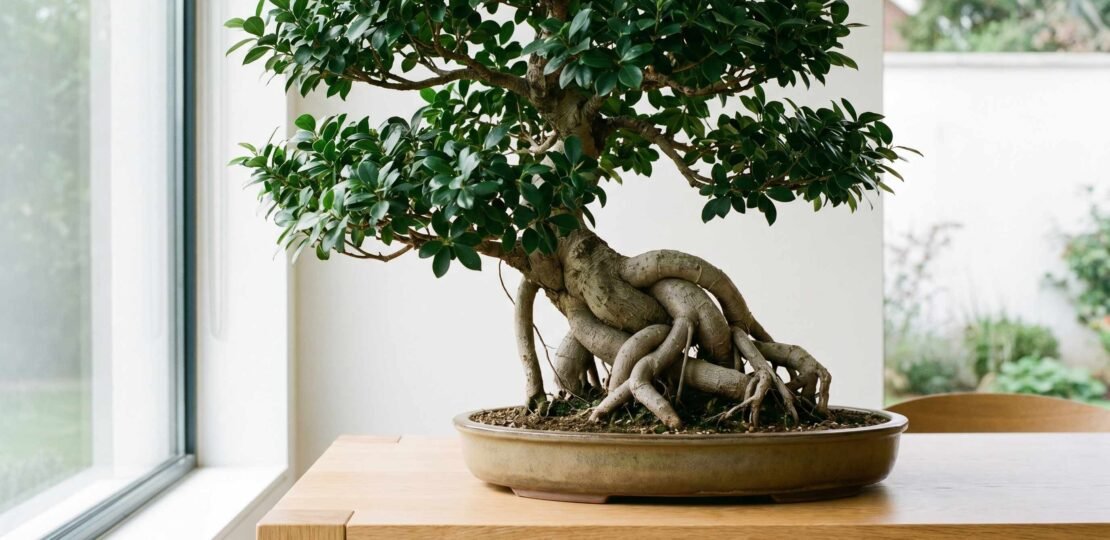
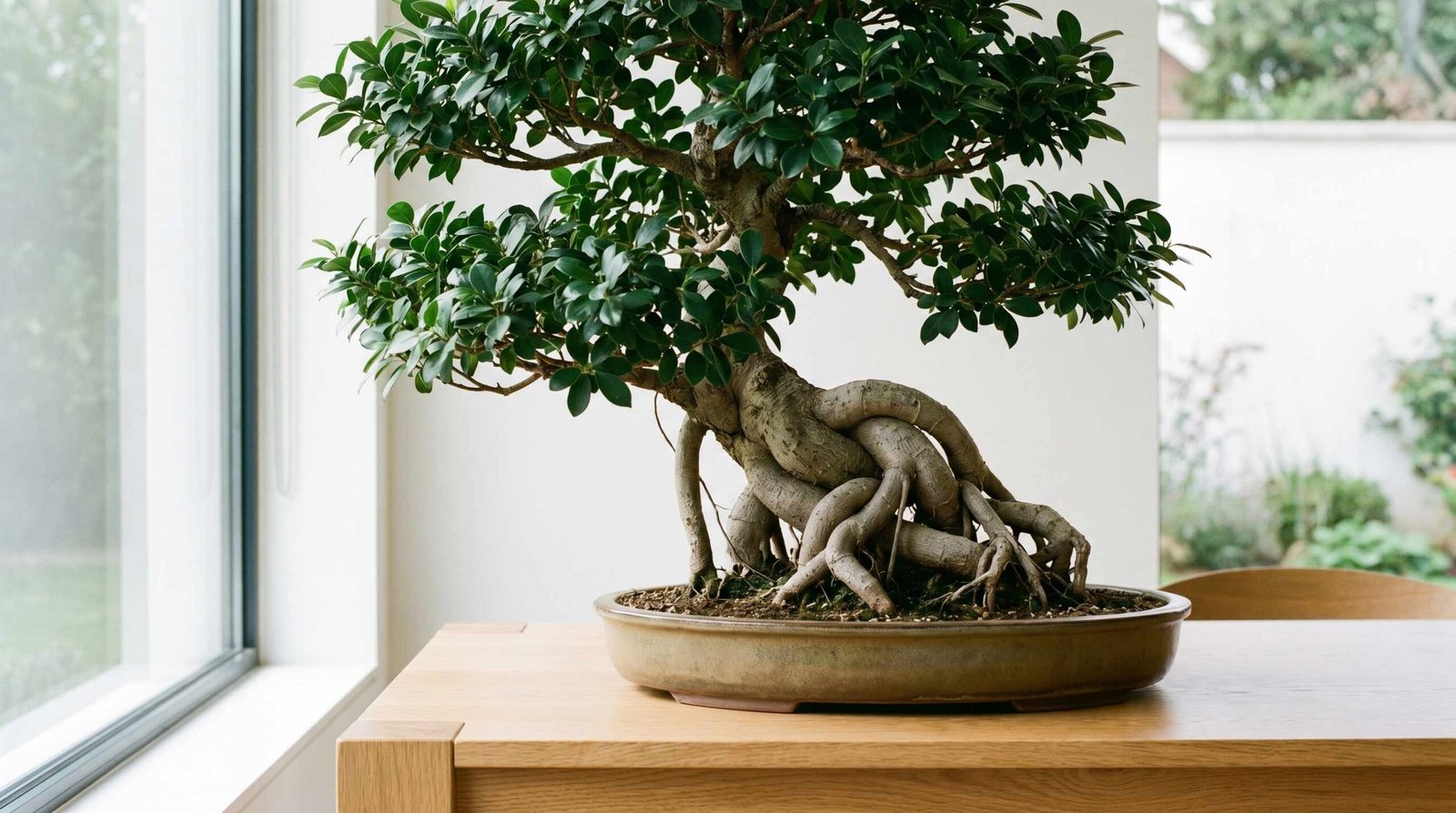
The ginseng ficus is Ficus microcarpa var. ginseng, a cultivar of the Chinese banyan fig grown for its thick, swollen aerial roots that resemble ginseng tubers. Those bulbous roots are not natural to a wild banyan. Growers in southern China and Taiwan cultivate the tree in deep beds, then expose the swollen base when potting it as a bonsai. The result is a chunky, sculptural trunk topped with a tidy canopy of small, glossy oval leaves.
You’ll find this tree everywhere. IKEA stocks it as a low-priced houseplant. Trader Joe’s runs it as a seasonal feature. Target, Home Depot, Lowe’s, and most independent garden centers carry it year-round. It’s often the first bonsai people own because it’s cheap, widely available, and marketed as nearly indestructible.
There’s a common point of confusion between ficus retusa and ginseng ficus. They’re closely related, and many retailers use the names interchangeably. The technical distinction: Ficus retusa typically refers to the species grown with a more traditional trunk, while the ginseng cultivar is selected and trained specifically for those swollen pot-belly roots. The care is essentially identical, so don’t lose sleep over the label.
For a thorough botanical breakdown, see the Ficus microcarpa species profile by NC State University Extension, which covers the species’ native range, growth habit, and tolerances.
So why does a tree marketed as bulletproof give so many beginners trouble? Three reasons. First, retailers ship them in dense peat-heavy soil that’s wrong for the species long term. Second, big-box stores often keep them in low light that’s barely enough to survive on. Third, new owners panic at the first leaf drop and overwater, kicking off root rot. The good news: every one of those problems has a fix, and we’ll walk through each.
Light Requirements
Ginseng ficus wants 4 to 6 hours of bright indirect light per day, with more being better. A south-facing window is ideal in most homes. East-facing works well if it gets unobstructed morning sun. West-facing is acceptable. North-facing windows usually don’t deliver enough light, so plan to supplement with a grow light if that’s your only option.
The tree can handle some direct sun, especially morning sun, but harsh midday sun through glass can scorch leaves in summer. If your window gets blazing afternoon light, pull the tree back a foot or two, or filter with a sheer curtain.
From late spring through early fall, ginseng ficus thrives outdoors as long as overnight temperatures stay above 55°F (13°C). Outdoor light is exponentially brighter than indoor light, and a season outside builds vigor in a way no windowsill can match. Place it in dappled shade for a week before moving it to brighter conditions, otherwise the leaves will sunburn.
Signs your tree isn’t getting enough light:
- Leggy growth with long internodes (the gap between leaves stretches)
- Pale, smaller new leaves
- Steady leaf drop with no other obvious cause
- Branches reaching aggressively toward the window
If you see these signs, move the tree closer to the brightest available window or add a full-spectrum LED grow light positioned 8 to 12 inches above the canopy on a 10 to 12 hour timer.
Your First 48 Hours: What to Do After Bringing It Home
Most ginseng ficus problems start in the first month. The tree just left a greenhouse with stable humidity, consistent light, and ideal temperatures. Now it’s sitting in your living room with dry winter air, mystery light levels, and a draft from the front door every time someone walks in. Your first 48 hours set the tone for the next year.
Step 1: Pick the spot and commit to it
Ficus species hate being moved. Each location change resets their acclimation clock and triggers leaf drop. Before you bring the tree home, decide where it lives. Bright window, away from heating and cooling vents, away from exterior doors, away from radiators. Put it there. Leave it there.
Step 2: Do not repot
The soil you bought it in is probably wrong (more on that below), but resist the urge to repot for at least 4 to 6 weeks. Repotting is surgery. Doing surgery on a stressed tree that just changed environments is how you kill it. Let the tree settle first.
Step 3: Do not fertilize
Wait 6 to 8 weeks before the first feeding. Fresh fertilizer on a stressed, possibly damaged root system can burn roots that are already struggling. Patience here pays off.
Step 4: Expect some leaf drop and stay calm
A ginseng ficus shedding 10 to 30 percent of its leaves in the first 2 to 4 weeks is normal acclimation behavior. The tree is recalibrating to your light, humidity, and temperature. New leaves will emerge once it settles in. Don’t change anything in response to gradual leaf drop. Especially don’t water more.
What’s normal: scattered yellow or green leaves dropping over days or weeks, no other symptoms, new buds visible at the branch tips.
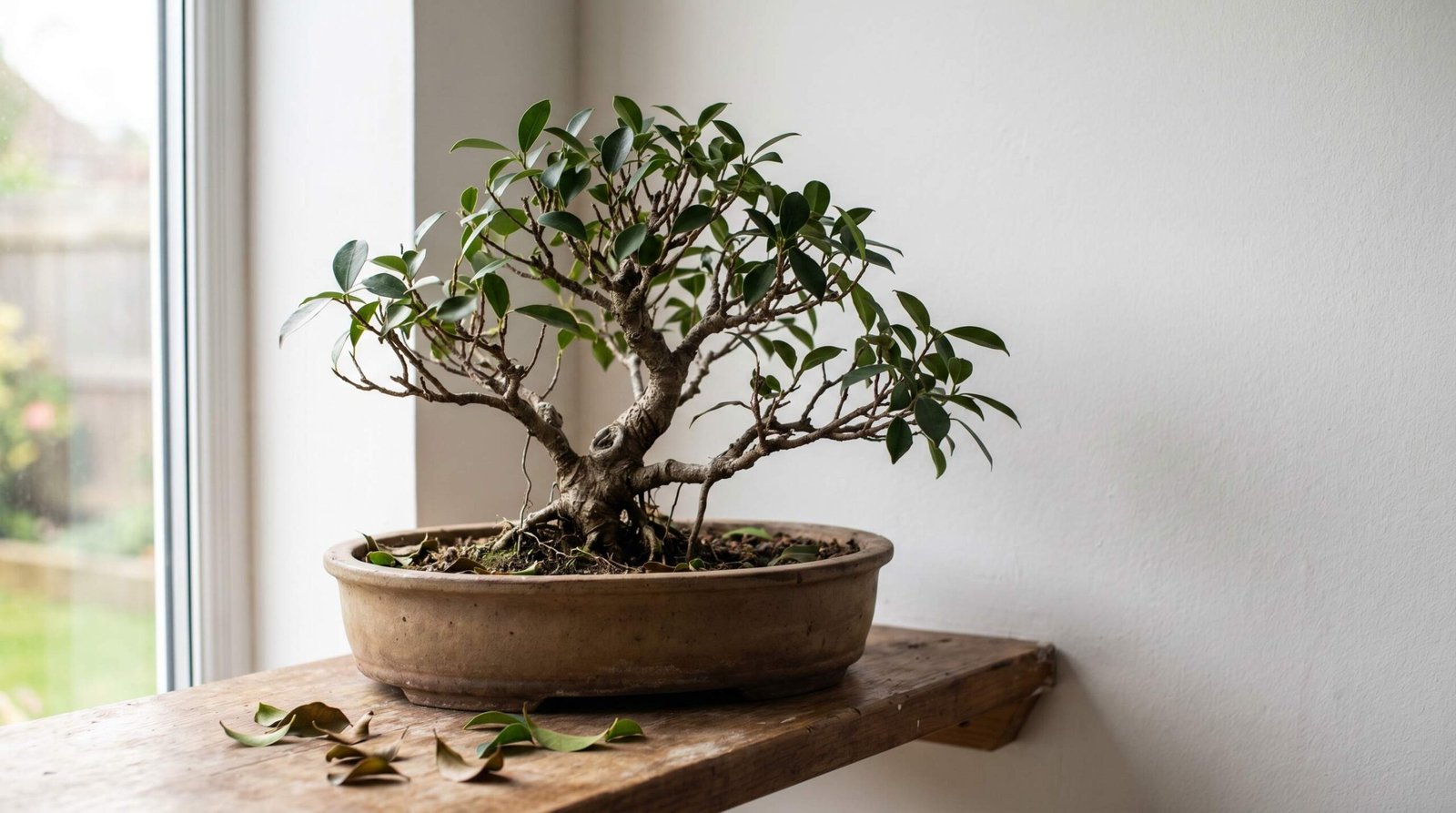
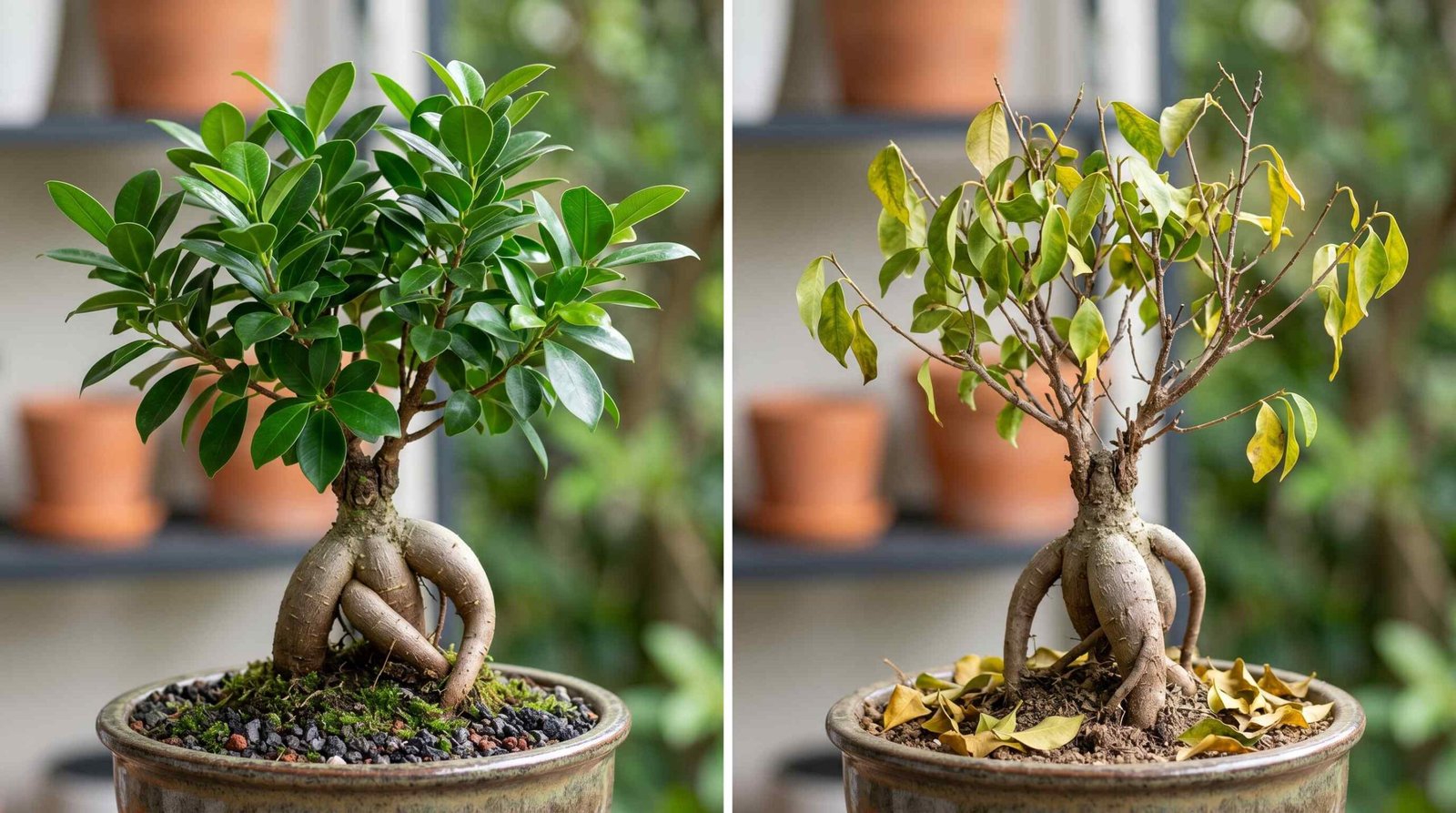
What’s not normal: rapid total defoliation in 48 hours, leaves dropping along with branch dieback, mushy trunk base, foul smell from the soil. Those signal a real problem, usually root rot from overwatering before you even brought it home.
Step 5: Check the soil moisture
This is the one immediate action to take. Stick your finger an inch into the soil. If it’s wet, do not water. If it’s dry, water thoroughly until water runs from the drainage hole. Then let it drain. Most retail ginseng ficus arrive overwatered from store care, so you’re far more likely to find soggy soil than dry.
Watering Ginseng Ficus Bonsai
Watering is the skill that separates trees that thrive from trees that fail. For a deeper dive into technique, see our complete bonsai watering guide.
The method is called soak-and-drain. Water thoroughly until water runs freely from the drainage hole. Wait. Let the soil dry until the top inch is dry to the touch. Water again. The wet-dry cycle is what healthy ficus roots want. Constant wet kills them.
Never water on a fixed schedule like “every Tuesday.” Watering frequency depends on pot size, soil mix, temperature, humidity, and season. The same tree might need water every two days in July and every ten days in January. Use the finger test, every time.
Here’s how overwatering and underwatering look different:
| Overwatering Symptoms | Underwatering Symptoms |
|---|---|
| Yellowing lower leaves first | Crispy brown leaf edges |
| Soggy or musty-smelling soil | Bone-dry soil pulling from pot sides |
| Soft, blackened roots | Wrinkled bark on small branches |
| Mushy trunk base | Leaves curling inward |
| Fungus gnats in the soil | Whole-tree wilting |
Misting is fine as a humidity supplement but it’s not watering. Misting wets the leaves and adds a small amount of humidity to the air around the tree. It does nothing for the root zone. We’ve seen beginners mist every day and then wonder why their tree died of thirst.
Humidity and Temperature
Ginseng ficus comes from subtropical Asia where humidity sits at 70 to 90 percent. Inside a heated home in winter, humidity often drops to 20 to 30 percent. That delta is why your tree looks crispy in February.
Target 50 to 70 percent relative humidity around the tree. You can hit that with:
- A humidity tray: a shallow tray filled with pebbles and water, with the pot sitting on the pebbles (not in the water)
- A small ultrasonic humidifier in the same room
- Grouping plants together so they share transpired moisture
- Bathroom or kitchen placement if light allows, because those rooms run more humid
Temperature minimum is 50°F (10°C). The tree starts to suffer cold damage below that. Aim for 65 to 80°F (18 to 27°C) as the comfortable range. Brief excursions to 90°F+ are fine if humidity and watering keep up.
Cold drafts are the single most common cause of mystery leaf drop. Locations to avoid:
- Within three feet of an exterior door that opens in winter
- Directly in front of air conditioning vents
- Right next to a radiator or forced-air heating vent (the hot blast is just as harmful as a cold draft)
- On a windowsill where leaves touch cold glass in winter
- Between curtains and a single-pane window overnight
The Right Soil for Ginseng Ficus Bonsai
The soil your ginseng ficus came in is almost certainly a problem. Big-box retailers use dense, peat-based potting mixes because peat is cheap, retains water for weeks (so unwatered store stock survives), and ships well. None of those qualities serve a bonsai once it’s home. For background on what makes good bonsai substrate, see our guide to bonsai soil.
Why retail peat soil fails over time:
- It holds water far too long, smothering roots
- It compacts into a dense brick that water runs around, not through
- It breaks down rapidly and loses structure within 12 months
- It encourages root rot, fungus gnats, and anaerobic conditions
A proper ginseng ficus mix is fast-draining and structurally stable. The standard formula we suggest:
- 40 percent akadama (Japanese baked clay that holds moisture without going anaerobic)
- 30 percent pumice (volcanic stone for drainage and root aeration)
- 30 percent lava rock (drainage, weight, and structure)
If you don’t want to mix your own, a pre-blended bonsai-specific tropical mix works. Look for something marketed for ficus or general tropical bonsai, like this pre-mixed bonsai soil blend, which has the particle size and drainage right for ginseng ficus.
What to avoid:
- Regular potting soil or “houseplant” mix (too dense, too peat-heavy)
- Cactus mix (too sandy, drains too fast, doesn’t hold enough moisture for ficus)
- Pure sphagnum or coco coir (collapses and compacts)
Switch to the right soil at the next scheduled repotting, not the day you bring the tree home. The combination of new environment plus root surgery plus new soil is too much stress at once.
Fertilizing Your Ginseng Ficus Bonsai
Bonsai live in tiny soil volumes, so they exhaust nutrients faster than landscape trees. Regular feeding is non-negotiable for vigor. For the full breakdown of fertilizer types and schedules, see our complete bonsai fertilizer guide.
Growing season (March through September): feed every two weeks with a balanced liquid fertilizer at 10-10-10 NPK or close to it. Half-strength is fine and arguably safer. For convenience, a balanced liquid fertilizer like this one dilutes easily and won’t burn roots at the suggested rate.
Winter (October through February): the tree’s growth slows even indoors. Cut to monthly at half-strength, or skip entirely if your tree has gone semi-dormant and isn’t pushing new growth. Overfeeding in winter pushes weak, leggy growth that nothing supports.
The cardinal rule: always water the tree before fertilizing. Liquid fertilizer applied to dry soil concentrates at the root surface and burns roots. Water first, let drain for ten minutes, then apply fertilizer.
Organic versus synthetic: both work. Organic pellets (like fish emulsion cakes or seaweed extract) release slowly and feed soil biology. Synthetic liquids are faster and more precise. For a beginner indoors, a synthetic balanced liquid is the simpler choice because it’s odorless and predictable.
Pruning and Shaping Your Ginseng Ficus
Ginseng ficus tolerates pruning extremely well, which is one reason it’s a great beginner species. The tree back-buds aggressively, meaning new shoots emerge from old wood after a cut. Mess up a cut, and the tree will give you another chance in six weeks. For the broader principles, see our step-by-step pruning guide.
Best time to prune: spring and summer during active growth. Wounds heal fastest then. Avoid heavy pruning in late fall or winter when the tree can’t easily seal cuts.
Structural pruning addresses the tree’s bones. Remove:
- Branches that cross other branches
- Branches growing straight down or straight up from a main limb
- Branches that emerge from the same point on the trunk (one or two will outpace the rest, kill the weakest)
- Dead twigs and inward-growing growth
Maintenance pruning keeps the canopy tidy and compact. When a branch grows out to 6 to 8 leaves, cut it back to 2 to 3 leaves. The tree will bud at the cut and produce two new shoots, building ramification (the dense twigginess that makes a mature bonsai look mature).
One critical point about the ginseng roots: those swollen aerial roots are the feature of the tree. They’re meant to be exposed above the soil line. Do not bury them. When you repot, position the tree so the top of those roots sits above the soil surface, then mound a small amount of soil only around the lower portion. If they start to push up out of the soil over time, that’s the tree doing exactly what it’s supposed to do.
When you cut ginseng ficus branches, the tree weeps a sticky white milky sap (latex). This is normal. Wash your hands if you get it on skin, because it can irritate sensitive skin and stain clothes. Wipe the cut tool with a damp cloth between cuts so the sap doesn’t gum up your blades.
Repotting Ginseng Ficus Bonsai
Repot every 2 to 3 years for young trees, every 3 to 5 years for established trees. The window is early spring just before the growth flush begins, typically late March through early May depending on climate.
Signs your tree needs repotting now:
- Water runs straight through and out the drainage hole without absorbing
- Roots are circling the pot (lift the tree out and check)
- Roots are pushing up out of the soil surface or out through the drainage hole
- The tree dries out within a day or two of watering
- Growth has slowed despite good conditions
The basic repot sequence:
- Stop watering 2 days before so the soil pulls away cleanly
- Lift the tree from the pot and gently rake out the old soil with a chopstick or root hook
- Prune the roots: trim long, thick roots and shorten the root mass by 20 to 30 percent
- Inspect for rot (dark, mushy, smelly roots) and cut out anything compromised
- Place fresh bonsai soil in the bottom of the pot, set the tree, and work soil into the root mass with a chopstick
- Water thoroughly and place in shade for 2 to 3 weeks while roots recover
Pot size rule of thumb: the pot’s length should be roughly 2/3 the width of the canopy spread. Depth should roughly equal the trunk’s diameter at the soil line. A pot that’s too big holds excess water and slows the tree’s development. A pot that’s too small dries out too fast.
Repotting is also the only time you get a clear look at the root system. Take photos. Note what looks healthy and what doesn’t. That baseline will help you diagnose problems years later.
Ginseng Ficus Bonsai Leaf Drop: Diagnosing the Cause
Leaf drop is the most common ginseng ficus panic moment for new owners. Sometimes it’s nothing. Sometimes it’s a slow-moving disaster. Use this table to figure out which.
| Cause | What Triggers It | Leaf Drop Pattern | Other Signs | Fix |
|---|---|---|---|---|
| Location change / acclimation | Just moved, just brought home from store | Gradual, scattered, 10 to 30 percent of leaves over 2 to 4 weeks | New buds still visible at branch tips, tree otherwise looks fine | Do nothing. Hold conditions steady. New leaves arrive in 4 to 8 weeks. |
| Cold draft / temperature drop | Near a door, window, or AC vent | Sudden, mostly one side of the tree (the cold side) | Leaves drop green, not yellow | Move the tree to a stable spot above 55°F (13°C) |
| Overwatering | Watering on a schedule or too frequently | Yellowing lower leaves first, then branchwide drop | Soggy soil, musty smell, possible fungus gnats | Stop watering until top inch is dry. Check roots if it continues. |
| Underwatering | Missed waterings, bone-dry soil | Crispy, brittle leaves drop at the lightest touch | Soil pulled away from pot edges, branches feel brittle | Submerge the pot in water for 10 minutes to fully rehydrate the root ball |
| Low humidity | Winter heating, AC, dry climate | Leaf edges curl, then drop | Crispy leaf tips, no soggy soil | Add humidity tray, humidifier, or group with other plants |
| Root rot | Chronic overwatering, dense soil, no drainage | Rapid total defoliation, branch dieback follows | Dark or mushy roots, foul smell, soft trunk base | Emergency repot. Cut affected roots. Treat with dilute hydrogen peroxide. Improve drainage. |
If you’re also seeing yellowing leaves and want a deeper diagnostic, our full guide to yellow bonsai leaves walks through every cause across species.
Common Pests and Problems
Indoors, ginseng ficus is one of the more pest-resistant species you can own. That said, three issues come up often enough to know how to handle.
Scale insects
Small brown or tan bumps stuck to branches and leaf undersides. They don’t move (adults), but they suck sap and excrete sticky honeydew that attracts ants and sooty mold. Wipe each one off with a cotton swab dipped in 70 percent isopropyl alcohol, then spray the whole tree with neem oil weekly for three weeks to break the lifecycle.
Spider mites
Almost invisible to the naked eye, but you’ll see fine webbing in branch crotches and stippled, dusty-looking leaves. Mites thrive in dry conditions, so the first move is raising humidity. Rinse the foliage with a strong water spray in the sink or shower, then spray with neem oil or insecticidal soap every 5 to 7 days for three weeks.
Root rot
The deadly one. Caused by chronic overwatering, poor drainage, or compacted soil. By the time you smell it or see branch dieback, the tree is in trouble. Immediate response: unpot the tree, wash off all soil, cut away every dark, soft, or smelly root with sterile scissors, dust the remaining roots with cinnamon (a mild antifungal) or treat with a 1 part 3 percent hydrogen peroxide to 3 parts water dilution, and repot in completely fresh, fast-draining bonsai soil. Withhold water for 5 to 7 days while the cut roots callus. Keep the tree in shade and high humidity during recovery.
Monthly Care Calendar (Seasonal Guide)
This calendar assumes you’re in a temperate climate with cold winters and warm summers. Adjust by 4 to 6 weeks for the deep south or the Pacific Northwest.
| Month | Light / Location | Watering | Fertilizer | Pruning / Notes |
|---|---|---|---|---|
| January | Brightest indoor window, away from drafts | Sparingly, only when top inch is fully dry | None | None. Rest period. |
| February | Same indoor location | Still light, as needed | None | Plan spring repot if due. |
| March | Move to brightest spot as days lengthen | Increase as tree wakes up | Resume light feeding mid-month, biweekly | Repot if needed before bud break. Light structural pruning OK. |
| April | Indoors near best window | Regular soak-and-drain | Biweekly balanced NPK | Active growth begins. Light maintenance pruning. |
| May | Move outdoors once nights stay above 55°F. Start in dappled shade. | More frequent as outdoor evaporation rises | Biweekly, full strength | Move gradually to brighter spot over 7 to 10 days. |
| June | Bright outdoor location, morning sun ideal | Often daily in hot weather, check by finger test | Biweekly, full strength | Heavy pruning OK. Wire if shaping. |
| July | Outdoor, may need afternoon shade in hot regions | Possibly twice daily during heat waves | Biweekly, full strength | Peak growth. Major pruning and shaping window. |
| August | Outdoor | Heavy, frequent | Biweekly | Continued shaping. Treat any pests now. |
| September | Outdoor still, but watch nighttime lows | Begin tapering as growth slows | Final feed early month, then taper | Stop heavy pruning. Prep for indoor move. |
| October | Bring indoors before first night below 55°F. Gradual transition over 5 to 7 days. | Reduce frequency as light drops | Optional half-strength once | Inspect for pests before moving inside. |
| November | Indoor, brightest available window | Sparingly, top inch fully dry | None | None. |
| December | Indoor, stable location | Minimal | None | Rest period. Keep away from holiday heating sources. |
Is Ginseng Ficus Bonsai Safe for Pets and Children?
The honest answer: it’s mildly toxic, so use common sense.
That milky white latex sap that weeps from cuts contains compounds called ficin and psoralen. In cats, dogs, and rabbits, ingestion can cause drooling, vomiting, diarrhea, and skin irritation around the mouth. Contact with the sap can also cause mild dermatitis in people with sensitive skin. For more detail on ficus toxicity by species, see our standard ficus bonsai care page also covers this, and for the official toxicity classification check the ASPCA’s Toxic and Non-Toxic Plants database.
Practical steps to keep everyone safe:
- Place the tree out of reach of curious cats and dogs. A high shelf with good light works well.
- Pick up any dropped leaves promptly. Pets often investigate fallen leaves.
- Wear gloves or wash hands after pruning if you’re sensitive to the sap.
- Store pruning scissors and concave cutters out of reach of children. The tree is far less dangerous than the tools used to prune it.
- Wipe any sap drips off furniture or floors with a damp cloth before they dry, both for safety and because the sap stains.
A ginseng ficus is not in the same league as an oleander or a sago palm in terms of risk. But mild toxicity is still toxicity, so positioning the tree out of reach is the simple fix.
Frequently Asked Questions
How often should I water my ginseng ficus bonsai?
There is no fixed answer. Water when the top inch of soil feels dry to the touch, not on a schedule. In a warm, bright summer location, that might be every day or every other day. In a cool indoor winter spot, it might be once every 7 to 10 days. Use the finger test every time. Then water thoroughly until water drains freely from the bottom, and let the soil dry partially before the next watering.
Why are the leaves falling off my ginseng ficus bonsai?
The most common cause for a new owner is acclimation stress: the tree just changed environments and is shedding leaves while it adjusts. Other likely causes include cold drafts (within three feet of a door or AC vent), overwatering (soggy soil, yellow lower leaves), low humidity in winter, or, less commonly, root rot. Check our leaf drop diagnostic table above to match your symptoms to a cause and a fix.
Can I keep a ginseng ficus bonsai outside?
Yes, and the tree usually loves it. From late spring through early fall, once overnight temperatures stay reliably above 55°F (13°C), move your tree outdoors to a spot with bright, dappled light. Acclimate slowly over a week to prevent sun scorch. Bring it back indoors before nights drop below 55°F. Outdoor light is exponentially stronger than indoor light and a summer outside builds dense, vigorous growth.
How fast does a ginseng ficus bonsai grow?
In good conditions with full feeding, expect noticeable new growth every 2 to 4 weeks during the growing season. A young tree can put out 6 to 12 inches of new shoots in a single summer. Trunk thickening is much slower and only meaningful if the tree is grown in the ground or a large training pot. Restricted to a small bonsai pot, trunk growth slows dramatically, which is by design.
Why are my ginseng ficus leaves turning yellow?
Yellowing usually points to overwatering, root issues, or nutrient deficiency. Overwatering is the most common: yellow lower leaves with soggy soil means cut back on water immediately. If the soil is dry and yellowing affects newer leaves, suspect a nitrogen deficiency and feed appropriately. If yellowing is paired with branch dieback or a sour smell, you may have root rot and should consider an emergency repot.
How do I make my ginseng ficus bonsai grow bigger?
Bonsai grow proportionally to root space, light, and feeding. To bulk up a ginseng ficus, repot it into a larger training pot or, if possible, plant it in the ground for a season. Give it strong light, water freely, and feed every two weeks at full strength during the growing season. Trunk thickening requires letting some branches grow out unrestricted. Once you’ve achieved the size you want, you can return the tree to a smaller bonsai pot to refine.
What is the ideal soil for ginseng ficus bonsai?
A fast-draining inorganic bonsai mix: roughly 40 percent akadama, 30 percent pumice, and 30 percent lava rock. This holds enough moisture for ficus roots without going anaerobic, drains freely, and keeps its structure for years. Avoid the dense peat-based soil that most retail ginseng ficus arrive in. Pre-mixed bonsai-specific tropical blends are a fine shortcut if you don’t want to mix your own.